01 / Overview
Follow the integration responsibility.
Aerospacelab's selection on 10 September to supply 264 satellites for IRIS² brings a new manufacturing arrangement into view. The company says its EUR 2.4 billion mandate includes building the platforms and delivering fully integrated spacecraft. Alongside the earlier medium Earth orbit awards, that creates a useful comparison of who carries responsibility for turning components into a working satellite.
IRIS², the European Union's Infrastructure for Resilience, Interconnectivity and Security by Satellite, combines low Earth orbit (LEO) and medium Earth orbit (MEO). Its industrial structure is becoming visible through separate operator and manufacturer announcements. Reading those together reveals that the division between buying a platform, supplying the communications payload and integrating the spacecraft changes across the constellation.
For a supplier, this is consequential. The organisation buying a satellite platform and the organisation defining a payload interface can occupy different places in the same programme. A procurement map organised only around the largest announced contract can therefore miss the customer that matters for a particular component or service.
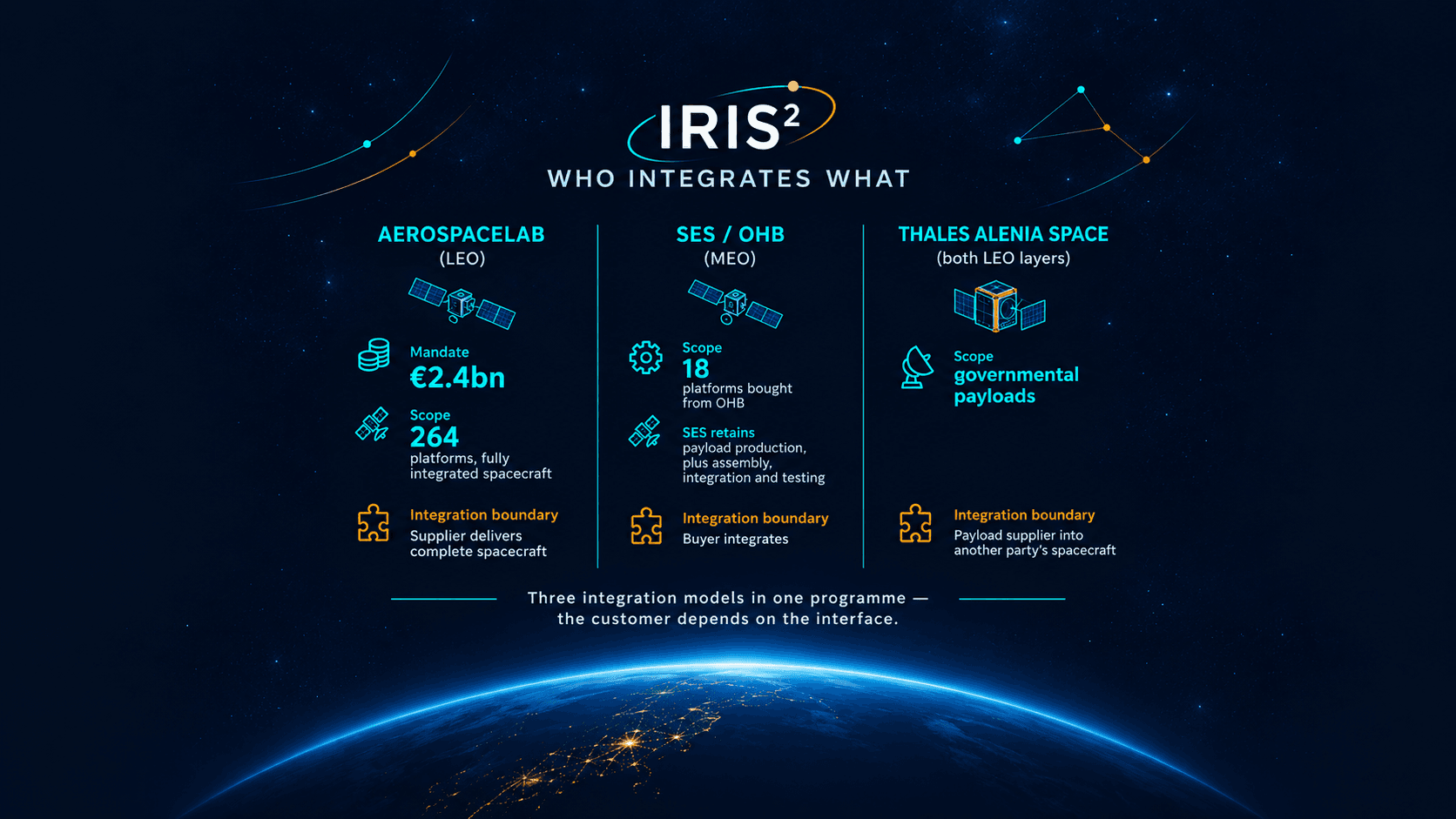
Different responsibilities within one programme.
Operator-led integration
OHB supplies 18 satellite platforms.
SES designs and builds the payloads and retains assembly, integration and testing in Luxembourg.
Integrated delivery
Aerospacelab describes 264 platforms and fully integrated spacecraft.
Thales Alenia Space is separately identified as governmental payload supplier.
Responsibilities as described in the company announcements; each role has its stated scope. Sources ↗
02 / The analysis
Platform suppliers and integration responsibilities
The MEO arrangement is explicit. OHB's 31 August award covers 18 satellite platforms for SES, for nearly EUR 1 billion. SES had already said on 7 August that it would design and build the payloads and undertake spacecraft assembly, integration and testing in Luxembourg. The operator retains those activities while buying the platforms externally.
In LEO, Eutelsat leads the segment and Aerospacelab describes responsibility for integrated delivery of its spacecraft. Thales Alenia Space's separate announcement assigns it the governmental communications payloads across both LEO layers. Its current Letter of Agreement represents approximately EUR 500 million, within an overall IRIS² contract scope that the company expects to exceed EUR 3 billion.
The distinction changes the interface that warrants attention. In MEO, the published arrangement places spacecraft assembly, integration and testing with the operator. For Aerospacelab's LEO spacecraft, platform production and integrated delivery sit with a manufacturer working alongside a separately identified governmental payload supplier. That makes the relationship between manufacturing flow and payload delivery a central part of following implementation.
This is an allocation of responsibilities within one programme. It offers a more precise way to assess industrial participation than classifying companies simply as established manufacturers or new entrants. A company can expand its responsibility for integrated spacecraft while another supplies a specialised subsystem across a wider part of the constellation.
03 / The analysis
A shared payload supplier across different platforms
Thales identifies Airbus Defence and Space as platform supplier for the 66 satellites in LEO Layer One, with launches planned in 2029. Aerospacelab supplies the 264 platforms in Layer Two, whose launches are scheduled to begin in 2030. Thales' governmental payload role spans both groups.
That arrangement gives the payload work a different industrial reach from either platform award. Components associated with the governmental communications payload could follow a procurement and qualification route that crosses platform families. Platform-specific equipment would follow the requirements of its respective spacecraft design. The useful question for a prospective supplier is therefore where its product sits in the architecture and who controls that interface.
The shared payload supplier also provides a concrete subject for subsequent reporting: how common the payload design remains between the layers, and how its delivery schedule aligns with each manufacturer's integration work. Those are questions that future design and production disclosures can answer. They translate a constellation announcement into identifiable milestones without relying on assumptions about corporate strategy.
Two platform suppliers. A shared payload role.
66 satellites
Airbus Defence and Space platformsLaunches planned in 2029.
264 satellites
Aerospacelab platformsLaunches scheduled to begin in 2030.
Across both layers: Thales Alenia Space supplies the governmental communications payloads. The shared supplier role does not establish identical designs. Sources ↗
04 / The analysis
Following the work into production
The next evidence will come from design reviews, subsystem awards, payload deliveries and integration milestones. Each would establish whether the responsibilities described in the announcements are becoming repeatable production processes. A schedule that identifies the first integrated spacecraft, for example, would connect the current contract map to a physical delivery sequence.
For the European supply chain, the opportunity is already more legible: the programme contains several routes into spacecraft production, with different organisations retaining different technical responsibilities. Following those routes separately will make subsequent awards easier to interpret and reveal which parts of the industrial system are advancing towards delivery.
05 / Evidence
Go to the source.
Original references from the published article. The visual guides use the same figures and distinguish contracted work from planned milestones.
- Aerospacelab Awarded €2.4 Billion Landmark Contract to Build 264 LEO Satellites for IRIS²Aerospacelab
- Thales Alenia Space to provide digital and secure payloads for 330 IRIS2 telecommunications satellites in Low Earth OrbitThales Alenia Space
- SES advances next-generation MEO strategy following successful completion of IRIS² Rendez-vous 1SES
- OHB has been awarded a contract worth nearly €1 billion for the development and production of eighteen satellite platforms for the EU's IRIS² Secure Connectivity ProgrammeOHB
- Aerospacelab, Thales Alenia Space Secure €5.4 Billion in IRIS2 ContractsEuropean Spaceflight