Space Insights editorial illustration; AI-assisted.
Arianespace's launch commitment and ESA's service award support one demonstration, while later cargo missions remain options requiring confirmation.
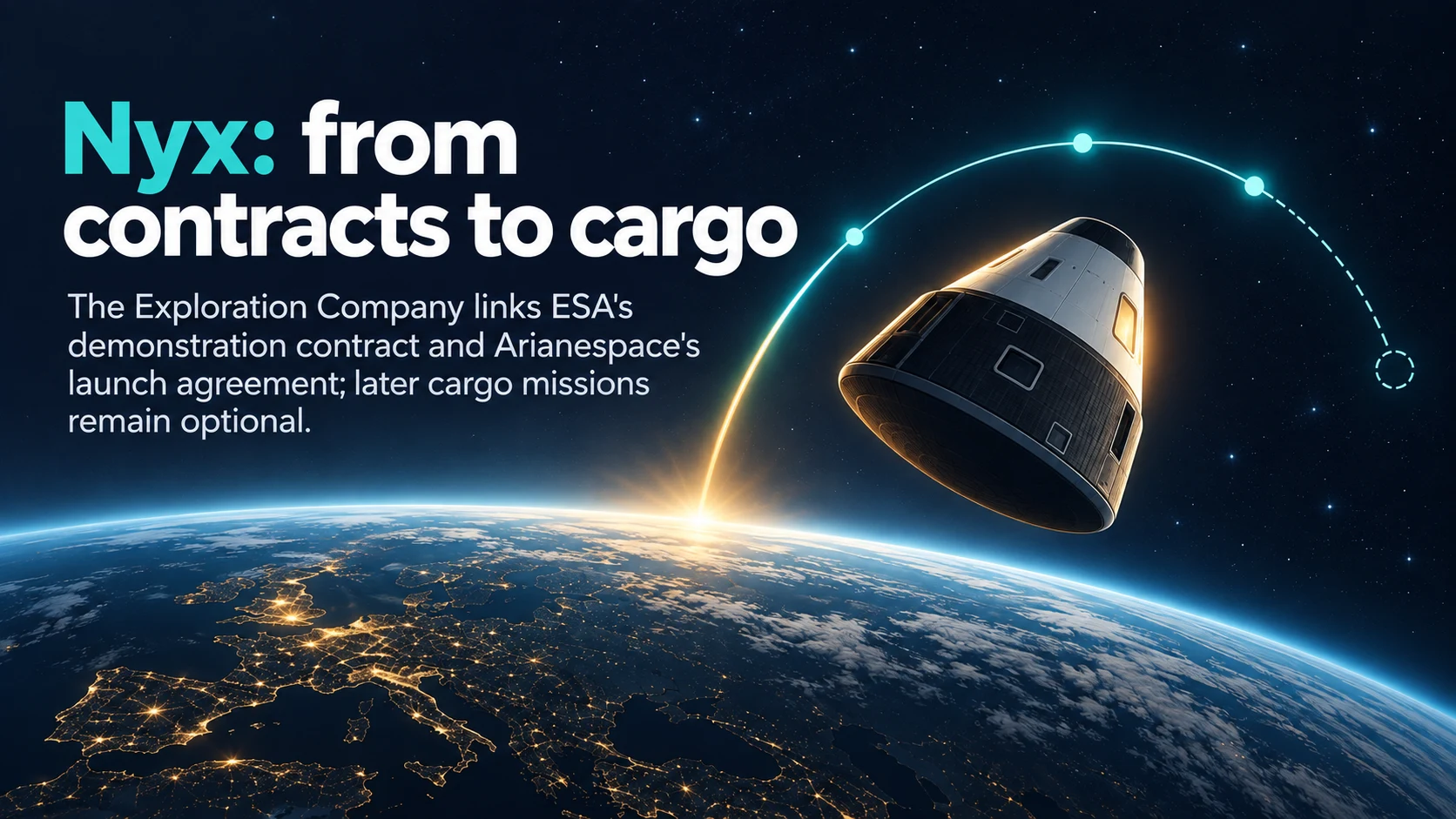
The Exploration Company connected two parts of its Nyx cargo programme on 10 September 2026: a European Space Agency (ESA) service contract under ALADDIN and an agreement with Arianespace to launch the demonstration capsule. ESA allocates EUR 310 million to the demonstration and EUR 450 million to two optional service missions requiring later confirmation. Together, the announcements identify a customer and a launch provider for the demonstration, with subsequent demand at a different stage of commitment.
That structure matters to suppliers and prospective cargo users assessing the programme. A launch agreement, an autonomous docking objective and an option for another mission each answer a different planning question. Reading them separately makes it easier to identify which commercial commitments are established and which technical outcomes still need flight evidence.
Two contracts support the same demonstration
Arianespace says it will launch Nyx aboard Ariane 64 from Kourou in French Guiana for the first ALADDIN demonstration. The Exploration Company is the capsule developer and Arianespace's launch customer. ESA is buying a demonstration service from The Exploration Company. These are connected relationships around the same mission, with different deliverables on either side of the capsule operator.
The launch agreement establishes the selected provider and configuration for reaching orbit. Arianespace describes Nyx continuing autonomously once there. ESA's programme objective extends to full-system completion and a demonstration of autonomous docking with the International Space Station (ISS). The assignment of a launch provider makes one part of that sequence more concrete; the station mission still has its own demonstration work.
For a supplier assessing its place in the programme, the relationship relevant to its work depends on what it provides. Launch integration, capsule development and cargo service delivery concern different responsibilities. The announcements help locate those responsibilities at company and agency level. Detailed acceptance requirements and contractual obligations would have to come from the relevant mission or procurement documents.
The options define a later purchasing decision
ESA's stated EUR 760 million total combines the demonstration allocation with the two optional missions. Its release expressly reserves confirmation of those additional services for later. The demonstration is intended for the ISS; the subsequent missions could serve that station or a future commercial station. The destination and commitment stage therefore matter alongside the headline value.
This gives the programme a route from demonstration towards further service purchases. Exercising an option would be a new commitment to another mission. Completing that mission would provide a different kind of evidence, about delivery. The two observations matter differently to a customer considering cargo access and to a supplier assessing how far its work extends beyond the demonstration.
An equally plausible reading of the option structure is that it preserves a buyer's flexibility while the vehicle and its destinations develop. An option can organise a possible continuation without fixing all future demand. The useful signal will be the later confirmation of a mission, its customer and destination, followed by evidence of performance. Counting the optional missions as already assured service volume would obscure that purchasing sequence.
Return and recovery need their own evidence
The Exploration Company's earlier Mission Possible demonstrator provides a concrete reason to distinguish stages within a flight. In its 30 June 2025 account of the mission launched on 23 June, the company reported controlled re-entry, followed by loss of communication and loss of the capsule before splashdown. The reported outcome combined an achieved re-entry milestone with an incomplete return and recovery sequence.
For a cargo user, that distinction concerns the service itself. A returned payload becomes useful through recovery and handover, so reaching orbit, docking and re-entering address different parts of the intended journey. Mission Possible is historical evidence of the company's earlier demonstration experience. The relevant evidence for full-size Nyx will come from that vehicle's own mission results.
Arianespace describes Nyx as designed for reuse. Repeat service and vehicle reuse also require different observations: another ordered cargo mission establishes additional demand, while recovery and a later flight of the same vehicle would establish reuse. Keeping both visible prevents a multi-mission programme from being read automatically as a demonstrated reusable operation.
From identified responsibilities to delivered service
The September agreements make the route into the demonstration easier to follow. ESA is the service customer, The Exploration Company is contracted to deliver the capsule demonstration, and Arianespace supplies the agreed launch. For prospective users, this provides a basis for discussing a particular service chain. Dependable cargo access will also require evidence that its successive parts work together.
The next useful observations are a confirmed mission schedule, completed launch and docking milestones, successful return and cargo recovery, and decisions on the optional services. Each would answer a specific question left by the current commitments. The programme has a contracted demonstration and a selected launch provider; its progression into repeated logistics will be established through those later decisions and mission outcomes.
Sources
- Arianespace signs agreement with The Exploration Company to launch Nyx capsule with Ariane 6, Arianespace.
- ESA signs service contract with The Exploration Company for its Nyx vehicle under 'ALADDIN', the European autonomous cargo capsule project, European Space Agency.
- Mission Possible: Re-Entry Milestone Achieved for Europe's Reusable Spaceflight, The Exploration Company.
Sources
- 1.Arianespace signs agreement with The Exploration Company to launch Nyx capsule with Ariane 6 — Arianespace
- 2.ESA signs service contract with The Exploration Company for its Nyx vehicle under 'ALADDIN', the European autonomous cargo capsule project — European Space Agency
- 3.Mission Possible: Re-Entry Milestone Achieved for Europe's Reusable Spaceflight — The Exploration Company
Get briefings like this every Friday.
Subscribe