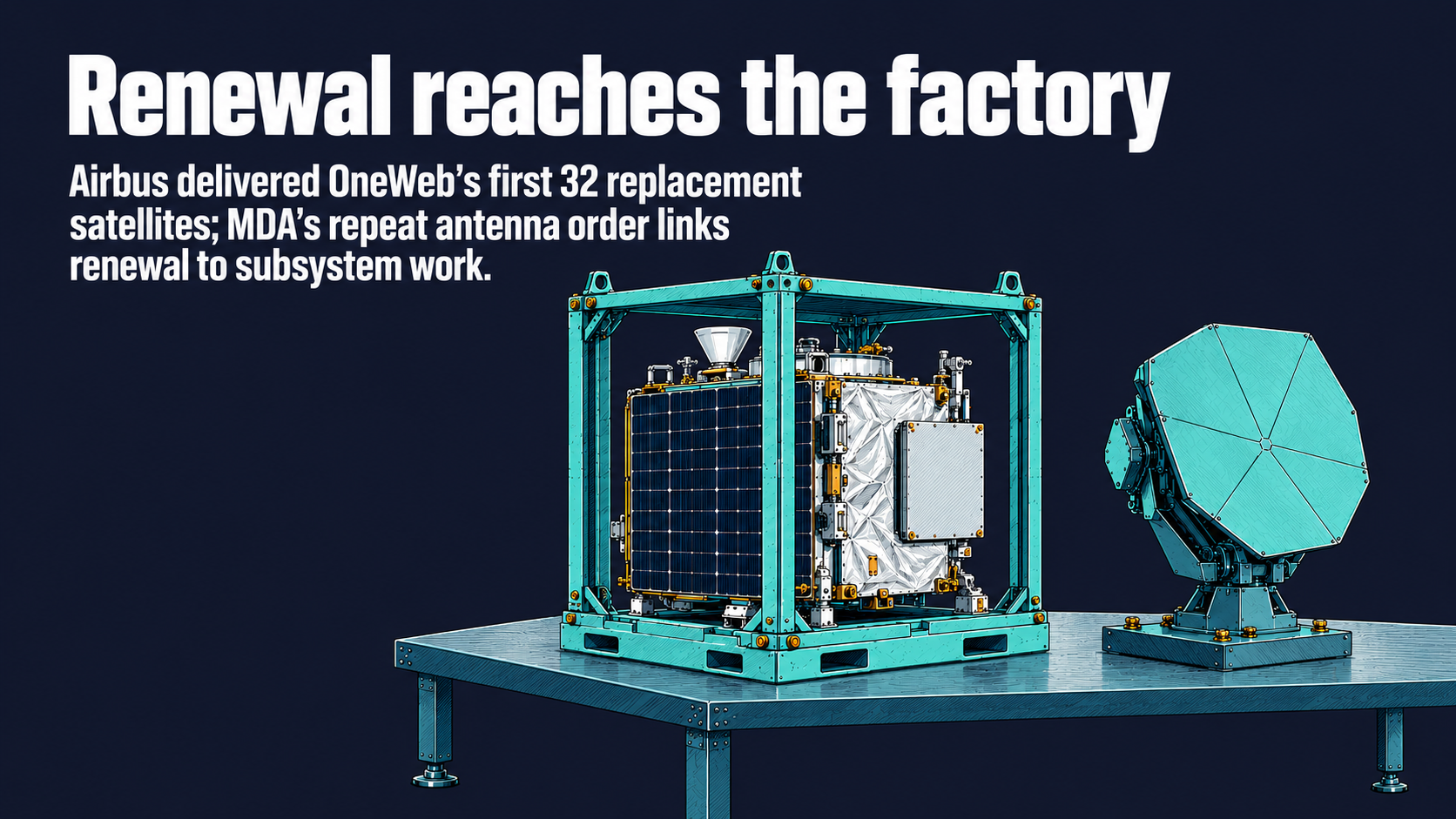
Space Insights editorial illustration of OneWeb fleet renewal and antenna manufacturing; not a photograph of the delivered spacecraft.
Airbus's delivery of 32 OneWeb satellites gives the constellation's renewal programme a dated manufacturing milestone. On 2 October 2026, the company reported that the spacecraft had been delivered to Eutelsat and were being prepared for shipment from Toulouse ahead of a launch in the United States. For industrial suppliers, that is a concrete point at which to connect the procurement record with the programme's physical progress. Airbus's delivery announcement.
The industrial story becomes clearer when that batch is placed alongside the earlier orders, including MDA Space's repeat antenna contract from Airbus. Together, the records show an existing fleet's renewal generating work at both spacecraft and subsystem level. MDA's antenna award.
The programme contains several commitment stages
Airbus's January announcement reported a contract for 340 satellites, following 100 procured in December 2024. That brought the ordered total to 440. The manufacturer identified a newly installed production line in Toulouse and expected deliveries from the end of 2026. The January contract.
On 10 September, Airbus described a further 229 satellites under an Authorisation to Proceed covering initial industrial activities. Added to the earlier 440, the planned scope reached 669. The contractual stage matters: September's record starts industrial work on an additional batch, while October's announcement establishes delivery of the first 32 spacecraft. The September authorisation.
For a component or production-equipment supplier, these are different planning inputs. Initial authorisation identifies work beginning on an additional requirement. A factory delivery establishes progress on hardware already in production. Keeping each input attached to its batch provides a more useful account of the programme than treating the largest stated satellite total as a measure of completed work.
Renewal reaches an established subsystem supplier
The January and September releases describe the new satellites as progressively replacing early OneWeb batches. The procurement is therefore tied to maintaining a network already serving customers. Airbus also identifies intended technology improvements, including digital channelisers for onboard processing and provision for hosted payloads. January's technical scope, September's follow-on scope.
MDA's 20 April announcement makes the subsystem demand explicit. Airbus selected it to design and build more than 880 Ka-band steerable antennas and 440 Ku-band user replacement antennas. MDA describes this as a repeat order following an initial OneWeb antenna award in 2016. It identifies Montréal as the location for antenna manufacturing, assembly and testing, with integration into Airbus-built Arrow satellites. MDA's contract scope.
That is a documented example of an original constellation supplier receiving further work during renewal. The relationship carries product history into a later procurement, while the new contract still specifies design and manufacture. For a supplier evaluating its installed base, the useful connection is between equipment already supplied, the customer's replenishment plan and the requirements of the next spacecraft configuration.
The geography also becomes more precise. Toulouse's spacecraft delivery and Montréal's stated antenna-production role describe different levels of the industrial chain. A change in final spacecraft-production location can coexist with continued international subsystem sourcing. This provides a more useful supplier map than assigning every part of the renewed fleet to its final assembly location.
Toulouse now has a delivered batch against the plan
October's release explicitly connects the milestone with the transfer of series production back to Europe. Read alongside January's description of the Toulouse line, it supplies evidence of delivered spacecraft from the stated manufacturing location. Airbus's October account.
A first batch supports assessment of a completed manufacturing step. Successive dated batch deliveries would establish the pattern of output, while launch and commissioning records would establish when that hardware joins the operational network. This gives industrial partners and service buyers distinct milestones to follow, depending on whether their decision concerns production or available network capacity.
The immediate finding is that OneWeb's renewal has advanced from a series of procurement commitments to an identified factory delivery. Linking the two makes the industrial demand more legible: existing-service continuity is generating documented replacement work, and the evidence now includes spacecraft leaving the production process.
Sources
- 1.Airbus delivers first batch of next-generation satellites for Eutelsat's OneWeb constellation — Airbus
- 2.Airbus awarded Eutelsat contract for further 340 low Earth orbit OneWeb satellites — Airbus
- 3.Eutelsat orders 229 additional OneWeb satellites from Airbus — Airbus
- 4.MDA Space contracted by Airbus for repeat order of antennas for OneWeb constellation extension — MDA Space
Get briefings like this every Friday.
Subscribe