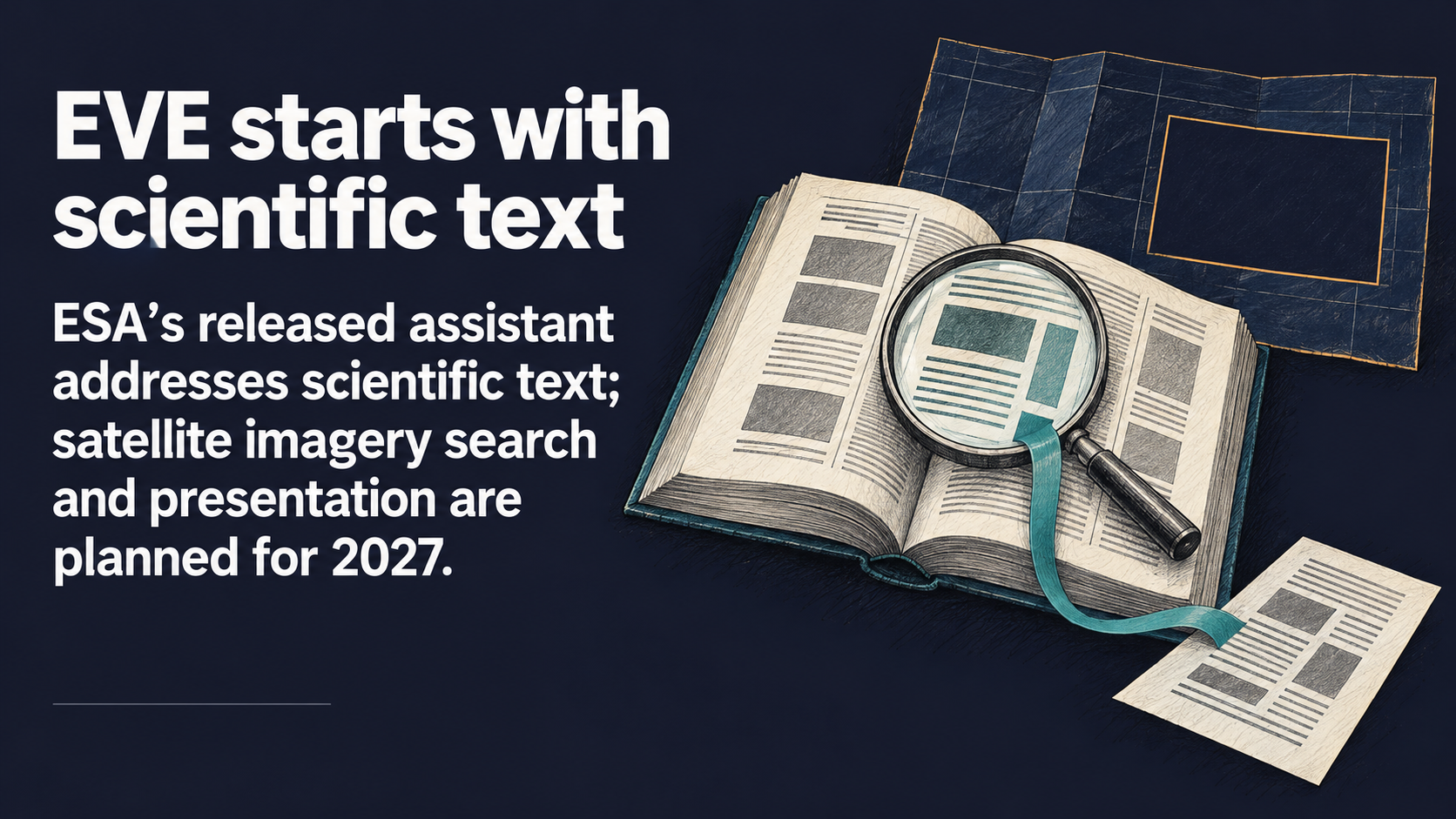
Space Insights editorial illustration of EVE's current scientific-text scope and planned imagery expansion; not a screenshot of the assistant.
The European Space Agency (ESA) announced the public release of Earth Virtual Expert (EVE) on 8 October 2026, with a current scope centred on text-based Earth observation knowledge. Public project repositories make its retrieval methods and evaluation tasks inspectable. Together, these give research and information-service teams a concrete product to assess before ESA's planned addition of satellite imagery search and presentation in 2027. ESA's release, EVE retrieval repository and evaluation repository.
The current interface works with scientific knowledge
EVE is a specialist language-model assistant developed through ESA Φ-lab with Pi School, Imperative Space and Mistral, under the Foresight element of FutureEO. It answers questions using Earth observation and Earth science texts, including institutional documentation and scientific research. ESA describes summarisation and translation among its functions.
Its retrieval-augmented generation system, or RAG, finds relevant source material to inform an answer. This matters because the interface can draw on documents beyond the information embedded in the model during training. The project's use-case description sets out retrieval, ranking and filtering of documents followed by answers with structured citations. EVE's stated use cases.
For an organisation assessing the tool, that creates a specific question: does an answer lead back to material that supports the conclusion? Locating a useful passage, representing it accurately and preserving its scientific qualifications are distinct requirements. A fluent explanation alone cannot show that all three have been met.
ESA also describes an additional model-based checking step intended to identify unsupported content for revision or filtering. This is part of the system's reliability design. An organisation evaluating EVE still needs evidence about the answers relevant to its own work.
Public tools make the evaluation more concrete
The EVE-RAG repository contains code and experiments covering document preparation, retrieval, answer generation and evaluation. The separate Evalkit repository provides tasks and metrics for testing language models on Earth observation benchmarks. These are inspectable project materials that a technical team can use to understand how questions and answers are assessed. EVE-RAG and Evalkit.
That offers a useful starting point for adoption work. A research team can define a set of questions it regularly encounters, identify the evidence a satisfactory answer requires, and examine where the assistant retrieves or interprets that evidence successfully. Questions involving disagreement between sources or a qualification buried in technical documentation are particularly relevant to a knowledge service.
The repositories make the methods available for scrutiny; an evaluation on the team's intended work would establish usefulness. Keeping those two steps separate gives the release a practical role: a candidate tool for scientific information discovery, with materials that support a structured assessment.
The imagery roadmap changes the task being evaluated
ESA says EVE entered a second development phase in September. Future work includes retrieving and analysing Earth observation data and carrying out tasks with multiple steps. Searching and presenting satellite imagery is planned for 2027. ESA's development roadmap.
Those additions would extend the product beyond finding and explaining scientific text. Assessing an imagery workflow would also require checking which observation was selected, its time and coverage, and how any subsequent processing used it. That is a different acceptance task from checking whether a cited paper supports an answer.
The wider ESA–Mistral relationship supplies institutional context. Their Letter of Intent, signed on 16 September and announced on 23 September, establishes a framework to explore AI cooperation and explicitly builds on existing work including EVE. The current product therefore has a development history preceding that framework. ESA's cooperation announcement.
For an EO information-service team, the immediate evaluation can stay focused on useful, traceable scientific answers. The later milestone is a documented release of the imagery functions, accompanied by evidence about how they select and handle observations. Separating those stages makes it possible to assess the available product on its own merits and prepare a different test for the expanded one.
Get briefings like this every Friday.
Subscribe