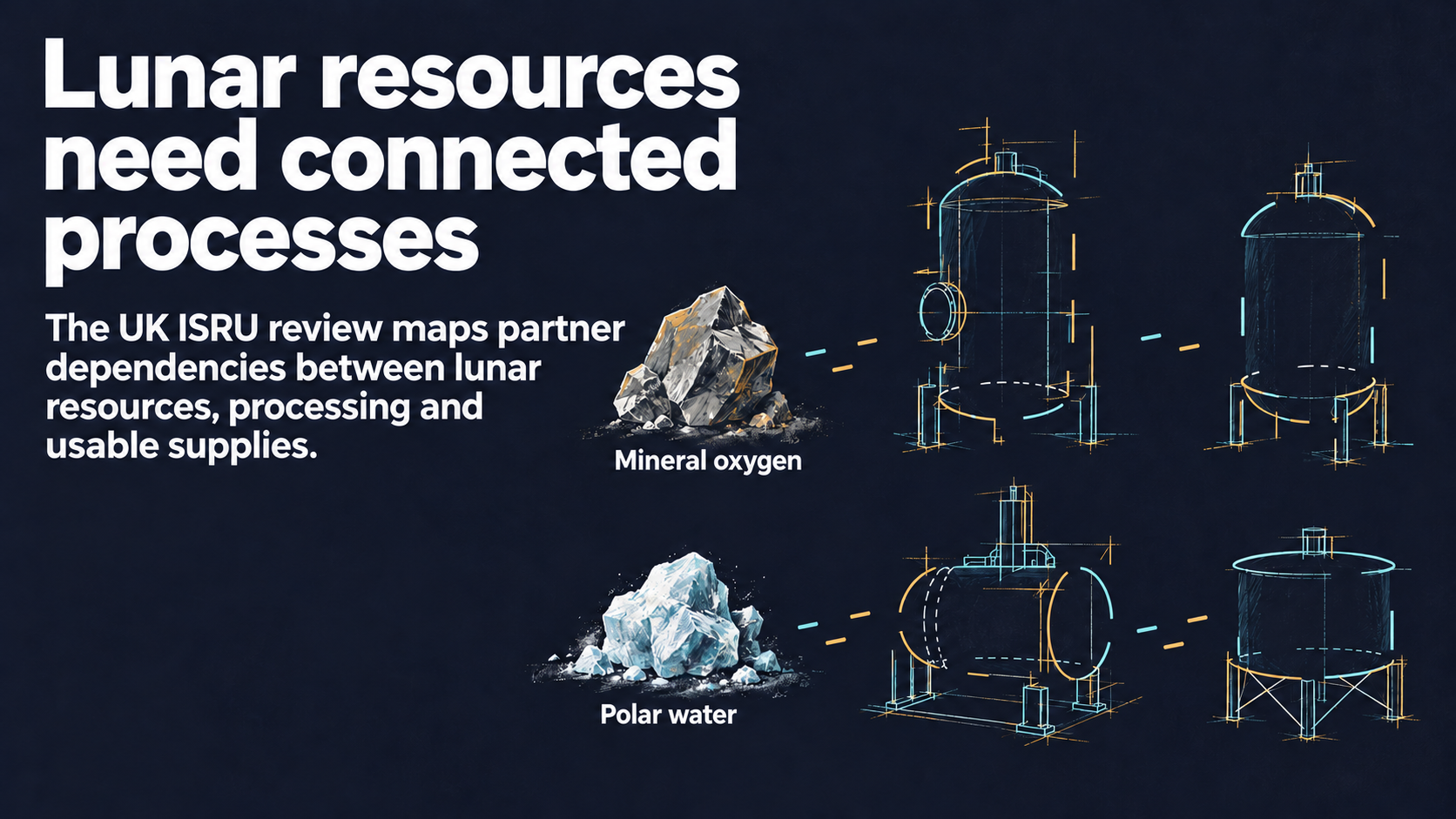
Space Insights editorial illustration of distinct lunar resource processing chains; not a technical system design or actual lunar installation.
The UK ISRU Technology Review, published on 6 October 2026, gives technology developers a way to identify the partners needed between a lunar resource and a usable supply. Its process map starts with the intended product and works through the functions required to deliver it. The independent Frazer-Nash review was commissioned by the UK Space Agency for information and future planning; its findings express the authors' assessment. UK technology review.
In-situ resource utilisation, or ISRU, means using materials available at a mission destination. For a developer choosing its next collaboration, the useful distinction is between a technology that performs one function and a sequence that supplies something a mission can use.
Mineral oxygen requires a feedstock and a delivery system
One route starts with oxygen chemically bound in lunar minerals. Excavation and preparation provide material to an extraction process; the resulting gas then needs quality assessment, transfer and storage for its intended use. The review treats these as connected functions and warns that technologies placed under the same function are not automatically interchangeable. The review's process-roadmapping method.
There is experimental evidence for the extraction step. In August 2021, ESA reported that Metalysis had processed simulated lunar material in pilot reactors, extracting oxygen and leaving metal powder. Its molten-salt process uses an electrical current to separate oxygen from the material. ESA also described work on monitoring oxygen production during processing. These were terrestrial experiments supporting possible lunar use. ESA's Metalysis account.
For an extraction developer, that creates two different partner questions. Upstream, can material preparation supply a feed that the reactor accepts consistently? Downstream, can gas handling and measurement deliver oxygen in the condition the receiving system requires? A demonstration joining those steps would test the interfaces as well as the individual equipment. The relevant output would be usable oxygen delivered across the system boundary, alongside the resources consumed in producing it.
Polar water puts sample handling and purification together
The water route begins with locating and acquiring icy material, then extracting water, removing contaminants and delivering the required product. If oxygen is the end product, water processing adds a further stage. This changes the partner set and the material that each stage must receive. The review's alternative resource pathways.
ESA's planned Prospect payload provides a concrete example of a sampling interface. Leonardo leads the payload and its ProSEED drilling system; the Open University leads the ProSPA instruments that analyse the acquired samples. ESA describes rapid transfer into a sealed oven to reduce the loss of icy material before controlled heating and gas analysis. The lander supplies power and communications. ESA's Prospect architecture.
Purification addresses another part of the chain. Naicker Scientific's SonoChem System, the UK Aqualunar Challenge winner, uses sound-induced bubbles to treat contaminated water. Challenge Works describes the need to perform purification with limited power in the lunar environment. Aqualunar technologies and operating requirements.
Read together, these examples show why a prospective partnership needs an agreed input specification. A system analysing gases released from a small sample and a process treating contaminated liquid water serve different purposes. Connecting stages requires an explicit account of what leaves one unit and enters the next, including the material's condition and contaminants. The project plan then has a concrete interface to qualify.
Qualification has to retain the production requirement
The review explicitly excludes scale from its technology readiness level assessment. A mature technology demonstrated on a small mission may therefore still require substantial development to supply a larger operation. Its map also sits alongside enabling requirements such as power and thermal management. Review scope and enabling technologies.
Component development remains a valid near-term task. The process-chain view makes that task more precise: a supplier can define the output it must hand over, the upstream conditions it can tolerate and the shared operating constraints under which it will be tested. Those requirements give a prospective partner something specific to evaluate.
For these two routes, the useful next evidence is a connected test with representative feedstock, measured product quality and delivered output under stated power and thermal conditions. Prospect's planned lunar sampling and analysis offers a separate test of acquisition and handling. Together, such evidence would help turn a list of capabilities into a defensible development package.
Get briefings like this every Friday.
Subscribe