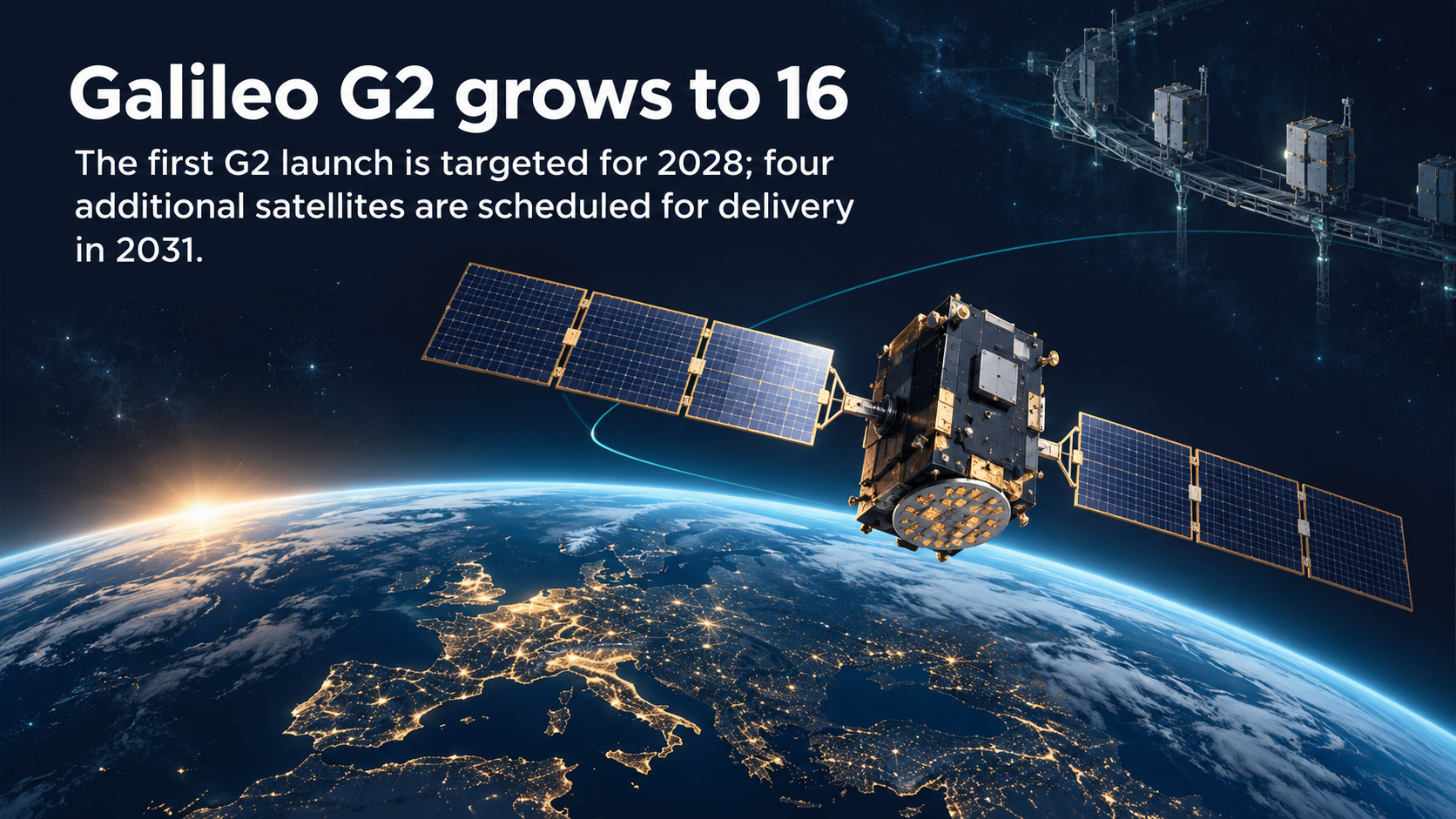
Space Insights editorial illustration of Galileo G2 and its additional delivery batch; not a depiction of actual spacecraft hardware or manufacturing facilities.
Galileo's Second Generation order has grown from 12 to 16 satellites, and the additional four will use the designs already under development. That combination makes ESA's announcement worth reading as an industrial continuity decision. It gives equipment suppliers a later batch to discuss, with relevance that depends on their place in the existing design and qualification work.
ESA announced the extensions on 27 October 2026. Thales Alenia Space and Airbus Defence and Space will each build two additional satellites, following the six ordered from each manufacturer in 2021. The new contracts were signed in Rome on 23 October and Ottobrunn on 26 October. ESA's procurement announcement.
What the repeat design changes for suppliers
ESA says the four additional satellites will be identical to those already under development. For an incumbent equipment supplier, this provides a reason to examine whether its existing qualified hardware, production arrangements and support obligations could serve the extension. The announcement does not identify the equipment contracts that will follow, so that assessment belongs with the relevant prime contractor.
A prospective entrant starts from a different position. Its commercial question is whether there is a specific requirement for which it can offer compatible equipment and meet the qualification milestones. Four additional spacecraft do not, by themselves, identify an accessible subcontract competition. The distinction matters when deciding whether to allocate engineering time to an opportunity or maintain a watching brief.
The counterpoint is that continuity at spacecraft-design level says little about each supplier's commercial position. The public announcement gives neither a component allocation nor an equipment procurement schedule. Existing suppliers cannot treat it as confirmation of their own follow-on orders, and newcomers cannot infer that every equipment choice is being reopened.
The dates explain which batch is being discussed
The initial spacecraft and the additional order occupy different stages of the programme.
| Date or target | Programme event |
|---|---|
| 2021 | Six G2 satellites ordered from each prime |
| 23 and 26 October 2026 | Two additional satellites contracted with each prime |
| 2027 | Integration and flight-related testing planned for the first satellites |
| 2028 | First G2 launch targeted |
| 2031 | Delivery of the four additional satellites scheduled, with launch to follow |
ESA says development and qualification activities for the first twelve are approaching completion, with system integration and compatibility testing in progress. The next evidence of readiness will therefore come from the initial spacecraft's tests and launch preparation. The extension adds a later manufacturing horizon to that work.
These dates do not support a comparison of production speed between the two orders: the 2028 milestone is the first launch, whereas 2031 refers to delivery of four additional satellites. For a capacity discussion, the relevant comparison is between the actual equipment requirements and acceptance dates for the batch concerned.
Spacecraft continuity and service responsibility
The G2 design includes digital navigation payloads, an improved navigation antenna, inter-satellite links and an advanced atomic-clock configuration. These are features of the generation, including the designs used for the extension.
ESA leads system design, development and qualification and acts as technical launch authority. EUSPA manages Galileo launches, brings satellites into service and oversees operations; the European Commission manages and funds the programme. The 2031 manufacturing delivery target therefore belongs in a different planning conversation from user-service availability.
For suppliers, the order's immediate value is a more specific basis for that conversation: a named prime, an existing design and an additional delivery batch. Whether it becomes work for an individual equipment business will depend on the requirement, qualification and contract that connect it to those spacecraft.
Get briefings like this every Friday.
Subscribe