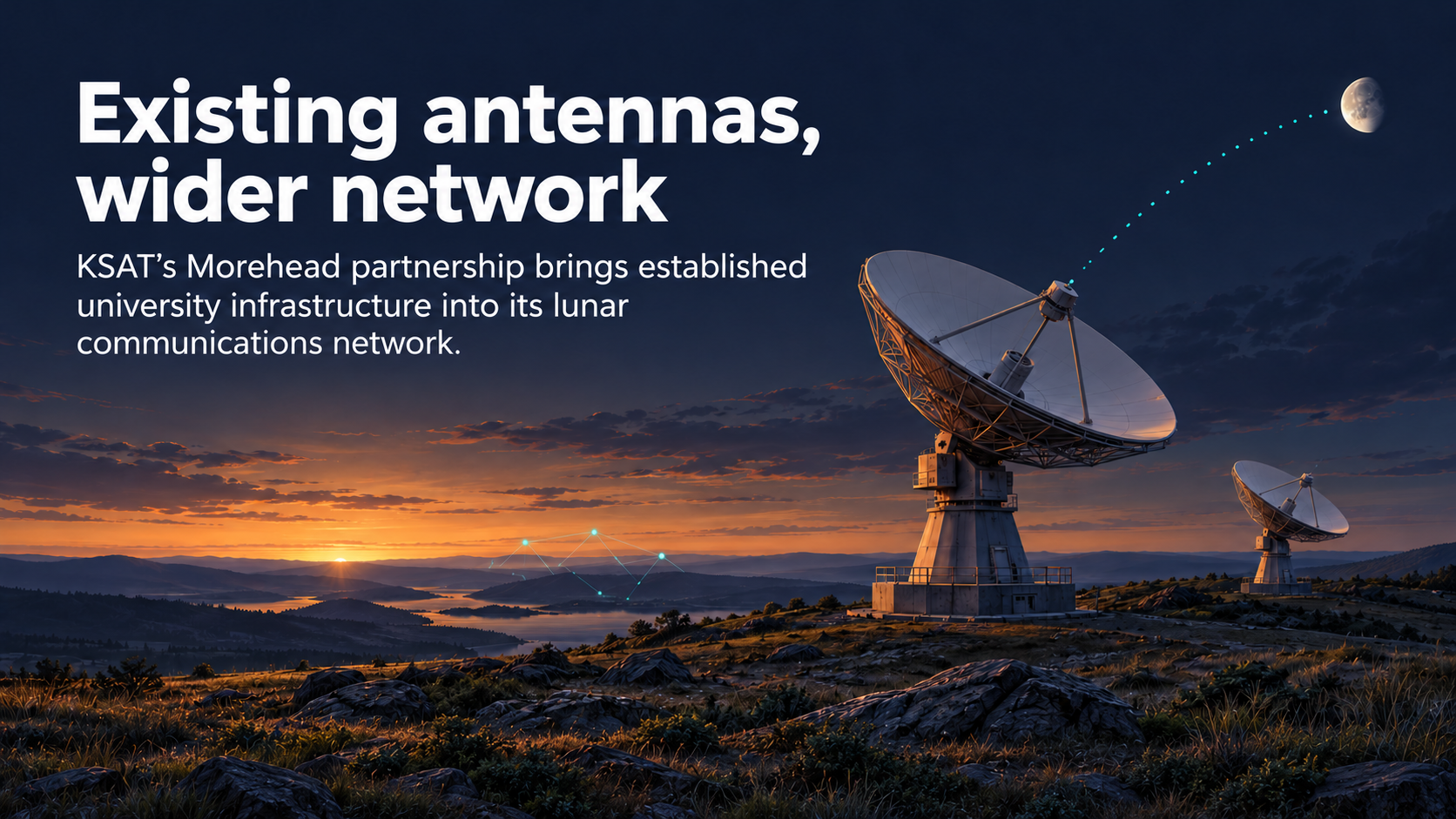
Space Insights editorial illustration of lunar ground communications; not a depiction of Morehead State University's actual antennas or site.
KSAT is expanding its lunar network through antennas that already exist. Its partnership with Morehead State University, announced on 30 October 2026, draws on the university's 21-metre and 12-metre-class antennas in Kentucky. The Norwegian ground-services company says the partnership adds capacity and resilience over the eastern United States. KSAT's Morehead announcement.
That is a different route to network expansion from the three 20-metre antennas KSAT described in September. Those sites, in the United States, Spain and Western Australia, were being developed specifically for its lunar network. The two announcements show existing partner infrastructure and new construction contributing to the same service proposition. KSAT's infrastructure update, 2 September.
Two ways to assemble a network
The new-build programme addresses the physical distribution of antennas. KSAT says the three sites are designed to provide near-continuous lunar coverage and support telemetry, tracking, command and high-rate data services. That describes the intended network design; the September update reports construction progress rather than a measured record of continuous service.
Morehead contributes established deep-space communications capabilities at a named institution and location. The announcement concerns a partnership using those assets, rather than the construction of two additional dishes. The immediate change is the relationship through which the existing infrastructure contributes to KSAT's network.
KSAT describes partner infrastructure as part of its lunar service. The Morehead announcement gives that network model a specific university, antenna assets and an eastern US location. KSAT Lunar service description.
For an infrastructure owner, the case illustrates a route into a commercial network without having to recreate every site under one ownership structure. For a mission team, it means the service under consideration may combine assets with different institutional origins. Both observations matter when evaluating a network offer, even before a mission reserves antenna time.
What a mission team would buy
An antenna's diameter is useful technical context. A mission procurement, however, needs a defined service for a defined period. Our reading of the Morehead case is that buyers should examine how a partner site becomes part of that deliverable.
Three questions make that examination concrete:
- Which communications and tracking functions would the proposed mission receive from the site, and what compatibility evidence supports them?
- How would the required contact periods be reserved within the wider network service?
- What acceptance evidence and service commitments would apply to the purchased mission support?
These are buyer questions prompted by the partnership, rather than terms announced by KSAT or Morehead. They connect the public infrastructure story to the information a mission team would need in its own procurement.
The commercial value is in the combination
The two announcements point to a practical feature of the emerging lunar ground business: capacity can be assembled through both construction and cooperation with established facilities. KSAT's reported resilience benefit should be assessed through the service offered to a mission, rather than inferred from an antenna count alone.
A documented mission supported through Morehead under the partnership, or published service-entry and acceptance information, would make that benefit more concrete. For now, the evidence is a named network partnership using existing antennas alongside a separately documented construction programme. That is enough to broaden a buyer's view of how lunar ground services are being assembled, while leaving the mission-specific terms to the procurement itself.
Get briefings like this every Friday.
Subscribe