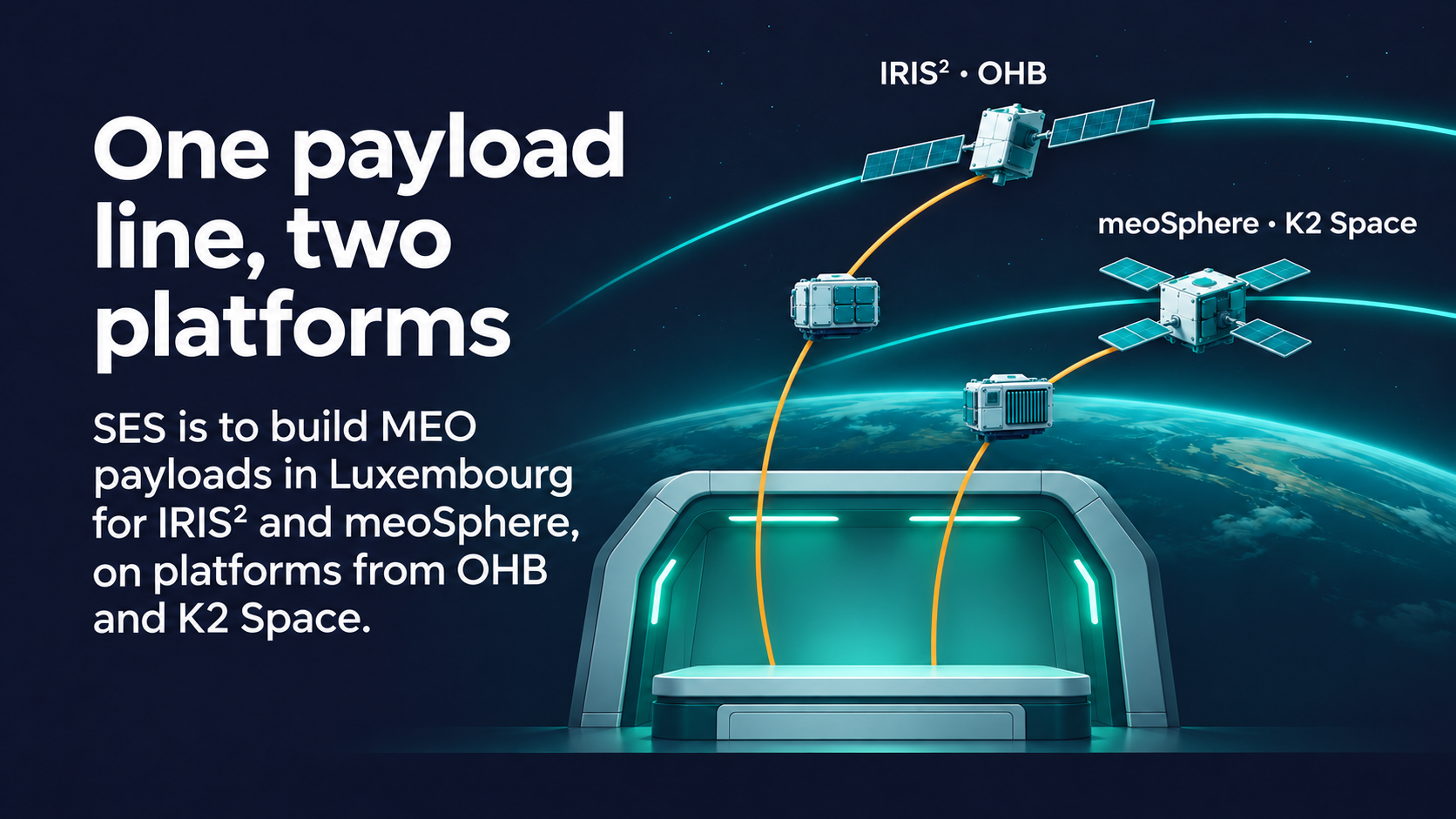
Space Insights editorial illustration of SES's MEO manufacturing model; not a depiction of actual satellite hardware or the Luxembourg facility.
SES's disclosures of 4 and 5 November move its medium Earth orbit (MEO) manufacturing model from plan towards recorded activity. An SES payload on K2 Space's GRAVITAS mission, part of meoSphere Pathfinder 1, completed a bidirectional optical link with Cailabs' ground station in Rennes. SES said production and testing of Pathfinders 2 and 3 have started and that construction of its Luxembourg site is under way, with completion expected in the first half of 2028. Its IRIS² role now sits in backlog as €3.4 billion of low-margin construction revenue, within a group backlog of €10.0 billion. SES, 4 November; SES results, 5 November; SES call transcript.
The underlying division of work is established. On 7 August SES said it would design and build the IRIS² MEO payloads and perform assembly, integration and test (AIT) in Luxembourg; on 31 August OHB announced a contract worth nearly €1 billion for the 18 IRIS² MEO platforms. Earlier Space Insights analyses covered that split (Buses from Bremen, Payloads in Luxembourg), the IRIS² layers (IRIS² Integration Responsibilities Differ Across Orbital Layers) and the factory (SES's Luxembourg factory adds a site and timetable to its MEO manufacturing role). SES, 7 August; OHB, 31 August.
One payload line serves two MEO programmes
SES's results release says it will design and build the payloads, and perform AIT, for its next-generation MEO satellites "including meoSphere and IRIS²". For meoSphere, its own multi-mission network for government and commercial customers, SES announced on 24 March that its payloads would be paired with an initial 28 high-power platforms developed by K2 Space. For IRIS², the platforms come from OHB. SES, 24 March (AMF filing).
The payloads are related, not identical. SES's chief executive told analysts they use "many of the same technologies and manufacturing processes", while the IRIS² version carries security elements that meoSphere will not have unless customers order them. The platforms differ too: OHB gives about 15 kW and a launch mass of about 2.6 tonnes for each IRIS² MEO satellite, while SES specifies 20 kW for each meoSphere phase-one satellite. OHB and K2 supply separate constellations, not alternative sources for one design. SES call transcript; OHB, 31 August; SES, 24 March (AMF filing).
Who does what in SES's MEO work, and at what stage
| Role | Organisation | Stage evidence | Not stated in the cited sources |
|---|---|---|---|
| IRIS² MEO platforms (18) | OHB, for SES | Contract worth nearly €1 billion, 31 August | Relation to SES's own contribution |
| meoSphere platforms (first 28) | K2 Space | Announced 24 March; a K2 platform carried Pathfinder 1 | Contract value |
| Payload design, production and AIT, both programmes | SES, Luxembourg | About 1,200 m² of labs with a certified SMT line producing early payloads; Pathfinders 2 and 3 in production and testing; site targeted for H1 2028, production for 2029 | Annual throughput; external subcontracts |
| IRIS² common user terminal development, operations, and LEO/MEO service provision through IRIS² control centres | SES leads | Role set after Rendez-vous 1, August | Terminal suppliers; procurement route |
| IRIS² ground segment and Low LEO constellation | Hispasat, prime contractor | €1,926 million order intake at Indra, third quarter | Split between the two; subcontracts |
| Pathfinder 1 only | Mynaric CONDOR terminal; Cailabs ground station; Thales Alenia Space AIT and operations support | Optical link announced 4 November | Roles in production satellites |
Our reading for suppliers follows from the table. For payload equipment and AIT services on both programmes, the counterpart is SES, and, as of November 2026, the active entry point is the pathfinder line rather than the 2028 facility. Platform equipment belongs with OHB or K2 according to the programme, and IRIS² ground-segment work runs through Hispasat. Pathfinder 1 also shows the operator-led model still drawing on outside partners.
How IRIS² appears in SES's accounts
SES's analyst presentation puts the initial total contract value of its IRIS² role at about €3.5 billion. The European Commission funds about €2.1 billion, 60% of that value, and SES's own contribution remains €1.35 billion. The €3.4 billion in backlog is the remaining value after revenue recognised in 2026, expected at low margin and, in the chief executive's words, dependent on meeting milestones "like in IRIS²". SES analyst presentation; SES call transcript.
The accounting matters to anyone reading that backlog as demand. SES's chief financial officer said IRIS² revenue will be recognised on a percent-complete basis. The Commission's portion is booked as revenue with its cost of sales, and SES's own investment is also recognised as revenue because SES will hold 90% access rights to the operational satellites; the CFO called it effectively a payment in kind. The €3.4 billion therefore includes SES's own contribution. It is not all money arriving from outside, and it does not measure work available to suppliers. OHB's platform contract is a separate figure; neither company says how it relates to SES's €1.35 billion.
SES says the €2.8 billion it announced earlier grew because its role now includes operations and user terminals, with the added value fully funded by the Commission. That earlier total and the remaining €3.4 billion are on different bases, so the two figures are not a like-for-like comparison.
Indra records IRIS² as order intake
Indra reported on 29 October that Hispasat's award as prime contractor for the IRIS² ground segment and Low LEO constellation generated €1,926 million of third-quarter order intake. Its Space backlog was €4,819 million on 30 September, against €174 million a year earlier. The €4,645 million that Indra's release attributes to Space in its backlog growth is that increase, attributed to consolidating the Hispasat and Hisdesat backlogs (€2,722 million) and the IRIS² contracts. Organic Space revenue fell 17% over nine months. Indra, 29 October; Indra results PDF.
SES's construction-revenue backlog, Indra's order intake and Eutelsat's €8.9 billion of future IRIS² construction revenue measure different things at different companies. They cannot be added into a programme total or read as progress. Eutelsat, 29 October.
What the model has not yet shown
SES's chief executive said the company sees "high double-digit savings" from building satellites itself rather than under the old model, and in the same answer that it is "very early to declare victory". The savings are SES's own, unquantified assessment. Moving payload production and AIT to the operator could change who buys payload subsystems while leaving the volume broadly intact, or it could narrow work previously contracted through a satellite prime. The public documents do not show which.
What to watch next
SES has moved its Capital Markets Day to 11 March 2027, alongside full-year results, to discuss verticalisation; the CFO said IRIS² revenue recognition will be modelled there. Pathfinder 2, targeted for 2027, the Luxembourg site's commissioning, K2's contract value and Hispasat's subcontracts will add evidence. The most direct test of the operator-as-buyer reading would be SES's first announced external subcontract for payload equipment or AIT services.
Sources
- 1.Nine months and Q3 2026 results — SES
- 2.Q3 2026 analyst presentation — SES
- 3.Q3 2026 earnings call transcript — 5 November — SES
- 4.Optical communications milestone for meoSphere — SES
- 5.Next-generation MEO strategy update — 7 August — SES
- 6.meoSphere announcement — 24 March 2026 — SES / AMF
- 7.Contract for eighteen IRIS² satellite platforms — OHB
- 8.Third-quarter 2026 results — Indra Group
- 9.3Q 2026 results — full release — Indra Group
- 10.First-quarter 2026–27 revenues — Eutelsat
Get briefings like this every Friday.
Subscribe