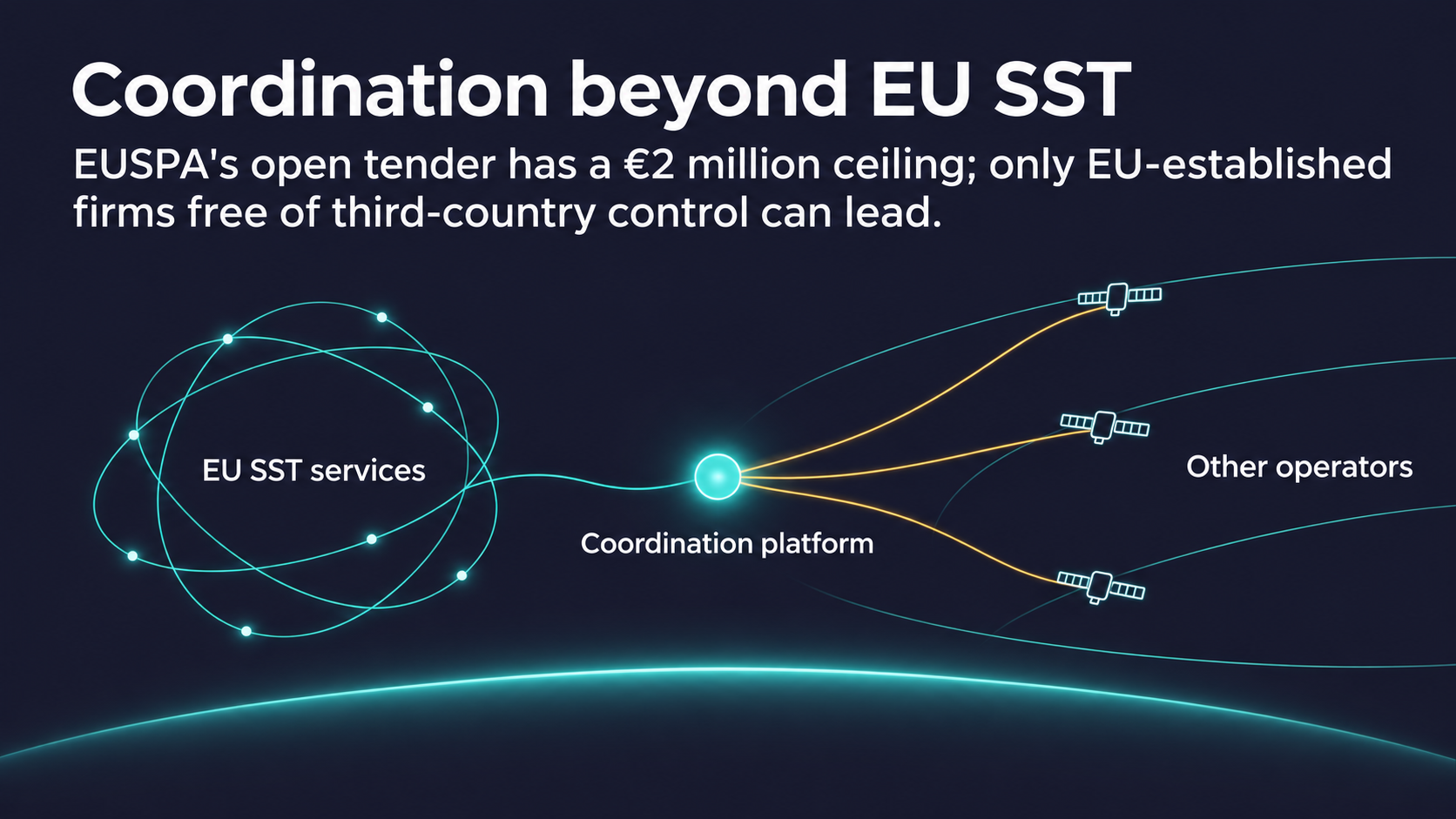
Space Insights editorial illustration of the proposed Space Traffic Coordination Platform; not a depiction of an operational system or final technical architecture.
The European Union Agency for the Space Programme (EUSPA) is seeking one contractor to develop and set up an EU Platform for Space Traffic Coordination (EU STCP). The open procedure, published on TED on 26 October 2026 as notice 738225-2026, has an estimated value of €2 million excluding VAT, which the tender specifications also set as the maximum total value. Tenders are due by 23:59 CET on 25 January 2027. TED notice; EUSPA.
What EUSPA is buying
The procedure leads to a single contract in one lot, not a framework agreement. EUSPA calls it a direct contract: all terms are fixed at the outset and it is implemented after signature without further contract procedures, while the contractor is still chosen by open competition. It runs for 30 months, against 24 in the March 2026 prior information notice. Offers above €2 million are rejected automatically, and the draft contract sets firm and fixed prices.
The notice also reserves an option to entrust repetitions of similar services to the same contractor by negotiated procedure, up to 50% of the initial contract. It is a possibility, not a commitment, with no separate value in the notice, and should not be added to the €2 million.
The platform is to be integrated with existing EU Space Surveillance and Tracking (EU SST) services. The terms of reference say coordination through the EU SST collision avoidance service is currently limited to its users. The platform should extend coordination to external actors' contact, orbit and manoeuvre data, support interfaces with national, regional and commercial space situational awareness (SSA) services, and assess draft "Rules of the Road" from CEN/CENELEC standardisation in a sandbox. Testing those rules is not adopting them.
Who can lead, and who can join
Participation follows Article 24 of the Space Regulation (EU) 2021/696. An entity must be established, with its executive management, in an EU Member State, commit to carrying out all relevant activities in Member States, and not be controlled by a third country or third-country entity. Control is assessed along the whole ownership chain. The conditions apply at three levels:
- Prime contractors and Core Team members: no waivers. The Core Team includes any entity whose capacity a bidder uses to meet the selection criteria, so a partner lending turnover or references takes on the same conditions.
- Security-sensitive subcontractors outside the Core Team: conditions apply, waivers are narrow. A waiver needs a motivated request; for the establishment conditions it requires, among other things, that no substitute is readily available in the Member States, and looks first to EEA or EFTA countries with an agreement under Article 7 of the Space Regulation.
- Other subcontractors outside the Core Team: not subject to the conditions. The term security-sensitive is defined broadly, however, covering access to EU classified information or to the Union's validation or operational infrastructure, including its development environment. Since development takes place in the agency's SST development environment, our reading is that many software subcontractors would fall within it.
The documents do not say which countries meet that Article 7 condition here; a role depending on a waiver needs settling through clarification.
Security and capacity thresholds
The contract is classified up to RESTREINT UE/EU RESTRICTED, and no personnel security clearance is required at that level. Every entity expected to handle classified information must, at submission, have appointed a Local Security Officer and submit a reinforced non-disclosure undertaking with a declaration of accreditation for its communication and information system, or a certificate from the competent authority. For a smaller firm, the accreditation evidence may be the heavier preparation.
Selection requires annual turnover of at least €1 million over the last three years, with Core Team capacities counted together, plus, within five years, at least two projects in the institutional space environment or wider space industry and at least three complex software projects on Kubernetes-orchestrated containers; one project can count towards both.
The contractor must subcontract at least 10% of the total tender price through competitive tendering outside its own corporate group, unless a derogation is justified. At the €2 million ceiling that floor would be €200,000 (our calculation); a lower bid lowers it. That plan and a plan to involve SMEs and start-ups are scored together.
How tenders are scored, and where the documents differ
Quality is marked out of 100, with a minimum of 60 overall and per-criterion minimums. Project management (Q1) carries 40 points and stakeholder engagement and user-needs collection (Q2) 30, together 70 of 100; committed technical performance (Q3), the supply-chain plans (Q4) and contract and security compliance (Q5) carry 10 each. That profile suits a requirements, engagement and integration assignment more than a product competition.
The tender specifications combine scores 70/30, as 70% quality and 30% price. The TED notice, and the portal's structured notice data, list quality at 30 and price at 70 (30/70), with both fields referring bidders to the procurement documents. The documents also describe the place of performance differently: the specifications require the contractor's premises to be in an EU Member State, the notice says anywhere in the European Economic Area. No corrigendum was listed on the portal record on 9 November. Clarification requests close on 17 January 2027, and EUSPA may publish clarifications until 19 January. Both points bear on pricing and are worth raising before then.
Where the strategic value lies
The documents limit what the winner keeps. The solution must be free of the bidder's background intellectual property and of third-party rights, apart from permissively licensed open-source dependencies. It is deployed within existing SST infrastructure operated by the agency, and after a six-month warranty from acceptance, all development and maintenance passes to EUSPA.
The value lies in definition. The contractor produces the validated user needs, the concept of operations and the system requirements, and shapes the interfaces through which operators and SSA services outside EU SST would coordinate. For commercial SSA providers with their own coordination tools, embedding a proprietary product would count against a bid under Q3; the interface objective points instead to a position as a service the platform connects to.
The terms of reference cite the Commission's 2022 EU Approach for Space Traffic Management, not the civil and military STM requirements that DG DEFIS reported finalised in June 2026 (DG DEFIS), a step examined in an earlier Space Insights analysis.
What to watch
The portal's clarification record up to 19 January comes first. Tenders open on 1 February 2027 at 15:00 CET. EUSPA's estimates, which it calls indicative and not binding, put evaluation in February or March, award in March and the start of work in April 2027. The TED award notice should then show the winner and contract value; any later use of the 50% option would appear in subsequent procurement records.
Sources
- 1.Space Traffic Coordination Platform — notice 738225-2026 — TED
- 2.Space Traffic Coordination Platform (STCP) procurement — EUSPA
- 3.STCP tender documents and clarifications — European Commission Funding & Tenders Portal
- 4.EU space operators complete civilian and military STM requirements — European Commission / DG DEFIS
Get briefings like this every Friday.
Subscribe