Airbus Defence and Space's EBIT Adjusted rose from a €566 million loss in 2024 to €798 million in 2025, with a whole-division target of €1.3 billion by 2029; the proposed Bromo combination with Thales and Leonardo remains subject to EU merger review. Space Insights.
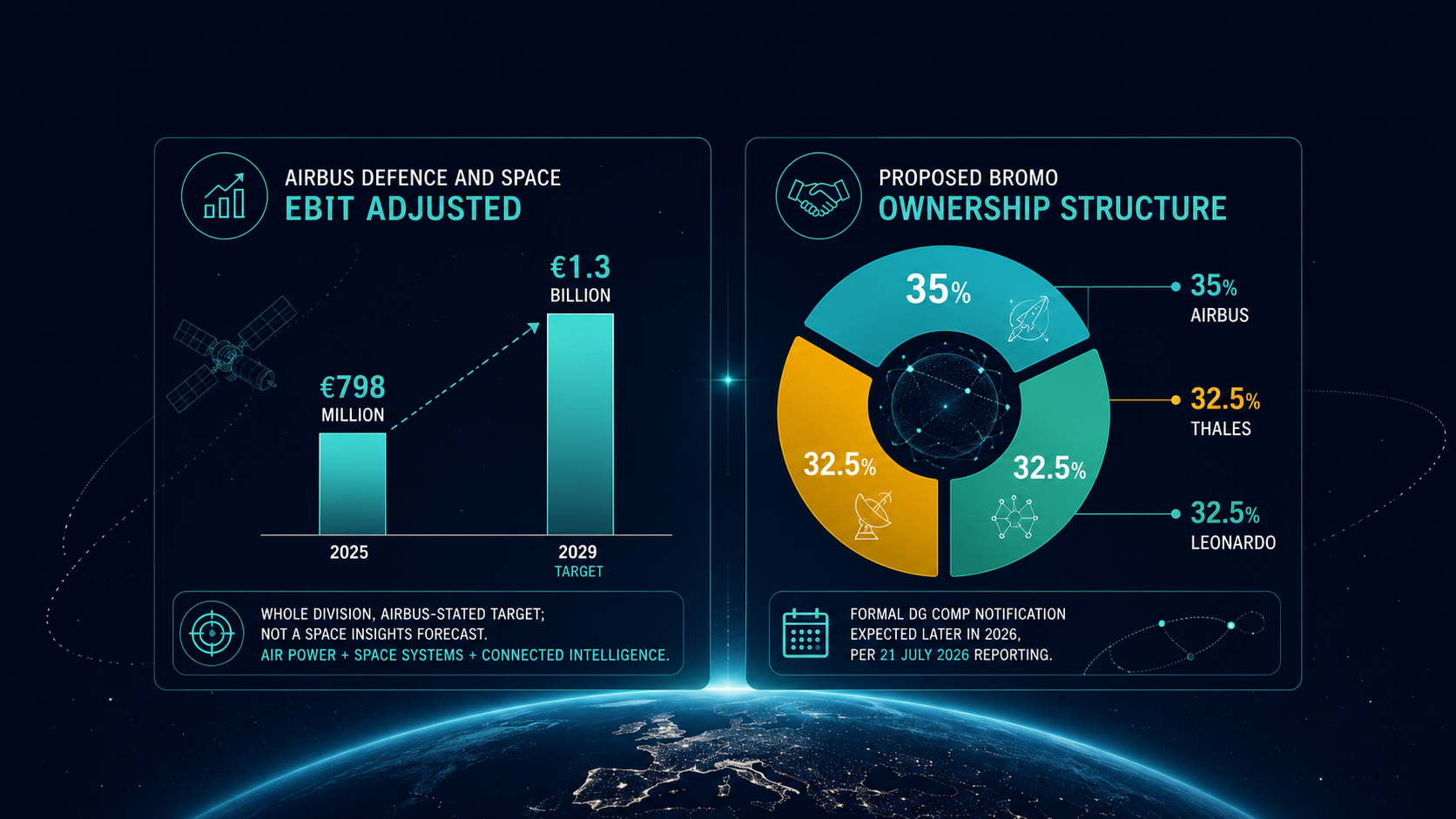
Airbus Defence and Space recorded EBIT Adjusted of €798 million for 2025, reversing a €566 million loss the year before, per Airbus SE's full-year 2025 results published in February 2026. Division chief executive Mike Schoellhorn, in comments reported by SpaceNews on 23 July 2026, put that figure at around €800 million and set a target of €1.3 billion EBIT Adjusted by 2029. Both are divisional figures covering Air Power, Space Systems and Connected Intelligence; neither is a space-business-only number. Airbus attributed the 2025 earnings recovery to higher volumes, improved profitability and its transformation plan; Schoellhorn separately pointed to record ESA funding and rising demand across secure connectivity, Earth observation and military satellite programmes as support for the division's forward order environment. Asked whether the 2029 target held with or without Project Bromo, the division's proposed merger with the space businesses of Thales and Leonardo, he said: "My answer will be it is robust against both scenarios."
Context
Airbus Defence and Space has spent the past several years working through significant programme charges, having taken nearly €2 billion in charges on space programmes across 2023 and 2024, per SpaceNews. The €798 million EBIT Adjusted recorded for 2025, against a reported EBIT of €639 million for the division, marks a recovery from that period, and Schoellhorn described the current environment as favourable for consolidating that turnaround: "There couldn't have been a better time to fix the space business and to be ready for the significant orders and demand that we are currently seeing," he said.
The demand drivers he cited are structural rather than one-off, and are separate from the causes Airbus gives for the 2025 earnings recovery itself. At the ESA Council at Ministerial Level (CM25) in Bremen on 26 to 27 November 2025, member states subscribed a final €22.3 billion, a record for the agency; some early ESA communications carried a lower preliminary total, since superseded by the confirmed figure. Separately, the European Commission's IRIS² secure connectivity constellation, along with a wider build-out of European military satellite systems and Earth observation capacity, is identified by Airbus as a demand driver across the sector. "Europe is really doubling down with constellations," Schoellhorn said. "You hear IRIS². You hear military constellations. You hear Earth observation."
Project Bromo, the internal code name for the proposed merger of Airbus's Space Systems and Space Digital businesses with Leonardo's Space Division, Telespazio and its Thales Alenia Space shareholding, and Thales's Thales Alenia Space, Telespazio and SESO shareholdings, was set out in a memorandum of understanding signed on 23 October 2025. Under that MoU, Airbus would hold 35% of the combined entity, with Thales and Leonardo each holding 32.5%. Space launchers are explicitly excluded from the perimeter. The combined business is reported to be headquartered in Toulouse, according to SpaceNews's October 2025 coverage of the MoU; the companies' own joint release does not itself specify a headquarters location. Based on 2024 figures, the businesses being combined generated approximately €6.5 billion in annual revenue and employed around 25,000 people. The companies have targeted 2027 for the joint venture's launch, subject to regulatory clearance and to consultation with employee representative bodies.
What the DG COMP timeline means for Bromo's 2027 target
As of 21 July 2026, the most recent reporting traced for this piece, Project Bromo had not been formally notified to the European Commission's Directorate-General for Competition (DG COMP). The Financial Times reported on that date that the parties hoped to submit the transaction to EU antitrust authorities later in 2026; public sources reviewed for this piece do not yet show a completed formal notification. Earlier, in late June 2026, Airbus chief executive Guillaume Faury and Leonardo chief executive and general manager Roberto Cingolani had publicly urged the Commission to clear the deal, per Financial Times reporting relayed by Il Sole 24 Ore on 23 June 2026. The exact wording of the executives' statements could not be independently verified against the original Financial Times text and is not repeated here; both are reported to have argued that consolidation is necessary for European space industry to compete at scale. Because no notification has yet been filed, no Commission decision timeline has formally begun. Once filed, the statutory Phase I review period, and a deeper Phase II investigation if one is triggered, would need to run their course before any decision, subject to statutory extensions and possible suspension of the clock while the Commission awaits requested information; the specific statutory clocks are set out in Forward look below. Space Insights editorial reading: a notification later in 2026 would narrow the runway available for the companies' stated 2027 target for making the combined entity operational, particularly if an in-depth review or remedies are required. No Phase II decision has been published, and none should be assumed.
That sequencing matters for how the story should be read. Airbus, Thales and Leonardo continue to operate as separate, independently listed parent companies while the merger review process has not yet formally begun. Public statements from Bromo's proponents reflect an intention and a lobbying position, not a change in the companies' current legal or operational status.
What OHB's stated position adds to the regulatory picture
Germany's OHB SE, one of Europe's independent satellite manufacturers, has put its opposition to the merger on the public record. Asked by Reuters on 7 May 2026 whether OHB would consider a legal challenge if the European Commission cleared the deal, OHB chief executive Marco Fuchs answered: "Yes." He described the transaction as "rather a disturbance of the market" and said OHB was raising concerns "because it impacts our supply chain."
The Reuters report does not attribute any specific legal route to Fuchs. Any future challenge to a Commission clearance decision by a third party would normally be brought before the EU General Court under Article 263 of the Treaty on the Functioning of the European Union, subject to standing and admissibility requirements for non-addressee applicants; that is a procedural avenue that exists in the Treaties, not a step OHB has said it will take. Spain's Indra Space has also been reported separately as raising competition concerns about the transaction, according to sector reporting; that specific attribution is not part of this article's sourced record and is not carried further here.
This is a documented position from a named executive, reported by a wire service, and it is treated here as exactly that: a stated stance, not a prediction of legal merit or outcome. Whether any challenge would succeed, or whether the Commission's eventual remedies (if any) would satisfy OHB, are open questions that this analysis does not attempt to resolve.
Two separate targets, not one
One distinction is worth making explicit, because the two figures are easy to conflate. The €1.3 billion 2029 EBIT Adjusted target Schoellhorn described applies to the Airbus Defence and Space division as a whole and is, by his own account, robust to either Bromo outcome. It is a narrower figure than the target Airbus SE set at group level on 21 July 2026, when the parent company outlined a mid-term outlook targeting between €12 billion and €13 billion of EBIT Adjusted in 2029 across the whole group, alongside a €5 billion share buyback programme approved by the Board of Directors over three years. The two targets are not the same thing, and neither should be read as a Space Insights projection: both are figures Airbus itself has stated, and both carry the caveats companies typically attach to multi-year targets.
Forward look
Two tracks are now running in parallel rather than in sequence: Airbus Defence and Space's own financial trajectory, which its executives say does not depend on Bromo's approval, and the regulatory process that will determine whether Bromo proceeds at all.
A formal notification to DG COMP, once made, is the next concrete milestone, and it starts a clock that can be measured. Under Council Regulation (EC) No 139/2004, Phase I runs 25 working days from notification, extended to 35 working days where commitments are offered or where a Member State makes a referral request under Article 9(2); a Phase II investigation, if opened, adds a further 90 working days from the date it opens, subject to statutory extensions and to possible suspension of the clock if the Commission must request additional information from the notifying parties. Those intervals are the arithmetic against which the companies' 2027 joint-venture target can be tested once a notification date exists. For sector readers, the sequence to track is therefore: notification date, Phase I expiry, whether commitments are offered inside Phase I, and whether the case is referred to Phase II.
Whether that notification happens in time to support a 2027 joint-venture launch, and how the Commission ultimately weighs OHB's competition concerns against the industrial case for scale, remain open. This is a story to track through the notification date, not to resolve in advance of it.
Related signals - Space Insights covered OHB SE's €510.7 million capital raise and its public objection to Project Bromo before DG COMP in Week 28. This piece extends that storyline from the Airbus side of the Bromo perimeter.
Sources
- 1.Airbus space business takes advantage of growing demand for satellite systems — SpaceNews
- 2.Airbus reports Full-Year (FY) 2025 results — Airbus SE (press release)
- 3.Business Update 2026 transcript — Airbus SE (investor transcript, 21 July 2026)
- 4.Airbus, Leonardo and Thales sign Memorandum of Understanding to create a leading European player in space — Airbus SE / Leonardo / Thales (joint press release)
- 5.Airbus, Leonardo and Thales agree to combine space businesses — SpaceNews
- 6.Germany's OHB to consider legal action if EU clears Airbus, Thales, Leonardo satellite merger — Reuters (via Investing.com)
- 7.Leonardo: set to present the Bromo project to the EU for approval of a joint venture with Airbus and Thales (FT) — Il Sole 24 Ore (relaying Financial Times reporting)
- 8.'Major' antitrust demands would destroy Europe space deal, warns Leonardo chief — Financial Times, 21 July 2026
- 9.Airbus to present new mid-term outlook, strengthen commitment to profitable growth and shareholder returns during investor update — Airbus SE (press release)
- 10.Ministerial Council 2025 (CM25, Bremen, 26 to 27 November 2025) — European Space Agency
- 11.Council Regulation (EC) No 139/2004 on the control of concentrations between undertakings — EUR-Lex
Get briefings like this every Friday.
Subscribe