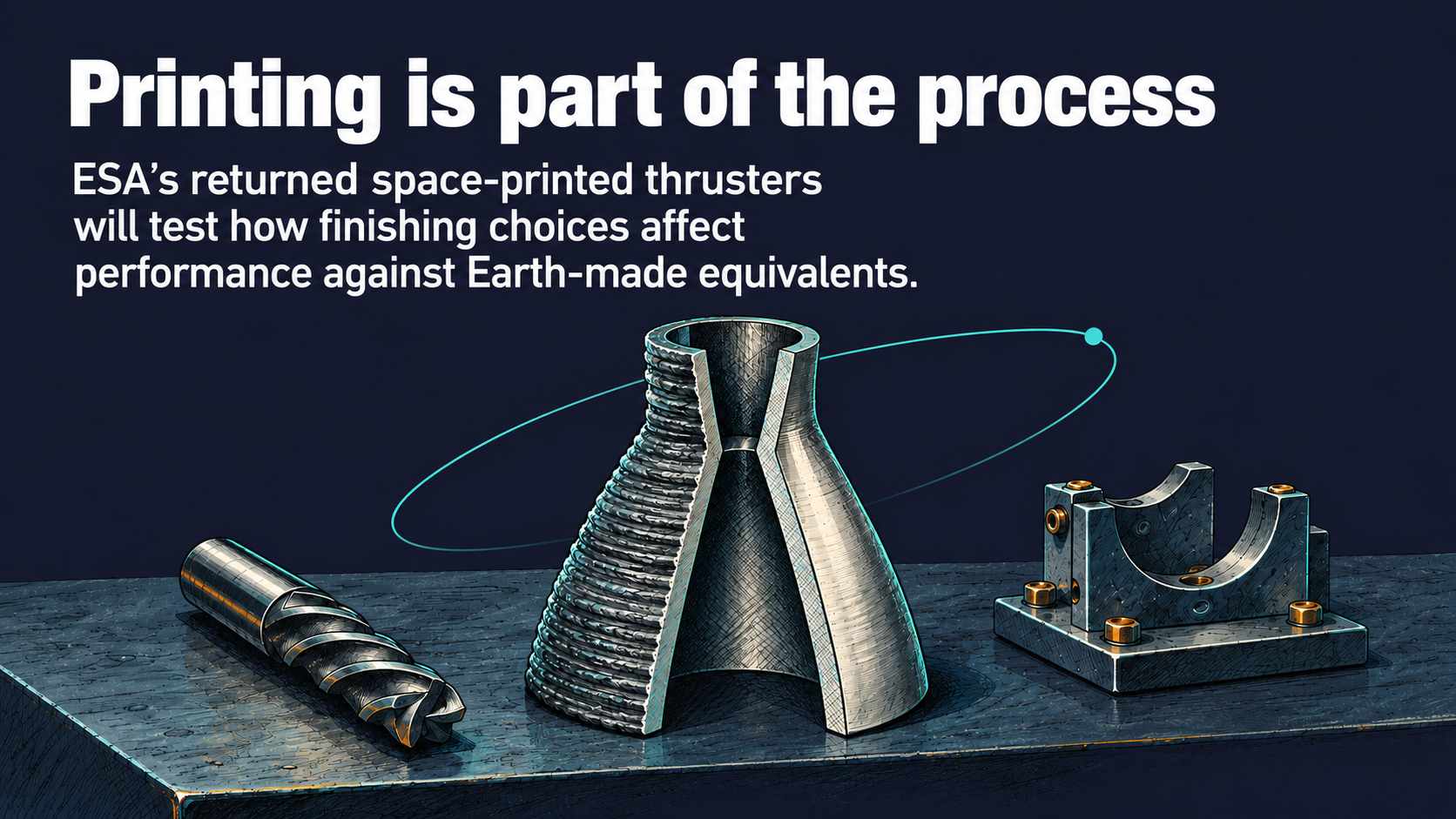
Space Insights editorial illustration of printing, finishing and testing; not a photograph of the returned thruster samples.
Planned DLR tests of returned, space-printed thrusters will examine a practical manufacturing choice: how much finishing to leave for after printing. For manufacturers, the decision concerns the full production route to a usable component, including the steps between forming a shape and demonstrating its performance. ESA’s 1 October update.
From a printed shape to a working part
The demonstrator’s early evidence addressed the printing process itself. In June 2024, ESA reported a stainless-steel test line produced inside the International Space Station’s Columbus module, completing commissioning and preparing the printer for full parts. The process fed wire into a laser-heated region, with operations overseen from the ground. ESA’s first-print report.
By November 2025, the investigation had moved to returned material. ESTEC engineers compared a space-made sample with an identically shaped reference produced using the same printer before its launch. They examined surfaces, used CT imaging to locate pores, and tested machined specimens in tension and bending. ESA described these steps as a way to investigate how the manufacturing environment affected the material. ESA’s material-testing account.
These stages answer different engineering questions. Depositing a shape establishes that the process can run. Examining its interior and mechanical behaviour provides evidence about the resulting material. Testing a component under operating conditions brings the assessment closer to the job a customer would require it to perform.
The finishing choice is part of the experiment
DLR’s two designs comprise a thruster printed close to its intended shape and a thicker-walled variant allowing refinement of the inner diameter. Planned hot-fire tests at Lampoldshausen, and comparisons with Earth-made equivalents, will assess functionality and performance. ESA’s account of DLR’s test plan.
The distinction matters when specifying a future manufacturing service. A part delivered directly from the printer and a part requiring further machining place different demands on the overall production system. Finishing equipment, inspection and handling become relevant to the assessment alongside the printer. The two designs make that production choice visible before the functional results arrive.
ESA’s earlier material-testing report explicitly included stock-material preparation and post-processing among the considerations for developing a printer able to provide usable spare parts. The thruster variants give that broader requirement a component-level test. ESA’s development considerations.
A feedback loop that includes ground operations
Findings from the first sample have already informed printing improvements for the two larger parts accompanying the small thrusters in the fifth sample. Functional results remain forthcoming. ESA’s October update.
There is an operational side to that learning. In July, ESA reported preparation of a recovery attempt for a different print interrupted by an anomaly. It also identified CNES’s CADMOS centre as the printer’s operator, working with ESA and Airbus teams. Producing parts in orbit currently involves an experimental system supported by ground expertise. ESA’s July operations account.
This could remain a valuable laboratory experiment without establishing an economic case for manufacturing a particular item in space. The decision for a prospective user is therefore application-specific: what performance must the part achieve, what finishing does it require, and which steps would have to be available where it is used?
Published comparisons of the two designs and their Earth-made equivalents would help answer the performance question. Combined with the record of process adjustments and operating interventions, they would provide a more useful basis for choosing the next application than the successful printing of another shape alone.
Get briefings like this every Friday.
Subscribe