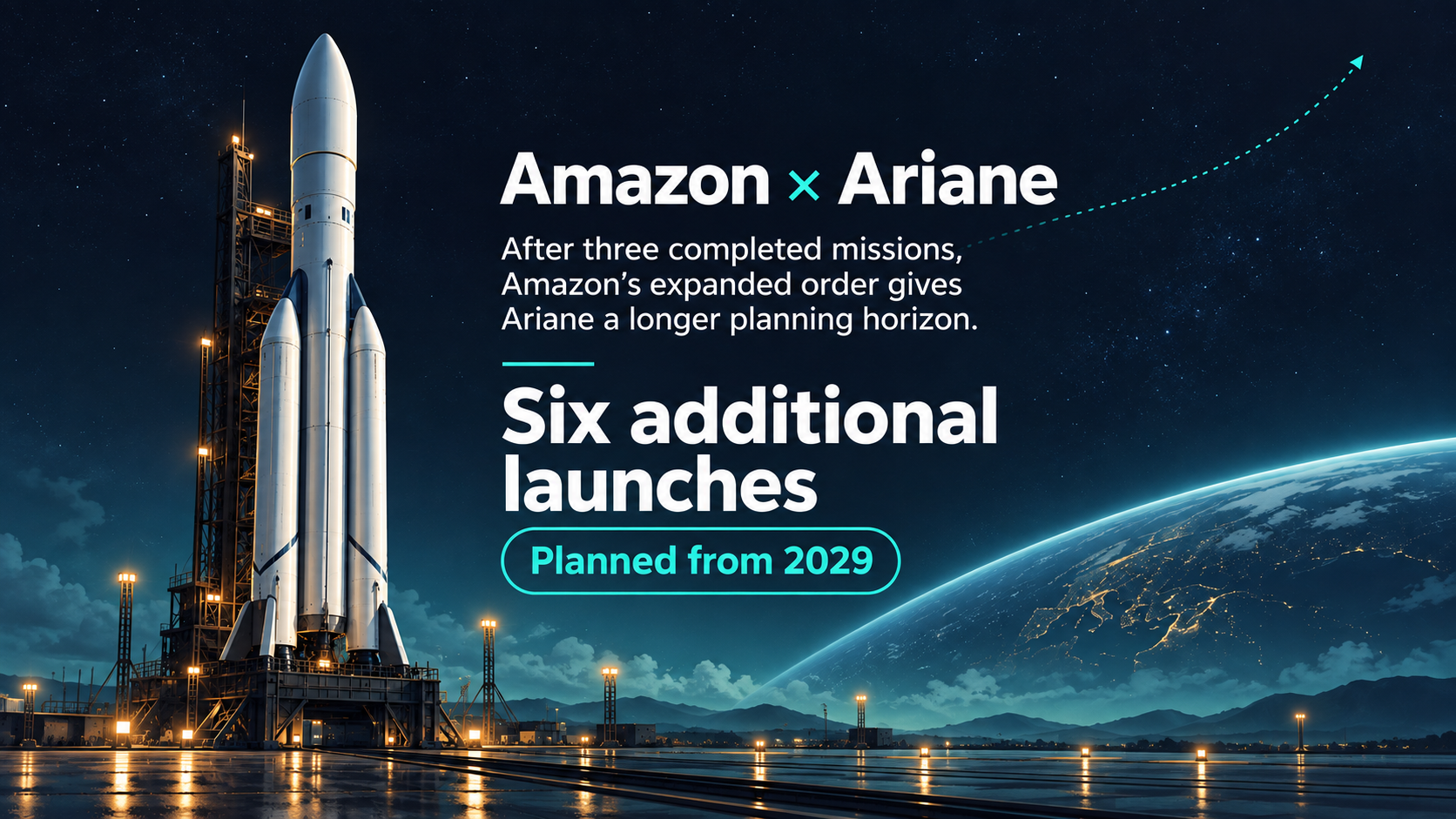
Three Amazon missions were flown in 2026 before the order grew. The six additional Ariane 64 launches take the agreement from 18 flights to 24 and are planned to begin in 2029, with the agreement's missions scheduled through 2031. The sequence is the point: the original commitment preceded the flights, this extension follows them. Space Insights.
Amazon Leo has ordered six additional Ariane 64 launches, extending its agreement with Arianespace from 18 to 24 flights. Announced on 9 September, the expansion comes after Arianespace reports delivering 100 Amazon satellites across three missions in 2026. The additional flights are planned to begin in 2029, with the agreement's missions scheduled through 2031.
The sequence gives this order its analytical value. The original commitment preceded the deployment flights; the extension follows experience with the service. For a launch programme moving into regular constellation delivery, a returning customer supplies evidence about commercial continuity alongside the technical evidence supplied by each mission.
Delivery gives the new commitment context
On 30 April, Ariane 6 flight VA268 deployed 32 Amazon satellites using four P120C boosters. On 17 June, VA269 carried 36 on the first flight of the upgraded P160C boosters. The European Space Agency (ESA) records both completed missions and attributes the larger June payload to the upgraded configuration.
These records establish a progression from delivery with one configuration to delivery with an enhanced version, followed by additional demand. Amazon's Chris Weber, vice president of Amazon Leo business and product, attributes the expansion to confidence in Ariane 6 and points to the missions already executed. That is the customer's public account of its decision.
For the industrial programme, this creates a useful connection between development and exploitation. An improvement has carried customer spacecraft, and that customer has subsequently extended its launch commitment. The commercial relationship can now be examined through actual delivery experience as well as the original procurement decision. Future reporting can test whether further repeat orders accompany continued execution.
The payload improvement and the new order measure different things. Spacecraft carried on one mission describe demonstrated lift capability for that mission. An order describes demand for future service. Bringing them together helps explain why a returning customer matters, while keeping the production task ahead visible: a stronger order book still has to become a sequence of completed flights.
A longer horizon for production planning
Arianespace says the additional commitment improves its long-term visibility and supports the increase in Ariane 6 activity. The practical value of that visibility is the ability to plan work across a longer period. Launch vehicles, payload preparation and launch-site operations must arrive in a compatible sequence; a customer commitment gives that sequence a clearer commercial anchor.
For suppliers, the informative next step is how the extended commitment appears in production orders and delivery schedules. A programme-level announcement identifies demand, while a component schedule establishes when manufacturing capacity is required. The interval between those disclosures is where the current commercial signal becomes useful for workforce, tooling and inventory planning.
Repeat constellation missions could also support continuity in mission preparation. Returning to an established customer relationship gives the organisations involved a body of operational experience to draw on. The extent of any efficiency gain would depend on the configurations and requirements of subsequent missions. Publicly reported preparation milestones would make that effect more observable than a general claim about economies of scale.
Tracking the conversion from orders to flights
The delivery calendar is now the most useful place to follow this story. Successive launches against the existing agreement will show progress in meeting the current commitment; production and schedule announcements for the extension will show how the longer horizon is being translated into work. Those are complementary indicators of execution and forward demand.
For Europe's launch sector, the development also sharpens the commercial question. Technical qualification opens access to a market; continued use and renewed purchasing establish a customer relationship over time. Amazon's extension supplies a concrete example of that progression, grounded in missions already flown and an agreement that reaches into the next decade.
Sources
- 1.Amazon Leo and Arianespace strengthen partnership with six additional Ariane 64 launches — Arianespace
- 2.Ariane 6 launches with more powerful boosters: a new record for Europe — ESA
- 3.Another one: Ariane 6 flies with four boosters once more — ESA
- 4.Updates — dated release index, retrieved 12 September 2026 — Arianespace
Get briefings like this every Friday.
Subscribe