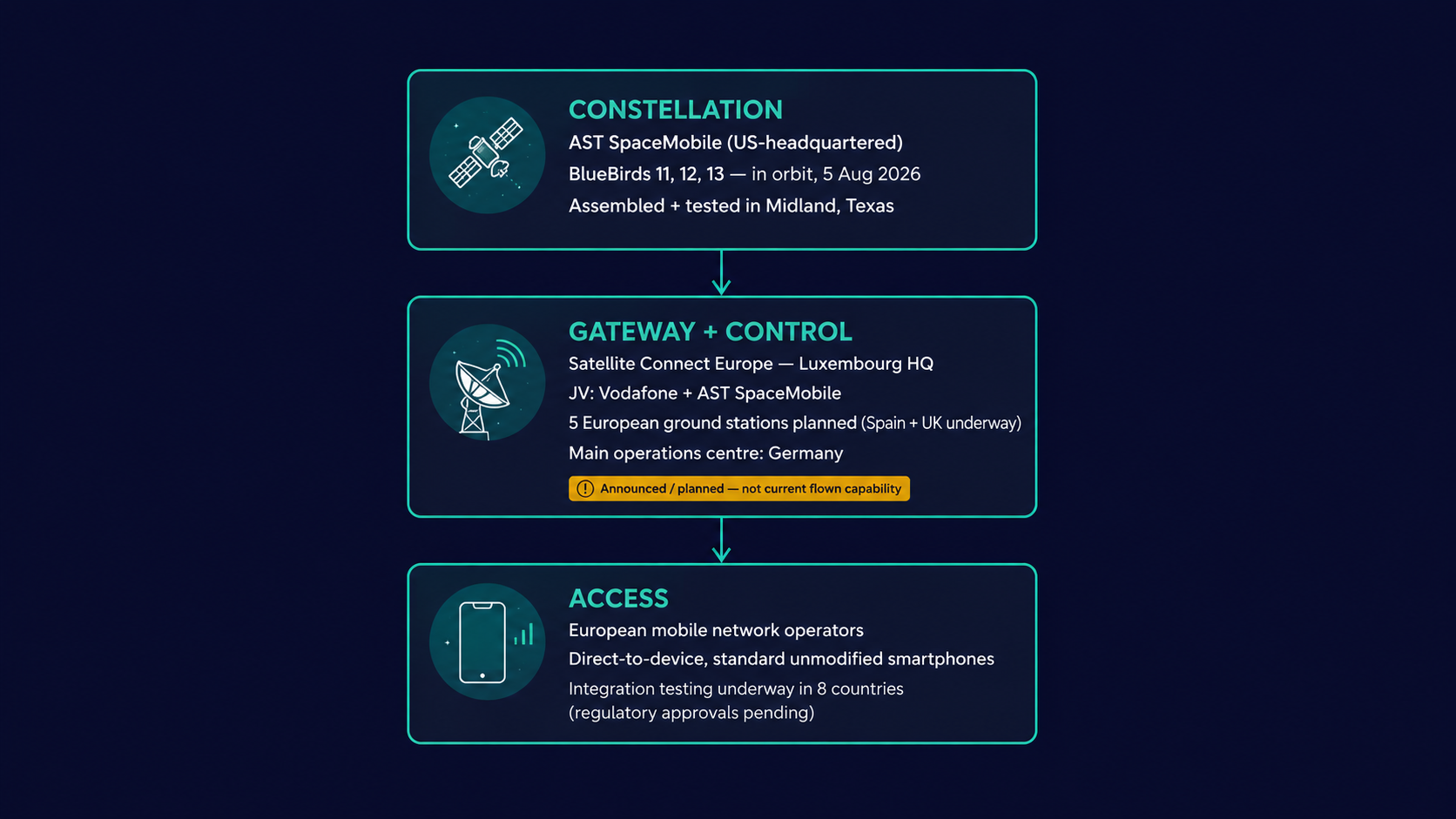
The European exposure to AST SpaceMobile's BlueBird constellation runs through three layers: the constellation itself, Satellite Connect Europe's gateway and ground infrastructure, and access via European mobile network operators, with integration testing under way in eight countries subject to regulatory approvals. Space Insights.
AST SpaceMobile (NASDAQ: ASTS) announced that BlueBird satellites 11, 12 and 13 reached orbit on 5 August 2026, launched on a Falcon 9 from Cape Canaveral Space Force Station. The company describes the satellites as further expanding its space-based cellular broadband network, supporting voice, data and video directly to standard, unmodified smartphones.
For a European intelligence publication, a US launch of a constellation operated by a US-headquartered company is not automatically a signal. On Space Insights' reading this one is, and the reason is not the rocket. It is what has been assembled underneath the constellation in Europe over the seventeen months between the March 2025 agreement and the launch, and what the company announced the day after it. The seventeen-month framing is our own count of the interval between the two companies' dated announcements, not a period either company describes.
What the company reported about the satellites
According to AST SpaceMobile's own announcement of 5 August, the next-generation BlueBirds are expected to deliver peak data rates approaching 200 Mbps, nearly double the 98.9 Mbps peak the company reports was achieved by its five initial Block 1 BlueBird satellites directly to standard smartphones. Both figures are the company's own, and the higher one is stated as an expectation for the new satellites rather than a measured result.
The same announcement states that BlueBirds 14, 15 and 16 are preparing for the next mission, with production advancing through BlueBird satellite 42. AST SpaceMobile is US-headquartered, with BlueBirds 11, 12 and 13 assembled, integrated and tested at the company's facilities in Midland, Texas.
Where Europe actually enters
Europe's exposure to this constellation has been built in stages, each documented in the two companies' own announcements.
On 3 March 2025, Vodafone (LSE: VOD) and AST SpaceMobile announced an agreement to create SatCo, a jointly owned European satellite service business intended to serve mobile network operators across all European markets with space-based cellular broadband. Vodafone's announcement was specific about the ground side: SatCo would build and run a network of ground stations providing backhaul from those operators to the satellite network in low Earth orbit, with European headquarters and management, and Vodafone framed the arrangement as fully supporting European digital sovereignty — Vodafone's characterisation, addressed on its own terms further below.
On 30 June 2025, Vodafone announced that the venture would be headquartered in Luxembourg, and that mobile operators covering 21 EU member states and other European countries had expressed an interest in using the service.
On 7 November 2025, the two companies announced that they had selected Germany for the venture's main satellite operations centre, to be located near either Munich or Hannover depending on final negotiations. The same announcement set out a planned EU constellation carrying what Vodafone calls a "command switch" for European oversight and security: updating all telemetry, tracking and control encryption keys for S-band and Q/V-band, modification of service encryption keys for communications across the continent, and the activation, deactivation and direction of satellite beams in Europe, with public protection and disaster relief among the stated use cases. This command switch is a feature Vodafone describes for that planned future EU constellation; it is not described as present on BlueBirds 11, 12 and 13 or any satellite currently in orbit.
On 27 February 2026, the venture formally launched under the name Satellite Connect Europe. Per Vodafone's announcement of that date, the Luxembourg-headquartered company is investing in the deployment of five Europe-based ground stations, with build underway in Spain and the United Kingdom and three further locations then being finalised, under a leadership team including Managing Director Meredith Sharples and incoming Chairman John Slamecka.
Agreements with European operators followed within days. On 2 March 2026, Satellite Connect Europe announced a commercial agreement with VodafoneThree covering direct-to-device data, voice and SMS integrated into VodafoneThree's 4G and 5G networks in the United Kingdom, with live customer trials planned, per that announcement, for summer 2026; a partnership with Vodafone Ireland conducting testing under what the company describes as Ireland's first Test and Trial licence for direct-to-device satellite mobile broadband; and the commencement of a demonstration with Sunrise in Switzerland. None of the sources cited here reports those UK customer trials as having started. On 26 March 2026, Satellite Connect Europe and Vodafone Ireland reported completing what they describe as Ireland's first mobile video call via an AST SpaceMobile BlueBird satellite on a standard smartphone, placed from Clare Island in County Mayo to Dublin.
What the company announced the day after the launch
On 6 August 2026, AST SpaceMobile announced that network integration testing activities, subject to regulatory approvals, are underway and advancing across the United Kingdom, Ireland, Romania, France, the Czech Republic, Germany, Spain and Ukraine, in what the release describes as collaboration with Vodafone, Orange, Telefónica, Deutsche Telekom and Vodafone Ukraine. That list of collaborating operators is AST SpaceMobile's own characterisation; apart from Vodafone, none of those operators is cited here from an announcement of its own. The company describes Satellite Connect Europe as the Luxembourg-headquartered joint venture providing the carrier-neutral gateway infrastructure supporting that work. Of the eight countries named, this article can confirm a specific national test-and-trial licence in only one, Ireland; for the remaining seven, the sources reviewed here describe regulatory status only as approvals pending, on a country-by-country basis rather than under any single European licensing regime.
That is testing under regulatory conditions, not commercial service. AST SpaceMobile's own framing is that the integration testing is a step toward commercial deployment, and its release attaches the qualifier "subject to regulatory approvals" to the testing itself. The company's most recent business update, on 10 August 2026, frames 2026 in terms of preparing a beta service involving non-commercial usage in select markets, which is a more limited framing than a commercial rollout. This article does not impute the outcome of the pending approvals, the completion of the testing, or any commercial service date in any European market.
Reading the sovereignty claim precisely
The sovereignty framing is Vodafone's and Satellite Connect Europe's, and it is worth locating rather than accepting or dismissing on reflex.
AST SpaceMobile is US-headquartered, and BlueBirds 11, 12 and 13 were assembled, integrated and tested at the company's facilities in Midland, Texas; the launch was on a US vehicle. What the structure locates in Europe, on the two companies' own account, is the distribution relationship with European operators, the gateway and ground-station layer, the main satellite operations centre in Germany, and a Luxembourg-headquartered joint venture jointly owned by Vodafone and AST SpaceMobile — the public sources reviewed here do not report an ownership split or a European-majority control stake within that joint venture. As announced in November 2025, the two companies have also described a planned command switch over encryption keys and beam direction across Europe, for a future EU constellation rather than for the satellites currently in orbit. Satellite Connect Europe's launch announcement puts a related point as network operations, data handling and service control remaining within European jurisdiction.
That is a more substantial set of things than a distribution layer. It is also still a specific set of things, and it is the companies' own characterisation rather than an independently verified allocation of ownership or control. The constellation now in orbit is an asset of a US-headquartered company, and the planned EU constellation described in November 2025 is an announced intention rather than hardware in flight. Whether the announced control architecture satisfies what European institutions mean by sovereignty in connectivity is not settled by a corporate announcement, and it is not one we can settle here. On Space Insights' reading, part of that answer is being written commercially, agreement by agreement, while Europe's D2D authorisation framework remains fragmented across national regulators rather than harmonised.
Space Insights editorial read: the exposure runs through the ground and distribution layer
This is the layer worth tracking as further satellites are added. The 5 August launch expands AST SpaceMobile's underlying constellation; the sources reviewed here do not report that BlueBirds 11, 12 and 13 themselves carry allocated European capacity or any Europe-specific configuration. Separately, and on a different timeline, Satellite Connect Europe has been building the European access and gateway structure: a Luxembourg company, a German operations centre, five planned ground stations, and the national regulatory approvals now attached to testing in eight countries. The route into Europe was set by a corporate arrangement announced in March 2025 and built out in stages since; the 5 August launch is capacity added to AST SpaceMobile's constellation, running alongside that separately built European structure rather than demonstrated to be part of it.
This is a Space Insights editorial reading, not a characterisation either company publishes. The source path is the dated announcements listed below: Vodafone Group on 3 March 2025, 30 June 2025, 7 November 2025 and 27 February 2026; Satellite Connect Europe on 2 and 26 March 2026; and AST SpaceMobile on 5 August, 6 August and 10 August 2026. The seventeen-month interval, and the reading of the launch as separate from the European structure it runs alongside, are ours; the dates and the figures are the issuers' own.
What we are not saying
We are not saying that commercial direct-to-device service has begun in any European market. The published position is agreements, trials and integration testing, with the testing itself qualified by AST SpaceMobile as subject to regulatory approvals, and the company's own 10 August 2026 update frames 2026 around a beta, non-commercial-usage service in select markets.
We are not saying the doubled download speed has been demonstrated. AST SpaceMobile states peak data rates approaching 200 Mbps as an expectation for the next-generation satellites; 98.9 Mbps is the peak it reports for its five initial Block 1 satellites.
We are not carrying the collaboration from Orange, Telefónica or Deutsche Telekom's own announcements. The list of collaborating operators is AST SpaceMobile's, published in its release of 6 August 2026; no announcement by those operators is cited here, and none of them is described here as a signed customer.
We are not saying that a national test or trial licence has been confirmed in all eight countries named in the 6 August announcement. A specific Test and Trial licence is confirmed here only for Ireland; for the other seven, the sources reviewed describe regulatory status only as approvals pending.
We are not saying the planned EU constellation and its command switch exist as flown hardware, or that they describe BlueBirds 11, 12 and 13. Both are described in an announcement dated 7 November 2025 as features of a future constellation, and the operations centre site remained subject to final negotiations at that date.
We are not saying BlueBirds 11, 12 and 13 carry allocated European capacity or a Europe-specific configuration. The 5 August launch announcement describes constellation expansion in general terms; it does not attribute specific capacity to Europe, and the European gateway and distribution structure is documented separately.
We are not saying the joint venture is majority-owned or controlled by the European party. The companies describe SatCo/Satellite Connect Europe as jointly owned by Vodafone and AST SpaceMobile; the sources reviewed here do not report an ownership split.
We are not offering a view on either company as an investment. Both are listed, every figure quoted here is their own, and nothing in this piece should be read as an assessment of commercial prospects.
Sources
- 1.AST SpaceMobile Announces Successful Orbital Launch of BlueBirds 11, 12, and 13 — AST SpaceMobile via Business Wire
- 2.AST SpaceMobile Accelerates Presence Across Europe with Leading Mobile Network Operators — AST SpaceMobile via Business Wire
- 3.AST SpaceMobile Provides Business Update and Second Quarter 2026 Results — AST SpaceMobile via Business Wire
- 4.Vodafone and AST SpaceMobile Sign Agreement to Create European Direct-To-Device Satellite Service Provider — Vodafone Group
- 5.Vodafone and AST SpaceMobile Choose Luxembourg as Joint Venture Headquarters to Drive European-Wide Space-Based Mobile Broadband Coverage — Vodafone Group
- 6.Vodafone and AST SpaceMobile Announce New EU Satellite Constellation and Select Germany for European Sovereign Satellite Operations Centre — Vodafone Group
- 7.Satellite Connect Europe launches to deliver direct-to-device broadband satellite connectivity for European Mobile Network Operators — Vodafone Group
- 8.Satellite Connect Europe to partner with VodafoneThree for customer trials of satellite mobile broadband in the UK — Satellite Connect Europe
- 9.Vodafone Ireland partners with Satellite Connect Europe to introduce seamless satellite connectivity — Satellite Connect Europe
- 10.Satellite Connect Europe and Vodafone Ireland complete Ireland's first mobile video call via an AST SpaceMobile BlueBird satellite using a standard smartphone — Satellite Connect Europe
- 11.Sunrise commences demonstration with Satellite Connect Europe — Satellite Connect Europe
Get briefings like this every Friday.
Subscribe