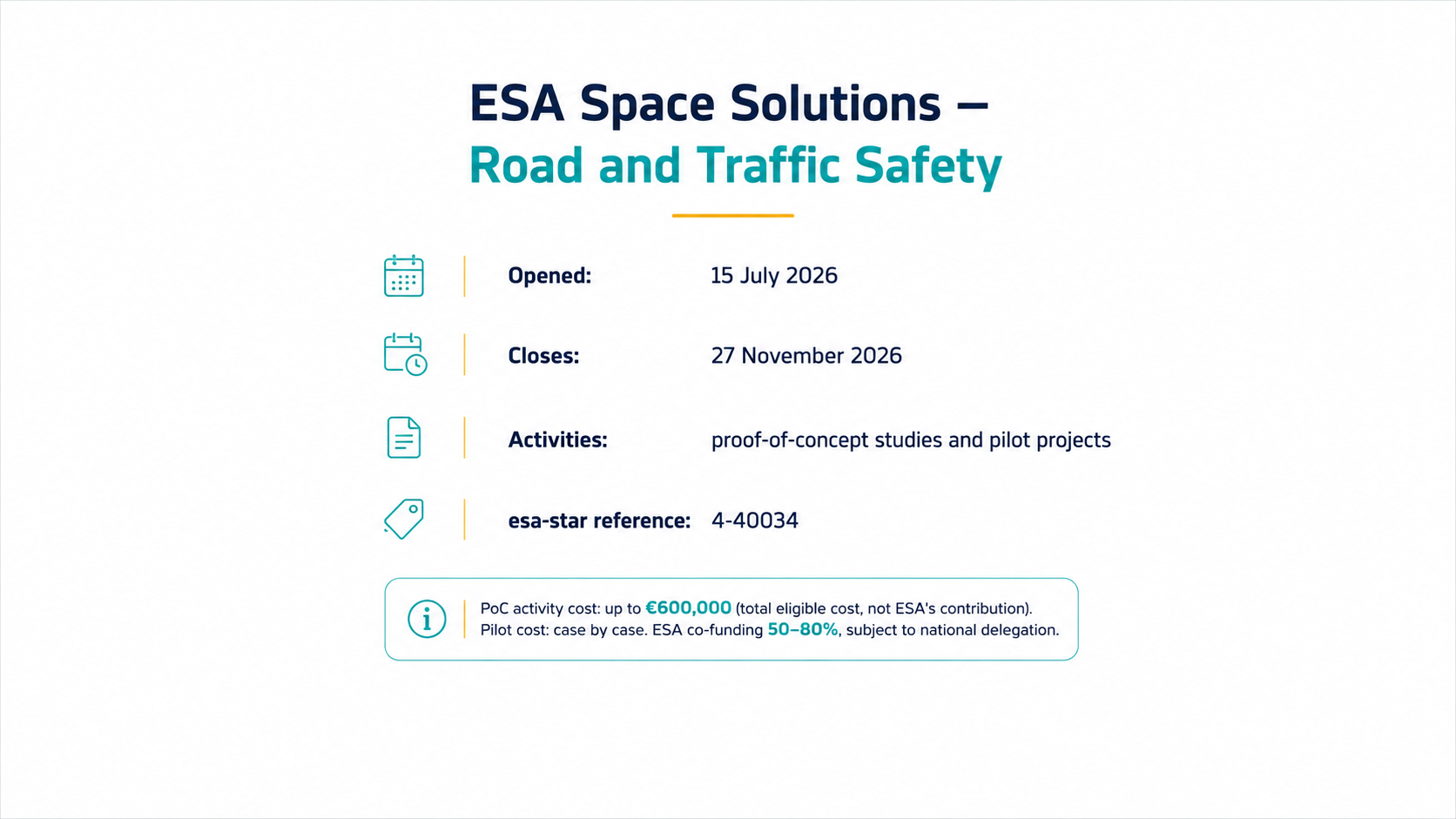
ESA Space Solutions' Road and Traffic Safety call runs 15 July to 27 November 2026 under esa-star reference 4-40034. Note: the €600,000 figure shown is the activity-cost ceiling for proof-of-concept studies only, not ESA's contribution and not the ceiling for pilot projects. Space Insights.
ESA Space Solutions opened a thematic call for proposals on 15 July 2026 supporting the development of sustainable space-based services and applications addressing challenges in the road and traffic safety sector. It closes on 27 November 2026 and carries esa-star reference 4-40034.
The call in brief
| **Opened** | 15 July 2026 |
| **Closes** | 27 November 2026 |
| **Instrument** | ESA Space Solutions thematic call for proposals, esa-star reference 4-40034 |
| **Activity types** | Proof-of-concept studies (nine months); pilot projects (one to two years) |
| **Activity cost** | Proof-of-concept studies: up to €600,000, limited to eligible cost. Pilot projects: case-by-case assessment, limited to eligible cost, no fixed ceiling stated in the published table |
| **ESA co-funding** | Baseline up to 75% of a company's cost for proof-of-concept, up to 50% for pilots; up to 80% for micro, small and medium businesses on either. Subject to the funding level authorised by the relevant national delegation or delegations |
| **Who it is for** | Companies intending to develop space-enabled services and products related to, but not restricted to, the call's topics |
| **First step** | Activity Pitch Questionnaire, submitted through ESA's Open Space Innovation Platform |
What is in scope
ESA states the call aims to develop solutions that use space-enabled technologies to improve safety and traffic management, improve the collection of critical data and better protect vulnerable road users, with the stated aim of reducing accidents, injuries and fatalities.
Its topics of relevance, which ESA says were identified with its Business Applications partners and which it explicitly presents as examples rather than limits, are: enhancing information exchange, including vehicle-to-vehicle and vehicle-to-infrastructure communication; improving road design, signage and maintenance, including rapid detection of defects such as potholes, surface cracks and faded markings; optimising traffic flow; implementing measures to protect non-motorised road users; and improving completion of International Road Assessment Programme (iRAP) star-rating surveys.
On the space side, ESA points to satellite Earth observation for map updating, hazard monitoring, road condition assessment and weather nowcasting; satellite navigation for positioning and for aggregated GNSS traffic-flow analysis; and satellite communications for near real-time exchange between vehicles and infrastructure, including in areas with poor terrestrial coverage.
How Space Insights reads ESA's five examples
What ESA lists, and how we read it. The five topics above, and their presentation as examples rather than limits, are ESA's. Read against each other, they fall into two clusters rather than five separate topics. One is about a road network reporting its own state continuously to more than one actor at once: vehicle-to-vehicle and vehicle-to-infrastructure exchange, traffic flow optimisation, vulnerable road user alerting. That is a data-integration problem before it is a space problem, which is part of why space-derived inputs have struggled to reach it. The other is about assessing and maintaining physical road assets at a cadence and cost that ground survey does not reach: defect detection, road design and iRAP survey completion. That second cluster is where the arithmetic for satellite Earth observation is more direct, and it is the one iRAP's star-rating protocol makes measurable.
Grouping ESA's five example topics into two clusters, and the reading of which cluster the Earth observation arithmetic reaches more directly, is a Space Insights editorial reading rather than a structure ESA's call page sets out.
How Space Insights reads the call's structure
What ESA states. The opportunity is open to companies that intend to develop space-enabled services and products. That is a different proposition from a research call, and it implies a different kind of submission: the proof-of-concept route is described as ending in a validated minimum viable product with early commercial traction, and the pilot route as ending in a fully operational service supported by key customers. ESA also states that proof-of-concept work verifies both technical feasibility and economic viability, and that the pilot route includes integration, development and testing work of its own — the call is not free of technical content at either stage.
How we read it. The more useful point is about the customer. Road authorities, municipalities and national transport agencies already buy traffic management systems, already run incident detection, and already hold budgets for both, procured through established transport-sector supply chains. That characterisation of the existing customer base is a Space Insights market reading rather than something ESA states, and it is offered as a reading of the market rather than a claim about who those suppliers are. Two elements of the call's construction are consistent with that reading: ESA states the topics were identified with its Business Applications partners, and National Highways, the operator of England's strategic road network, presented a use case at ESA's 15 July call webinar.
Space Insights reads one of the main gaps this call addresses as commercial as well as technical, not commercial instead of technical: Earth observation, GNSS and satellite communications can each contribute to the problems named in the scope, and ESA itself builds technical validation into both activity types. What the call's design additionally targets, on our reading, is the route into procurement channels built around terrestrial sensing, and the reference deployments that make a procurement officer comfortable. A funded activity that produces a working service with a named road authority behind it is likely to be worth considerably more to a European supplier than the same activity producing a demonstrator alone.
That is a Space Insights editorial reading, not ESA's stated rationale. But it is the reason this call is worth more than a diary entry for companies in the space applications market.
How the application route works
ESA's process for proof-of-concept studies and pilot projects runs in three steps. The first is the Activity Pitch Questionnaire, submitted through ESA's Open Space Innovation Platform. The second is an outline proposal: ESA's how-to-apply page states this must follow within two months of the APQ submission, while the call webinar deck dates the same two-month clock from ESA's feedback on the APQ. The third is a full proposal, due within four months of the outline proposal being approved and submitted through esa-star, where the company must first be registered. Because the how-to page and the webinar deck use different starting points for that two-month clock, applicants should not calculate the deadline from the webinar slide alone; ESA's own disclaimer gives esa-star's tender documentation precedence over its website in the event of a discrepancy, so that documentation, or direct confirmation from ESA, is the reliable source for the actual date.
Two conditions matter more than the templates. Written Authorisation of Funding from the relevant national delegation or delegations must accompany the full proposal, so the delegation should be informed early rather than at submission. And the full proposal is assessed by a Tender Evaluation Board, which recommends the activity for implementation before negotiation and signature. ESA also runs an Ambassador network as a local interface for applicants, present in eight countries including Norway.
On the figures
ESA publishes the figures for this call in more than one place, though not on the call's own landing page. As published at the time of writing, the Road and Traffic Safety call page itself states no amount, and neither does the BASS funding listing. The same funding structure is, however, published as text on ESA's general Open Call for Proposals: Proof-of-concept Studies and Pilot Projects page, and it is reproduced as an image of a table in the slide deck from this call's own 15 July webinar, downloadable from the call page.
ESA's table separates the two activity types, and the distinction is the part that matters most:
| Proof-of-concept studies | Pilot projects | |
|---|---|---|
| **Activity cost** | Up to €600,000, limited to eligible cost | Case-by-case assessment, limited to eligible cost, no fixed ceiling stated |
| **ESA co-funding, baseline** | Up to 75% of the company's cost | Up to 50% of the company's cost |
| **Micro, small and medium businesses** | Up to 80% of the business's cost | Up to 80% of the business's cost |
| **Universities, research institutes and public sector entities with no commercial interest** | Up to 100% of the entity's costs, with ESA co-funding not exceeding 30% of total activity cost | Same |
| **The same entities where they do have a commercial interest** | Up to 75% of the entity's costs | Up to 75% of the entity's costs |
The remainder in every case is industry co-funding, which ESA states may come from the public or private sector and may be direct or indirect. ESA's table carries a further condition on the no-commercial-interest row: universities, research institutes and public-sector entities claiming that treatment are expected to participate as subcontractors rather than as an independent applicant or prime, a condition worth reading alongside the funding percentage rather than treating the percentage alone as the offer.
Two further qualifications travel with the table and should not be separated from it. Every percentage above depends on the funding level authorised by the relevant national delegation or delegations, which is ESA's own footnote and not our gloss; ESA writes it as "National Delegation(s)", so a consortium spanning more than one member state should read it in the plural. And the small-business rates apply to enterprises meeting the European Commission's definition in Recommendation 2003/361/EC.
The €600,000 figure has circulated for this call as though it were both the ceiling for the call as a whole and ESA's own contribution. It is neither. It is the activity-cost ceiling for proof-of-concept studies specifically — the total eligible cost of the work, of which ESA funds a percentage set by the co-funding rates above, not the €600,000 itself. Pilot projects, the longer and more expensive of the two routes, carry no published ceiling at all and are assessed individually. A company costing a two-year pilot against €600,000, or assuming ESA will fund the full amount on either route, would be planning against the wrong number.
The authoritative documentation is on esa-star publication, which requires company registration to access. ESA's own disclaimer states that esa-star takes precedence over its website in the event of any discrepancy, and that is the right order of trust for anyone costing a proposal.
On eligibility, including Norway
ESA's call page currently states that the list of countries in which an applicant's team must be based "will be added here shortly". The slide deck from ESA's 15 July call webinar does carry the list, giving 22 countries: Belgium, Canada, Czechia, Denmark, Estonia, Finland, France, Germany, Greece, Hungary, Ireland, Italy, Luxembourg, Netherlands, Norway, Poland, Portugal, Slovenia, Spain, Sweden, Switzerland and the United Kingdom.
Norway is therefore on ESA's own list for this call, which answers the question a Nordic reader will ask first. Two qualifications belong with that answer. The list comes from ESA's call webinar deck and not yet from the call page, so the page is the version to re-check before committing effort. And appearing on the eligibility list is not the same as having funding secured: the national delegation's written authorisation at full proposal stage remains the operative gate.
What we are not saying
We are not saying €600,000 is available for a pilot project. It is the proof-of-concept activity-cost ceiling; pilots are assessed case by case and ESA publishes no ceiling for them.
We are not saying €600,000 is what ESA pays. It is the eligible activity cost for proof-of-concept studies; ESA's contribution is a percentage of that cost, set by the co-funding rates in the table above and subject to national delegation authorisation.
We are not saying any applicant will receive the baseline co-funding rates. ESA states they depend on the funding level authorised by the relevant national delegation or delegations.
We do not apply ESA's general Business Applications funding range to this call. It spans several activity types and would be a material over-claim here.
We do not treat the topic list as exhaustive. ESA states the call is not limited to the use cases it names.
We are not saying this call addresses only a commercial gap and no technical one. ESA states that proof-of-concept work verifies technical feasibility as well as economic viability, and that pilot projects include integration, development and testing work; our reading is that the call addresses a commercial gap in addition to that technical content, not instead of it.
What to watch
Two markers to watch between now and 27 November, and one planning note. The first marker is whether the eligible-country list appears on the call page itself, which would settle the sourcing question the deck currently answers. The second is whether ESA publishes an indicative funding level alongside the esa-star documentation. Neither has happened yet.
The planning note is for anyone intending to submit. The call closes on 27 November, but ESA's route starts with the APQ and runs through outline and full proposal stages on its own clocks, so on our reading the operative planning date sits earlier than the closing date rather than at it. That is a Space Insights reading of ESA's published process rather than a separate deadline ESA states.
Sources
- 1.Road and Traffic Safety — call for proposals — ESA Space Solutions
- 2.Open Call for Proposals: Proof-of-concept Studies and Pilot Projects — ESA Space Solutions
- 3.Road and Traffic Safety — call webinar slides, 15 July 2026 — ESA Space Solutions
- 4.How to apply to Proof-of-concept Studies and Pilot Projects — ESA Space Solutions
- 5.Funding — BASS calls — ESA Space Solutions
- 6.Mobility — Land — ESA Space Solutions
Get briefings like this every Friday.
Subscribe