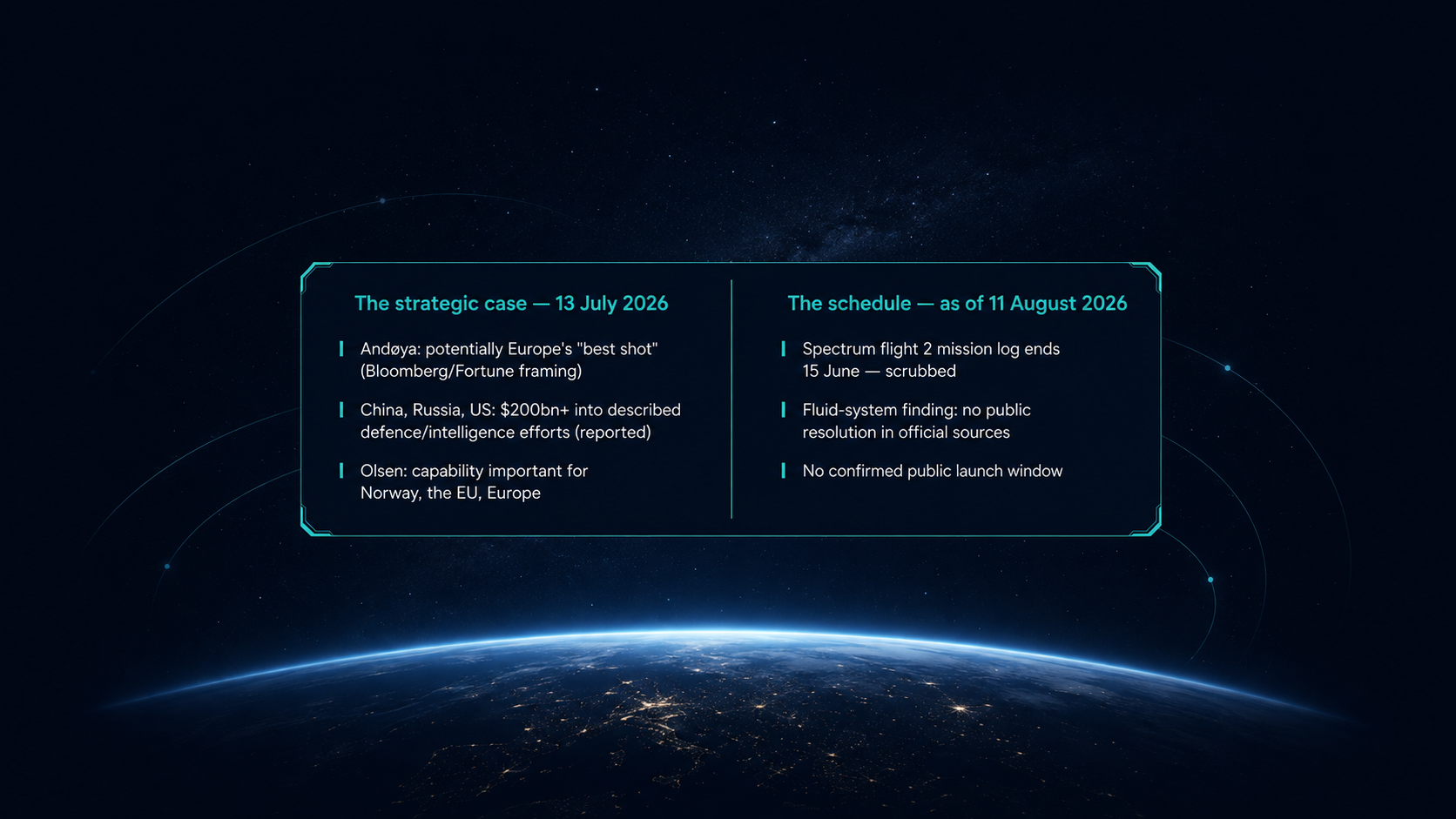
The strategic case for Andøya, made in July, set against Spectrum's actual schedule as of 11 August: no confirmed launch window and no public resolution of the fluid-system finding behind the 15 June scrub. Space Insights.
On 13 July, Bloomberg published a feature examining Europe's launch capacity in the context of what the feature frames as a contest to militarise space and reduce dependence on non-European launch providers, including SpaceX. It singles out Andøya Spaceport in northern Norway as what it calls, in hedged terms, potentially Europe's "best shot" at catching up in that contest. The Bloomberg original is paywalled: every claim carried here from the feature was read in Fortune's carriage of the same piece, published the same day.
The feature frames the wider contest in explicitly military language. This article does not adopt that framing. It confines itself to civil launch capacity and schedule, and it tests only the launch-capacity part of the feature's argument, not its military-autonomy framing, against Spectrum's current schedule.
The feature is four weeks old, and we are not carrying it as news. We are carrying it because of what it looks like when placed next to something we published three weeks after it.
What the reporting says
According to the feature, China, Russia and the United States are together putting more than $200 billion into the space-based defence and intelligence efforts it describes, and it separately notes that hundreds of satellites have been placed in orbit over the past half-decade, alongside systems testing and the deployment of satellite inspectors. The feature's own wording for the funding figure is "more than $200 billion into such efforts." The feature does not state with the same precision that the $200 billion figure itself covers the same five-year period as the satellite count, so this article treats the $200 billion figure and the half-decade satellite count as two separate observations from the feature rather than combining them into a single "$200bn over five years" claim. Both should be read as the scale of an argument rather than as an audited total. This article does not reproduce the feature's characterisation of specific weapons activity, and describes no operational capability. These are the feature's characterisations of Chinese, Russian and United States activity, not those states' own published descriptions of their programmes.
Against that, the feature presents Andøya as the European site that may have the best prospect of changing that position, and frames it as a route away from dependence on non-European launch providers. It attaches no timetable to the assessment.
Ketil Olsen, chief executive of Andøya Space and formerly a Norwegian vice admiral, is quoted directly on the stakes. Launching satellites into orbit, he says, "is a capability that is important for Norway, for the EU, for Europe" (per Fortune's carriage of the feature, 13 July 2026).
The concrete example the feature reaches for is Spectrum's inaugural orbital test flight from Andøya, which ended shortly after lift-off.
Space Insights editorial read: the same programme, three weeks later
That example is where the July framing and our own August reporting have to be read together, because the inaugural flight is not the current state of the programme.
On 5 August we published a review of where Spectrum's second flight actually stood, built from Isar Aerospace's own mission updates, ESA's Boost! pages and Andøya's published material. The finding was narrow and documented: the company's mission log for the second flight ended on 15 June, scrubbed, with a fluid-system anomaly under analysis. As of 4 August, no newer public launch window appeared on any of the official pages we reviewed. Third-party launch trackers carried August projections that were inconsistent with each other and that the company had not confirmed.
We re-checked that position on 11 August. It has not changed. Isar Aerospace's mission updates log still ends on 15 June, with the company standing down from that attempt while it isolated the root cause of off-nominal fluid-system behaviour. ESA's Boost! page still carries the 15 June window and is still marked as updated on 14 June. No launch window later than 15 June appears on the Isar, ESA or Andøya pages reviewed, and no public resolution of the fluid-system finding is visible in those official sources. Third-party trackers continue to carry inconsistent, unconfirmed projections for a launch window later in August; none has been confirmed by the company, and this article does not repeat specific tracker-projected dates that we cannot verify against an archived snapshot.
So the position, as of 11 August, is this. The strategic case identifies a site. The site's anchor vehicle has flown once without reaching orbit, and its second flight has no confirmed public window and no public resolution of the fluid-system finding visible in the official sources reviewed.
Both of those statements are accurate. Neither cancels the other. But they are measured in different units, and that is the point worth taking away.
Placing the July feature next to our own August schedule finding is a Space Insights editorial reading. Neither the feature nor Isar Aerospace, ESA or Andøya Space draws this comparison. The source path runs from Fortune's carriage of the 13 July Bloomberg feature on one side to Space Insights' own W32 analysis of 5 August on the other, itself built from Isar Aerospace's mission updates, ESA's Boost! page and Andøya Space's published material.
Why the unit mismatch matters
Arguments about sovereign access to space are conducted in the language of capability: sites, latitudes, infrastructure, industrial base, strategic position. On Andøya Space's own account, all of those characteristics are real. Andøya Space's own published material places the spaceport at 69°N on the Norwegian coast, describes it as free from significant air and maritime traffic, and gives it access to polar and sun-synchronous low Earth orbits from the one site. Those characteristics, on the site operator's own account, give Andøya a distinct position in Europe's emerging launch-site landscape; this article does not assess how that position compares with other European sites and launcher programmes, including Esrange, or the wider European launcher-capacity questions European officials have themselves raised.
Capability, though, is a statement about what is possible. Access is a statement about what is scheduled. For a planner assessing future European access, strategic location ultimately has to translate into qualified vehicles, confirmed missions and repeatable launch windows.
This is not a criticism of Isar Aerospace's engineering, and nothing here should be read as one. First-generation launch vehicles take the time they take, anomalies are found by looking for them, and a company that scrubs rather than flies through an unresolved fluid-system issue is behaving exactly as it should. The observation is about the debate, not the debugging.
It does suggest which number is worth watching. Investment announcements, site assessments and strategic framing are likely to keep arriving: Isar Aerospace announced a €270 million Series D on 9 June, per the company's own release, and the July feature followed a month after that. The measurable quantity is a different one. It is confirmed windows, then flights, then cadence. Until that series starts, the strategic case remains a well-founded argument about potential.
What we are not saying
We are not saying Andøya is not a strategically valuable site. The reporting's assessment on that point is well founded and we have no basis to dispute it; the site characteristics cited here are Andøya Space's own published account.
We are not saying Spectrum's second flight has failed, been cancelled, or slipped to any particular date. We are saying that as of 11 August, no confirmed public window and no public resolution of the fluid-system finding was visible on the official pages we reviewed. That may change at any time, including between this article's completion and its publication.
We are not asserting that Europe is behind China, Russia or the United States in orbital capability. That is the July feature's claim and we attribute it as such; assessing it would require a body of evidence this article does not carry.
We do not adopt the feature's own vocabulary for the military-autonomy contest it describes, including its framing of Andøya's "best shot" claim within that contest. Those terms appear here only attributed to the feature, not as this article's own characterisation.
We are not describing, and have not examined, any defence capability, system or deployment. Andøya Space's defence activities are outside the scope of this piece, which concerns civil launch capacity and schedule.
We are not reporting specific third-party tracker dates as confirmed or as historically accurate snapshots. Public trackers we reviewed no longer display the same projections cited in earlier drafts of this reporting, and without an archived record of those earlier listings we do not repeat them here as sourced dates.
Sources
- 1.Europe's Rocket Shortage Leaves it Defenseless in Space Wars — Bloomberg (paywalled; claims verified via Fortune's carriage of the same feature)
- 2.Rocket shortage leaves Europe defenseless in space wars — Fortune (carrying the Bloomberg feature; credited to Gerry Doyle, Alan Crawford and Bloomberg)
- 3.Three Scrubs, One Abort and No New Official Window: Where Spectrum's Second Flight Stands — Space Insights (W32, 5 August 2026)
- 4.Mission Updates Overview — Onward and Upward — Isar Aerospace
- 5.Spectrum's qualifying second launch — European Space Agency
- 6.The efficient way to space — Andøya Spaceport — Andøya Space
- 7.Isar Aerospace secures EUR 270m to provide sovereign space capabilities globally — Isar Aerospace
Get briefings like this every Friday.
Subscribe