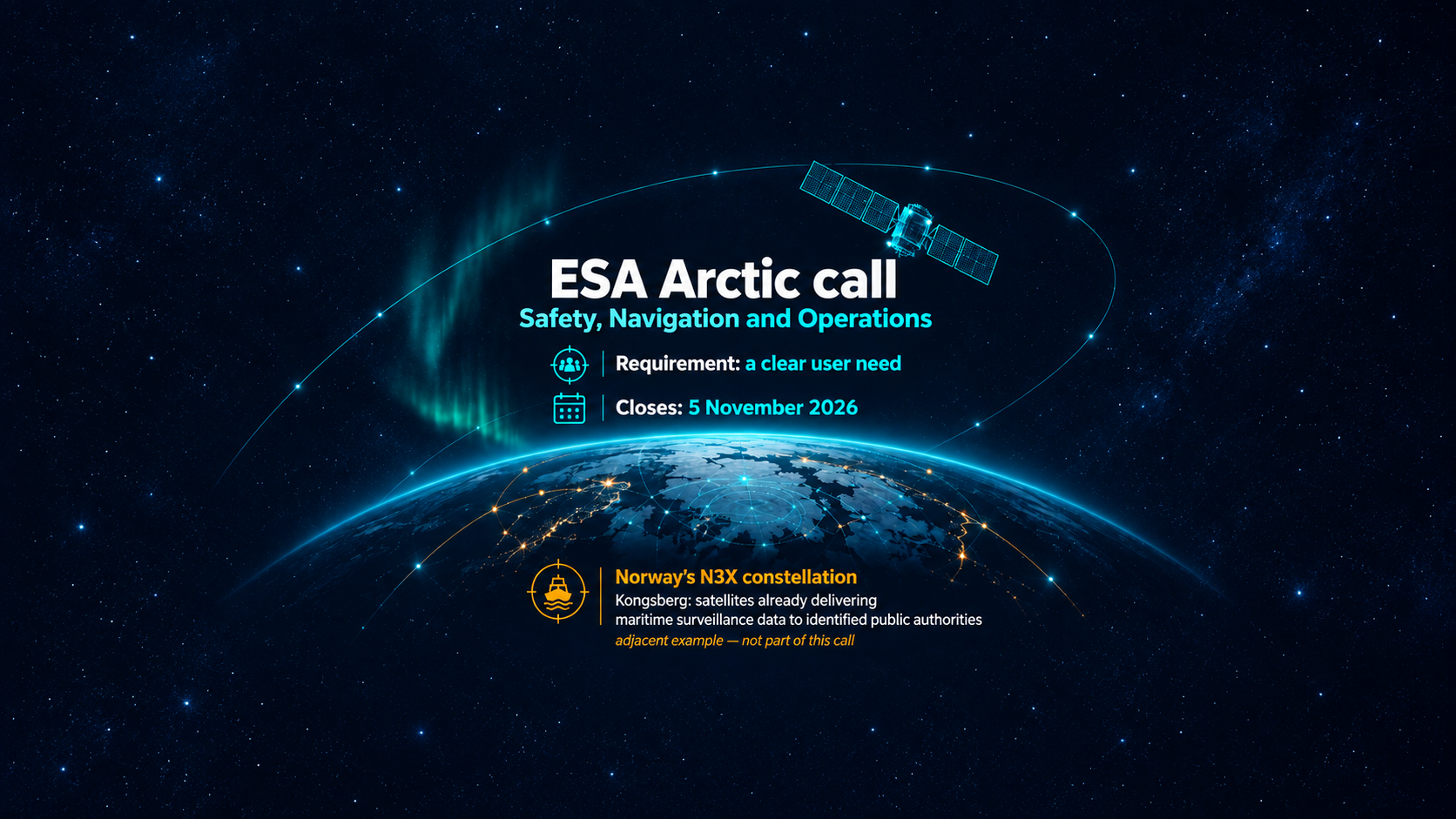
The call's own requirement is a clear user need, and it closes on 5 November 2026. Norway's N3X constellation sits below it as an adjacent example rather than part of the call: Kongsberg already delivers maritime surveillance data to identified public authorities. Space Insights.
ESA's Arctic safety, navigation and operations call opened on 5 September and closes on 5 November 2026. It supports proof-of-concept studies and pilot projects using space capabilities to address operational needs in the region. The requirement that gives the call its commercial direction is a clear user need: applicants must identify a problem experienced by an organisation that could use the proposed service.
For a company developing an Arctic application, that requirement changes the starting point of the proposal. A port authority's routing decision, a fisheries operator's exposure to ice or a search-and-rescue team's communications requirement gives a service a setting in which its usefulness can be tested. The satellite capability becomes part of that operational case.
Start with the decision the service supports
The call names ice monitoring, route optimisation, search and rescue, situational awareness and overall operational safety among its priorities. Potential users include public authorities, port and coastal authorities, fisheries and aquaculture operators, and environmental service providers.
Our reading is that these categories offer a practical way to organise a demonstration. A routing service, for example, could be assessed against a specific operator's decision cycle: when information is needed, who receives it and how it affects a route. Those are proposed evaluation questions. The call itself requires a clear user need and leaves applicants to develop their solution.
A useful distinction for that work is between producing an observation and delivering a service. An observation describes a condition; a service makes that information usable within an organisation's decisions. The same observation can have different requirements for timeliness, presentation and continuity depending on the user. A demonstration can make those requirements explicit before a team commits to a larger deployment.
A maritime example already in operation
Norway's N3X constellation provides an adjacent example of a space service connected to identified users. In its 24 August announcement, Kongsberg said the three satellites launched in 2025 were already delivering maritime surveillance data to Norwegian authorities, including the Armed Forces, Coastal Administration, Directorate of Fisheries and Customs.
The satellites carry AIS receivers and passive radio-frequency sensors. Kongsberg describes their combined use in detecting vessels with limited or misleading identification broadcasts and identifying AIS spoofing. The company plans to add three satellites in early 2027, bringing the constellation to six and improving revisit rates.
The service has an identified chain of responsibility. Kongsberg's account assigns satellite platforms to Kongsberg NanoAvionics, ground services and operations to KSAT, and overall integration and secure data delivery to Kongsberg. It also describes commercial use and the provision of surplus data capacity to allied nations.
For the ESA call, the useful comparison is how a capability is connected to an operational user. N3X offers an example of that connection in maritime surveillance. Ice monitoring and search and rescue present their own requirements, so each proposed service needs its own demonstration of usefulness.
Where a partnership can add value
A space company and an operational partner bring different parts of that demonstration. The first can explain what its data or communications capability provides. The second can specify how the information fits an existing procedure and what would make the service useful enough to retain.
This suggests a partnership structure built around a defined decision: a user, the relevant space capability, the means of delivering the information and an agreed way to evaluate the result. For a navigation application, the evaluation might concern the availability of information at the point a route is chosen. For a monitoring service, it might concern whether a notification reaches the person responsible for responding. These are possible approaches to proposal design, rather than additional ESA requirements.
That structure also gives the commercial discussion something concrete to address. After a pilot, the parties can assess which service functions proved useful, what support they required and which organisation would take responsibility for continuing them.
The application route
Proposals go through ESA's Activity Pitch Questionnaire. The call states co-funding of 50 to 80 per cent, depending on SME status and Member State approval, and encourages contact with the relevant national delegation. Denmark's pre-authorisation is subject to specified conditions.
The immediate opportunity is therefore to develop an operational case alongside the funding application. The next useful evidence will be the user commitments and measurable service outcomes that emerge from that process. Those details would show how an Arctic space capability is being translated into something an organisation can use repeatedly.
Get briefings like this every Friday.
Subscribe