ESA Director General Josef Aschbacher framed European space autonomy as a choice of agency in May 2026. Space Insights.
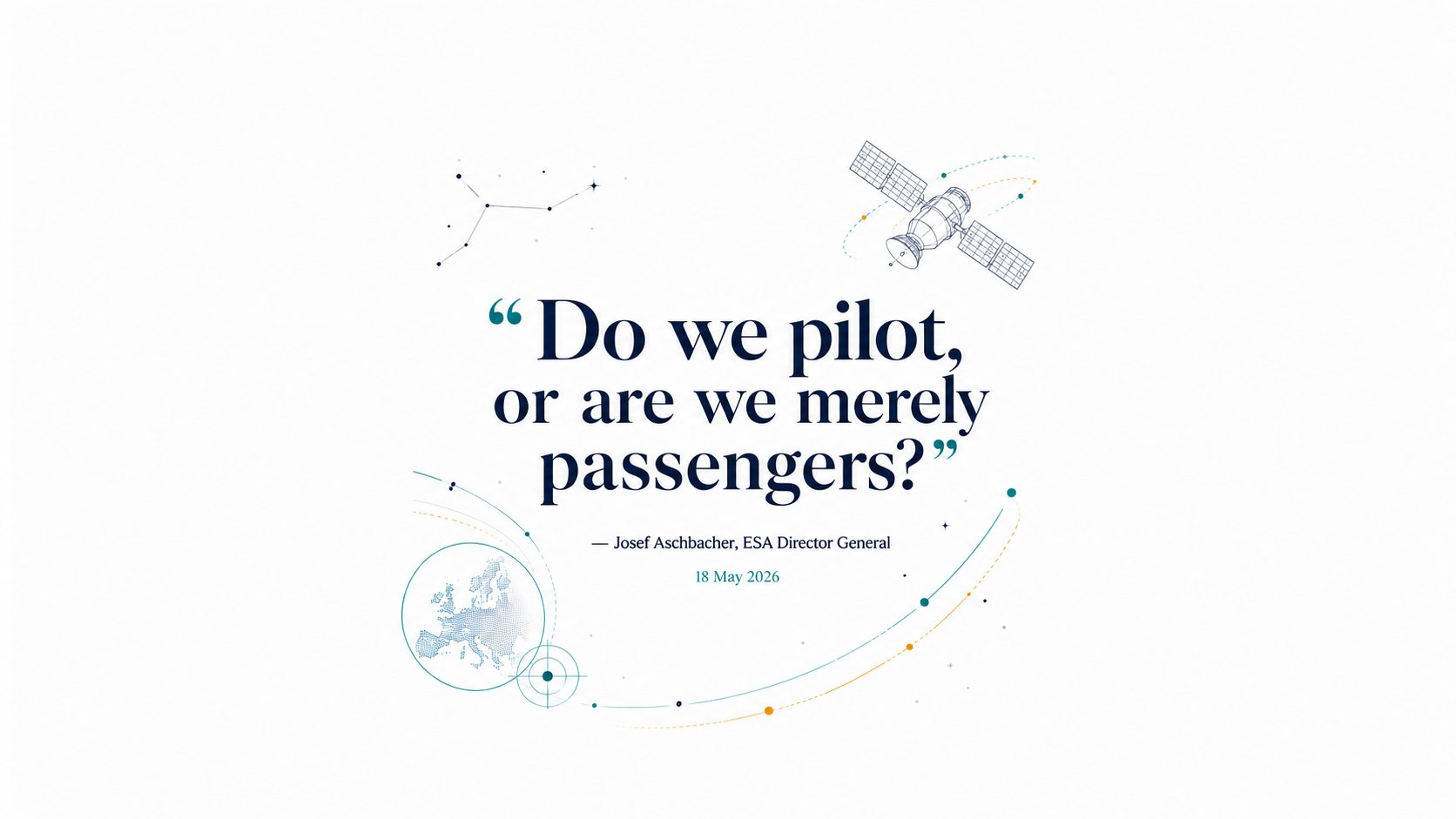
ESA Director General Josef Aschbacher made a public call for European decision-makers to accelerate strategic space autonomy, asking: "Do we pilot, or are we merely passengers?" The primary source is Aschbacher's 18 May 2026 LinkedIn Pulse article; Space.com reported the argument on 24 June 2026. The November 2025 ESA Ministerial Council in Bremen agreed a €22.3 billion budget envelope for 2026 to 2028 — the financial context within which Aschbacher's call for autonomy is grounded. His LinkedIn Pulse article identifies recent changes to the Artemis architecture, the Gateway pause, and the cancellation of Mars Sample Return as the context that makes the argument urgent; these are Aschbacher's framings of US-side programme moves, as stated in his LinkedIn Pulse article and covered by Space.com on 24 June.
What Aschbacher said and what he anchored it to
The framing is precise in its implication: it positions European participation in space exploration as a question of agency rather than presence. The pilot-or-passenger contrast is the editorially most useful entry point because it forces the institutional question: under what conditions does European hardware, expertise and budget translate into decision-making control, rather than contribution to another party's programme? Being present on a US-led programme — as a contributor whose hardware is paused or redirected at another party's discretion — is the model the "passenger" framing implicitly contrasts with.
The November 2025 ESA Ministerial Council in Bremen agreed a €22.3 billion budget envelope for 2026 to 2028. That envelope provides the capital base to make the autonomy case operational rather than rhetorical. European space institutions have the resources; the statement is a call to direct those resources toward programmes and partnerships over which Europe exercises decision-making control.
The statement does not characterise the US partnership as ended. Space.com frames this as eroding confidence; Aschbacher's own wording is that Europe has become too exposed to decisions beyond its control — a formulation that acknowledges a change in the agency's posture without claiming the partnership has broken down.
The context the statement is responding to
The November 2025 Ministerial set the budget envelope but did not resolve the architecture question: what European space exploration actually looks like if the Artemis programme, as originally structured, no longer provides the destination.
Aschbacher's LinkedIn Pulse article names three context-setting moves: recent changes to the Artemis architecture, the Gateway pause, and the cancellation of Mars Sample Return. These are Aschbacher's framings of the US-side moves as stated in his LinkedIn Pulse article and covered by Space.com; the formal US-government terminology and the technical status of each programme may differ from the characterisations offered there.
As set out in this week's Gateway analysis (Signal 2, per ESA's 17 June briefing coverage), ESA's three contributions — I-Hab, Lunar View, and Lunar Link — are in a programme that paused without warning, each at a different stage of maturity. European member states subscribed to those programmes at Ministerial Councils; the public sources reviewed do not establish the consultation process for the US-side pause decision. HALO's primary structure had arrived in Arizona for Northrop Grumman final outfitting before the 2026 architecture shift.
That sequence — European budget commitments followed by a US programme change without a public European role in that decision — is the structural condition the statement responds to. Aschbacher is not describing a hypothetical future risk; he is describing an exposure his agency has experienced.
What the statement requires of European institutions
A call for autonomy without a specific programme proposal is a direction, not a decision. The article makes explicit a shift in vocabulary from "Europe contributes to international programmes" toward "Europe must be able to lead its own" — a shift the article positions; Councils and Ministerials determine whether that vocabulary becomes commitment.
The December 2026 Interim Ministerial Council in Italy is where ESA member states will discuss the European exploration roadmap. That Ministerial — announced at the 347th ESA Council in June 2026 — is the venue at which the direction Aschbacher is calling for would be translated into subscribed programme budgets, if member states agree. Whether and on what terms that translation happens is not predetermined by this statement.
The timing is editorially useful because the six months between this statement and December are the positioning window: for national delegations negotiating their programme subscriptions, for industrial primes shaping proposals for the post-Gateway deep-space architecture, and for ESA's own programme leadership deciding which capabilities to develop or preserve independently.
The €22.3 billion CM25 subscription envelope is the financial context for that conversation, not the guarantee. Member states subscribed to it for existing programme portfolios; directing any portion of it toward new autonomous European missions would require decisions at the December Ministerial that have not yet been made. When the "pilots vs passengers" choice becomes a concrete procurement or budget commitment — not just a vocabulary shift — is the operative stake question that the December Ministerial is positioned to answer.
Forward look
The watch items are straightforward. First: what the Interim Ministerial in December tables as Europe's exploration roadmap — whether it includes a standalone European deep-space programme, a revised Artemis contribution on different terms, or a combination. Second: whether any specific programme proposal emerges from ESA's internal planning between now and December that operationalises the autonomy direction. Third: the fate of the three Gateway contributions — I-Hab, Lunar View, and Lunar Link — whose redirection destinations remain publicly unspecified.
Aschbacher's statement sets a direction. The institutions that act on it are the ESA Council, the member state delegations, and ultimately the Ministerial in December. The statement is the public framing for a negotiation that happens inside those institutions.
Space Insights cross-pipeline context
The W27 week produces three signals that sit at different institutional levels of the same underlying question. Signal 1 (OHB SE capital raise) is the industrial and capital-markets layer: European satellite manufacturing and launcher capacity receiving private-market capital in the same week a DG publicly called for strategic autonomy. Signal 2 (ESA Gateway next steps) is the hardware layer: ESA committing to continue I-Hab through critical design review despite the Gateway pause — a live demonstration of European hardware persisting through a US programme decision, which is precisely the institutional exposure Aschbacher's statement responds to.
This linkage is a Space Insights editorial reading connecting W27 Signals 1, 2, and 3; Aschbacher's LinkedIn Pulse article does not reference Gateway hardware or OHB's capital raise specifically.
The editorial read across the three signals is that the autonomy argument is being made at the political-leadership level (Signal 3) at the same moment it is being operationally tested at the hardware level (Signal 2) and capitalised at the industrial level (Signal 1). These three layers are not coordinated — they are independently generated signals that Space Insights reads as a convergent pattern for W27.
Related signals - **Signal 2 — ESA Gateway next steps:** the same week, ESA committed to continuing I-Hab until critical design review — a live demonstration of European hardware persisting through a US programme pause. *(cross-reference; not a load-bearing claim inside this article)* - **Signal 1 — OHB SE capital raise:** the industrial capacity dimension of European space autonomy — a planned capital increase of up to €510.7 million for satellite manufacturing and launcher development, in the same week the DG made the autonomy argument. *(cross-reference; not a load-bearing claim inside this article)*
Sources
- 1.Are we pilots or are we passengers? (LinkedIn Pulse) — Josef Aschbacher / ESA
- 2.ESA Chief Calls for Greater European Space Autonomy as Trust in US Partnership Erodes — Space.com
- 3.ESA Member States commit to largest contributions at Ministerial (CM25) — ESA
- 4.NASA — unveils initiatives to achieve America's national space policy (Gateway pause, 24 March 2026) — NASA
Get briefings like this every Friday.
Subscribe