Space Insights editorial illustration; AI-assisted.
An ESA–ENTSO-E event connected space applications with specific grid functions and existing operator systems, ahead of a call planned for November.
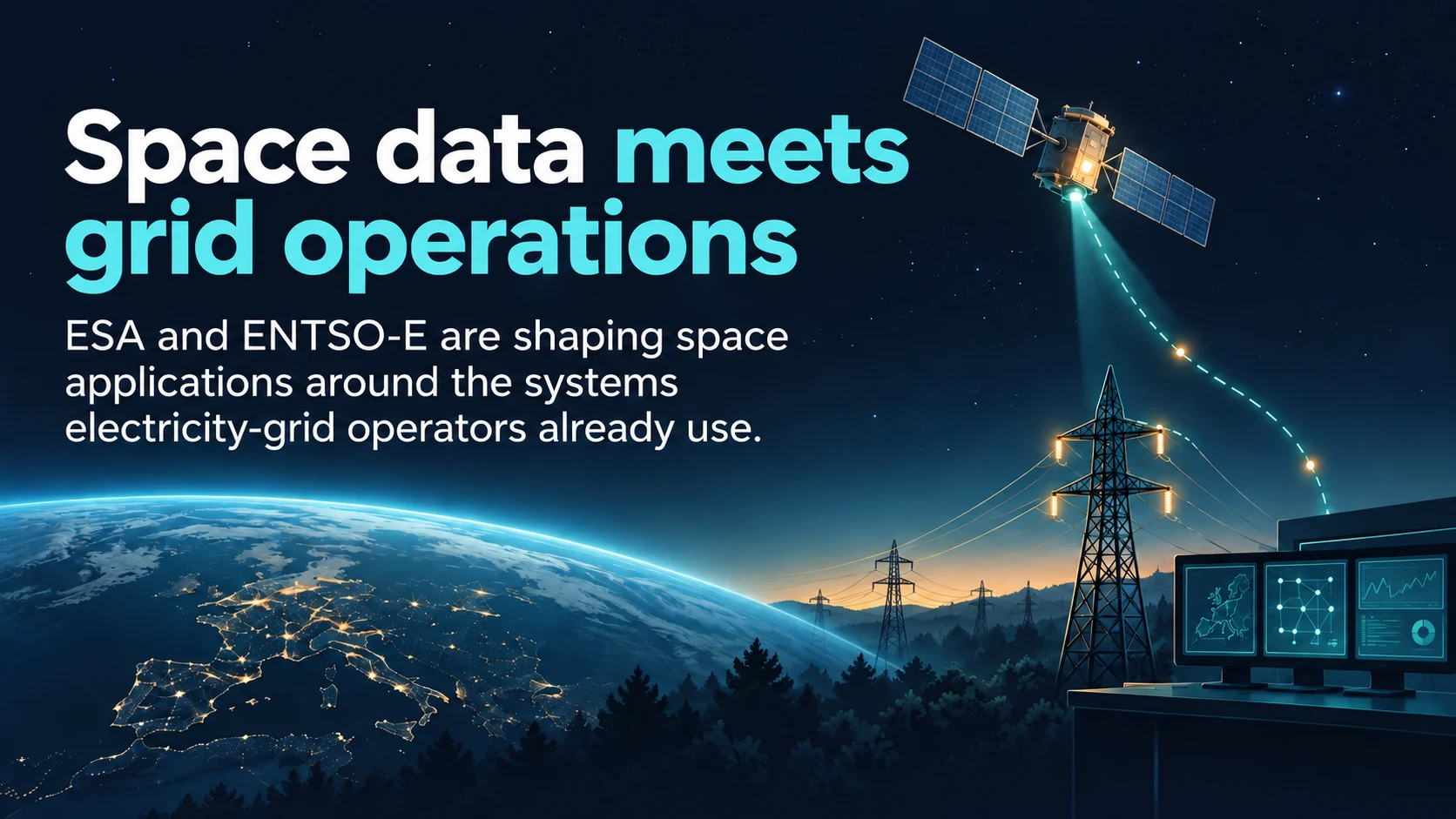
Space services being developed for European electricity grids have a concrete destination: the systems transmission operators already use. At a 16 September 2026 event organised by the European Space Agency (ESA), through its Business Applications and Space Solutions programme, and the European Network of Transmission System Operators for Electricity (ENTSO-E), the stated ambition was direct integration into geoinformation, asset-management and operational systems.
ESA's subsequent account says the Space-Enabled Solutions for Resilient Grids call is planned to open in November, when 16 operational use cases will be detailed. For companies preparing potential projects, the event offers an initial product brief: identify the grid function a service would support and how its output could enter the operator's work. Final application conditions will come with the call.
Four challenges, different product purposes
The published agenda gives that brief specificity. It assigned vegetation and right-of-way monitoring to 50Hertz, rapid damage assessment for critical components to IPTO, cyber-resilient time synchronisation to Elia Transmission Belgium, and continuity of critical communications services to Swissgrid. These were announced discussion subjects, rather than a list of awarded projects or deployed products.
The contrast matters for product design. Vegetation monitoring concerns an observation about the condition of a corridor. Time synchronisation and communications continuity address different operational functions. Grouping them under grid resilience establishes a common purpose, but a useful demonstration would need to reflect the particular function being discussed. A monitoring result and a continuity service cannot be judged solely by the same question about image quality.
ESA's event report organises the wider work around situational awareness and operational resilience. It also records ENTSO-E's intention that space services complement existing terrestrial solutions. The development task is therefore to explain how a proposed space contribution fits alongside an operator's existing provision. The published examples offer starting points for that discussion without establishing the eventual scope of each funded project.
Where an observation enters an operator's work
The most specific direction in the event report concerns the destination systems. ENTSO-E's Space4TSOs task-force leader called for products and services that integrate into geoinformation and asset-management systems, alongside energy management systems (EMS) and supervisory control and data acquisition (SCADA). Geographic information systems (GIS) form one part of that destination. This is an attributed statement of the initiative's direction; the final call will establish its application requirements.
The stated integration ambition gives developers a practical starting point for product discussions. A developer can organise that discussion around three connected questions: where an output enters the workflow, who acts on it, and what evidence would establish that it is useful. Naming a user organisation is only the beginning of that work. The relevant operational function gives the demonstration a setting in which its contribution can be examined.
For example, a vegetation-monitoring team could explore with an operator whether an observation can be associated with an existing asset record and made useful to a maintenance process. That would test a proposed connection between the observation and a decision. The trial and its acceptance criteria would need to be agreed with that operator; this is an illustrative design question, not a description of 50Hertz's internal systems.
For a communications-continuity concept, the discussion would start from a different service purpose and the role it could play alongside terrestrial provision. The contrast helps explain why a single generic demonstration of space capability is unlikely to answer every use case. The specific operating task gives partners a basis for deciding what their demonstration needs to establish.
Choosing partners around the integration task
That approach has an implication for consortium preparation. A team able to produce a space-derived output may also need a partner who understands the relevant operator system and a user able to assess the proposed contribution. The event's emphasis on matchmaking supports beginning those conversations while the use cases are being developed. It does not yet determine a required consortium structure.
There is also a narrower interpretation of the event: the systems named may express ambition before the detailed call defines what a project must demonstrate. Participation in matchmaking does not establish a purchasing commitment or access to production systems. A technically credible pilot may remain a limited demonstration. Keeping that distinction visible allows preparation to advance without treating an expressed need as an awarded customer relationship.
November will make the preparation more specific
The next document to examine is the planned November call, particularly its full use-case descriptions and participation conditions. Those details will show how the event's integration ambition translates into the proposed work and what applicants must establish. They will also provide the basis for eligibility and funding decisions that the event account alone cannot settle.
After that, named trials, defined user commitments and reported integration outcomes would provide stronger evidence of progress towards operational use. The useful question will be whether a service's contribution is demonstrated within the relevant grid function. The September event has made that question more specific by naming both operational challenges and the systems into which solutions are intended to fit.
Sources
- Sparking a resilient European energy grid with space solutions, European Space Agency, 17 September 2026, updated 18 September.
- Powering a Sustainable Future: Energy, Space & Innovation, European Space Agency, 14 July 2026, updated 15 September; agenda for 16 September.
Get briefings like this every Friday.
Subscribe