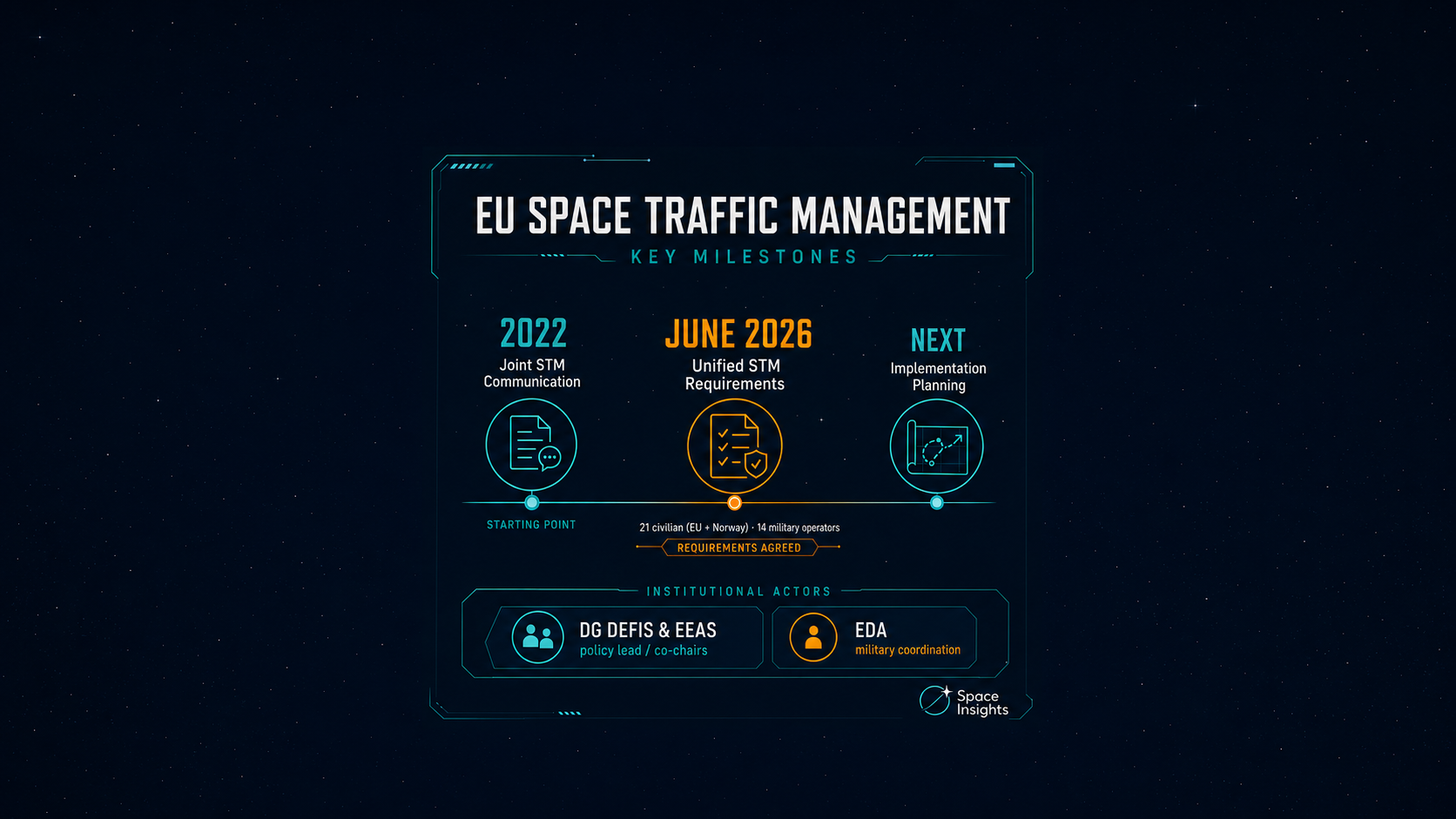
35 EU and Norwegian civilian and military operators completed Action 1 of the Joint STM Communication in June 2026. Space Insights.
Twenty-one EU and Norwegian civilian space operators and fourteen EU military operators — with military coordination provided by the European Defence Agency — agreed a unified set of Space Traffic Management requirements in mid-June 2026. DG DEFIS and the EEAS aggregated the requirements of both communities and compiled them into the joint report for implementation planning. The agreement completes Action 1 of the EU's Joint STM Communication, the framework published in 2022 by the European Commission and the High Representative for Foreign Affairs and Security Policy.
What the STM requirements cover
The public Executive Summary groups the requirements around principles, governance, operations, communication and data-sharing, space safety, complementary measures, and common operational scenarios. Governance defines the institutional roles and authority structures for STM decision-making across civilian and military actors. Operations requirements include assessment and manoeuvre protocols and autonomous collision-avoidance capabilities. Communication and data-sharing specifies what tracking data operators must share, with whom, and under what conditions. Space safety and complementary measures address the broader resilience requirements, with common operational scenarios providing the practical contexts against which the framework is tested.
The public Executive Summary is explicit that the requirements do not prescribe which measures should eventually become law, mandatory rules or voluntary measures — that determination is for future regulatory and legislative processes.
Covering this range of requirements in a single agreed document — and covering them across both civilian and military operators — is the significant achievement. Civilian and military space operations in the EU operate under different governance structures and accountability frameworks; bringing 35 operators across both domains to a common technical position required the EDA to coordinate the military side alongside the civilian process. The collaboration ran from May 2024 to April 2026, with civilian operators contributing through a dedicated expert group and the EDA soliciting military operator views separately.
The full requirements document is available to the operator community; a public Executive Summary was released separately. DG DEFIS and the EEAS aggregating the requirements and compiling them into the joint report is the handoff from operator-level agreement to Commission-level implementation planning.
Why this milestone matters for STM governance
The Joint STM Communication of 2022 set out a concrete EU approach to space traffic management and identified a set of actions. Action 1 was to assess the STM civil and defence requirements for the EU — which this agreement now completes. This article does not reference the EU Space Act directly, and the EC source does not reference it either; nonetheless, the requirements provide the technical grounding that future STM regulation — including any provisions developed under the EU Space Act proposal, currently under co-legislative procedure and not yet adopted, or parallel STM governance frameworks — will need to draw on. They do not constitute a finalised regulatory standard or confirm that any specific compliance requirements are imminent.
Without operator-level technical agreement, any regulatory standard risks being either unimplementable or irrelevant. The 35-operator agreement resolves that prerequisite: DG DEFIS and the EEAS now have a technically grounded set of requirements to inform the next stages of their work.
The implementation planning process that follows is not a short one. Regulatory translation, stakeholder consultation, legislative process and eventual adoption take time in the EU institutional framework. The June 2026 milestone does not mean STM regulation is imminent; it means the process now has a technical foundation it previously lacked.
Space Insights cross-pipeline context
Current EU Space Act proposals — under co-legislative procedure — would establish a political framework for Space Traffic Management; the requirements agreed in June 2026 provide the technical layer that such a framework would need to draw on. The connection between the two is a Space Insights editorial framing; the EC source does not reference the EU Space Act.
The civilian-military interface
The military operator participation — 14 operators, EDA-coordinated — deserves specific attention. Space Traffic Management is often discussed as a civilian domain, but military space operations occupy the same orbital environment. A civilian STM framework that does not accommodate military operations is incomplete; a military-only framework is insufficient for the mixed-use orbital environment that LEO and MEO have become.
The joint civilian-military requirements document navigates this by treating both operator sets as participants in the same STM framework while acknowledging their different governance contexts. The EDA's coordination role makes that possible: it provides the institutional bridge between civilian space governance (DG DEFIS, EUSPA) and military space operations (member state defence ministries, EEAS).
The two communities also face different forward implications. Civilian operators — the 21 EU and Norwegian participants — are the group most likely to watch whether these requirements later inform compliance, licensing or procurement frameworks; they sit closest to the consequences if such frameworks emerge. Military operators contributed the shared technical framework through EDA coordination, but their accountability path remains within member state defence governance rather than EU civil licensing. For European civilian space operators planning their next 12 to 24 months of orbital operations and procurement cycles, the operative watch item is whether these requirements inform future licensing conditions or procurement standards; this document is the technical foundation for that possible development, not a confirmed compliance requirement.
For European space operators managing real-time conjunction assessments with both civilian and military satellites in the same orbital shells, a unified STM framework is a practical operational requirement as much as a policy objective.
Forward look
The implementation planning is now with DG DEFIS and the EEAS. The questions that will define the pace and shape of that implementation include: how the governance requirements are translated into institutional roles without duplicating existing EU space governance structures; how the data-sharing requirements are reconciled with classification constraints on military tracking data; and how the operational scenario protocols interact with NATO space coordination frameworks.
The STM requirements agreement is a necessary step. It is not the last one.
Related signals - **Signal 3 — ESA DG autonomy:** the same week ESA's Director General called for Europe to be autonomous in space, 35 EU and Norwegian civilian and EU military operators agreed the technical requirements that would underpin Europe's own STM implementation — one political direction, one technical foundation. - **Signal 4 — Kongsberg NanoAvionics €122.5M Meridian contract:** a constellation expected to grow to at least 1,200 satellites is precisely the type of operational actor that future STM governance frameworks may need to govern.
Sources
- 1.EU Space Operators Complete Their Civilian and Military Requirements for Space Traffic Management — European Commission / DG DEFIS
- 2.EU Space Act — Space Traffic Management provisions — European Commission
- 3.EDA helps shape European approach to space traffic management — European Defence Agency (EDA)
Get briefings like this every Friday.
Subscribe