Europe's 48-to-one 2024 launch gap was an outlier low, not a fixed measure of where the continent stands today. Space Insights.
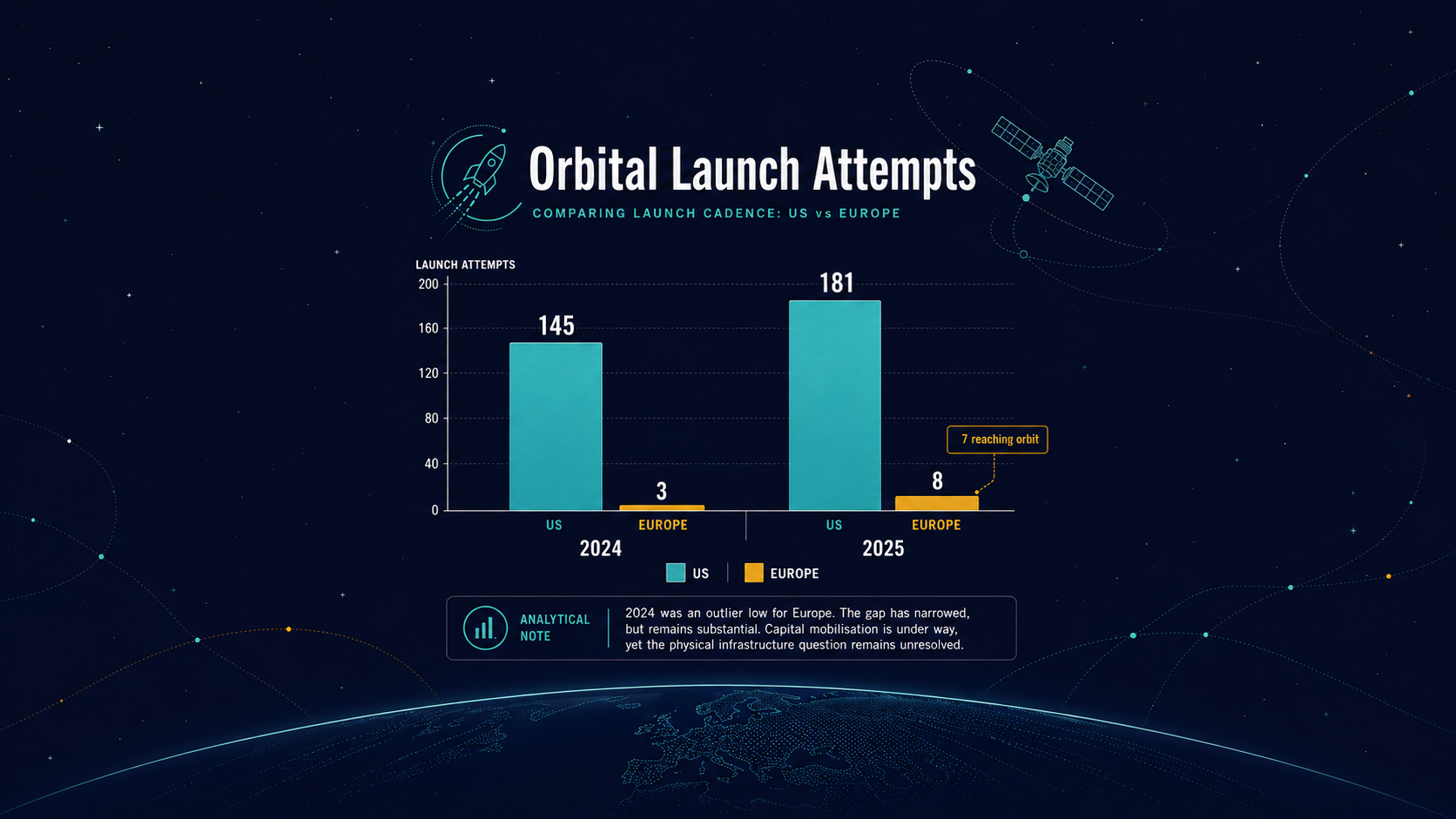
The number is stark enough that it deserves to be stated plainly before any analysis is applied to it. Under Jonathan McDowell's methodology, the United States recorded 145 orbital launch attempts in 2024. Europe recorded three. The ratio, approximately 48 to one, is not a projection or an estimate derived from industry models. It is the measured output of the two launch landscapes in a single calendar year, compiled in McDowell's 2024 space activity report. It is also, as the following section makes clear, a snapshot of an unusually weak year for Europe rather than a fixed, current gap.
Understanding what produced that ratio, what changed in 2025, and what is being done to close it, is necessary context for reading almost every other major development in the European space sector this week.
How the gap was created, and how it moved in 2025
Europe's 2024 launch deficit is the result of a sequence of intersecting setbacks rather than a single policy failure. The most significant is structural: the retirement of Ariane 5, Europe's long-serving heavy-lift workhorse, before Ariane 6 was ready to replace it. The gap between the final Ariane 5 flight and Ariane 6's first operational mission left Europe without autonomous access to geostationary orbit for a period that extended into the mid-2020s.
The loss of Soyuz access compounded the problem. Russia's invasion of Ukraine in February 2022 terminated European cooperation with Roscosmos, eliminating a medium-lift launcher that had been deployed for Galileo constellation builds and other institutional missions. European launch planners had used Soyuz as a capacity buffer when Ariane was committed or unavailable; that buffer disappeared overnight. In 2024, four Galileo satellites flew on two Falcon 9 missions during the transition to Ariane 6 and after the loss of Soyuz access. Galileo returned to Ariane 6 in December 2025.
McDowell's most recently completed full-year data shows the gap narrowed, though it remained large, in 2025: 181 US orbital launch attempts against eight European, of which 179 and seven respectively reached orbit or marginal orbit. The 48-to-one ratio from 2024 should be read as a historical low point for that specific year, not as the current or ongoing gap.
The infrastructure of an answer
The European response to the launch gap is real, multi-layered, and still some years from resolving the cadence problem at the scale that defence and institutional demand now requires.
Ariane 6 is flying and building cadence: in June 2026 it launched 36 Amazon Leo constellation satellites in a single mission. Arianespace has stated a target of between six and eight missions for 2026 overall; that figure is a stated target, not yet a demonstrated year's cadence. Five Vega-C launches are planned for 2026 under Avio's management as the programme transitions. These are meaningful additions, but they operate on a cadence still well below what the Bundeswehr's SATCOMBw Level 4 constellation or IRIS² will require when they enter their build phases.
The new-space launch cohort is advancing, with meaningful uncertainties on each front. Rocket Factory Augsburg (RFA), a subsidiary of OHB SE, says the first orbital flight of RFA ONE from SaxaVord Spaceport in Shetland is planned for summer 2026, subject to integration, testing, licensing and range readiness, following a first-stage hot-fire test incident in August 2024. If it flies successfully, it would potentially be the first vertical orbital launch from UK soil; that milestone has not yet occurred. Isar Aerospace has been working toward a second flight of its Spectrum rocket from Andøya Spaceport in Norway, after the first flight was terminated approximately 30 seconds post-liftoff in March 2025; the second qualification mission remains pending after several 2026 attempts were scrubbed or postponed for valve, range-safety, pressure-vessel and fluid-system issues, most recently in June 2026. PLD Space has raised more than €350 million and is targeting a first demonstration flight of its Miura 5 orbital launcher from Kourou in 2026; no fixed launch date has been publicly confirmed. None of these launches has been confirmed as successful at the time of writing.
Isar Aerospace's chief commercial officer Josef Wiedemann and other industry participants have argued that future sovereign constellations at the scale of SATCOMBw Level 4 or IRIS² could exceed currently available responsive-launch capacity in Europe. Public programme records do not yet provide a complete launch manifest against which that claim can be tested, though the general infrastructure requirements, ground facilities, range capacity, integration throughput and supply-chain depth, are well documented needs for any high-cadence sovereign launch programme.
The capital mobilisation and the infrastructure question
European governments and institutions have committed substantial capital toward closing the strategic gap, though not all of it is yet adopted or launch-specific spending. The European Commission has proposed a €131 billion defence-and-space window within the European Competitiveness Fund for the 2028 to 2034 Multiannual Financial Framework; the proposal is not yet an adopted budget, and is not allocated specifically to launch infrastructure. Germany has announced plans to invest €35 billion in military space capacity by 2030 under its defence ministry's space strategy; this is a broad capability investment plan, not a launch-infrastructure-specific budget or an already-allocated contract portfolio. ESA's ministerial council commitments, initially reported at €22.1 billion in November 2025, were finalised at €22.3 billion.
The question that the capital commitment does not automatically resolve is whether the physical launch infrastructure, the launch vehicles, the ground facilities, the qualified supply chains for high-cadence satellite production, can be built quickly enough to absorb the investment. Launch startups are pursuing alternative sites at different levels of commitment: PLD Space describes the Etlaq Spaceport in Oman as a second launch base; HyImpulse has signed a letter of intent to use the site; Latitude is targeting an experimental first flight there in late 2027. Public statements from the companies do not establish a single shared rationale for these moves; Space Insights presents them as parallel developments rather than a coordinated response to European infrastructure limits.
The global space economy is projected by industry forecasters to reach significant scale by 2035. The position that Europe occupies in that economy, as a principal, a partner, or a customer, will be substantially determined by whether the infrastructure being built now closes the cadence gap in the programme windows that matter.
Sources
- 1.2024 Orbital Launch Attempts by Country (citing Jonathan McDowell 2024 space activity report) — Payload Space
- 2.Two new satellites join the Galileo constellation — European Space Agency
- 3.Ariane 6 launches with more powerful boosters, a new record for Europe — European Space Agency
- 4.Media Archives — Rocket Factory Augsburg
- 5.News Ticker Overview - Isar Aerospace First Test Flight — Isar Aerospace
- 6.PLD Space secures €180 million Series C to accelerate global access to space — PLD Space
- 7.Statement by the President: next long-term EU budget — European Commission
- 8.ESA Member States commit to largest contributions at Ministerial — European Space Agency
- 9.Germany vows to protect its interests in growing global space race — Reuters
- 10.News & Media — Etlaq Spaceport
- 11.Is Europe Moving Fast Enough to Close its Space Defense Gaps — Via Satellite
- 12.Eurospace Europe Space Industry Sales Increased 23 Percent in 2025 — Space Intel Report
Get briefings like this every Friday.
Subscribe