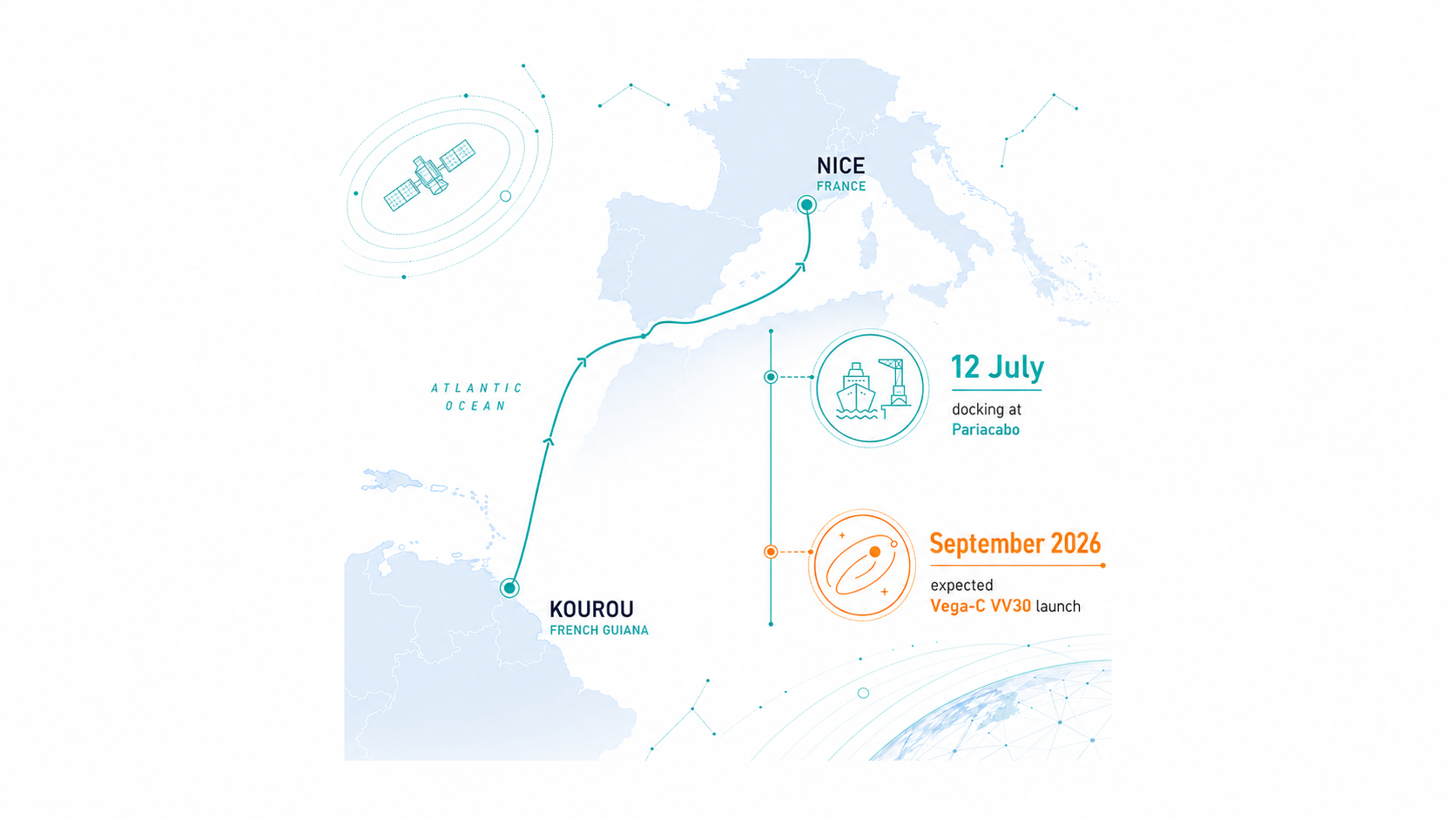
FLEX and Sentinel-3C docked at Pariacabo, Kourou, on 12 July 2026, ahead of a joint Vega-C VV30 launch ESA expects in September 2026. Space Insights.
FLEX, the European Space Agency's eighth Earth Explorer mission, and the Copernicus Sentinel-3C satellite docked at Pariacabo, the port of Kourou, French Guiana, on 12 July 2026, after a two week sea voyage from Nice. Following final preparations at Thales Alenia Space's facility in Cannes, the satellites crossed the Mediterranean and the Atlantic before docking at the port; their transport containers were offloaded and moved to Europe's Spaceport itself by road the following day.
What FLEX and Sentinel-3C actually do
FLEX (Fluorescence Explorer) is designed around a single instrument, the Fluorescence Imaging Spectrometer, which detects the faint fluorescence that plants emit as a by-product of photosynthesis. ESA states the mission will deliver the first global maps of vegetation fluorescence, at a resolution of 300 m by 300 m, to assess photosynthetic activity, vegetation health and early signs of plant stress. Sentinel-3C is the third satellite in the Sentinel-3 series, part of the EU's Copernicus programme developed by ESA, carrying instruments that monitor Earth's oceans, land, ice and atmosphere — including clouds, aerosols and water vapour — supporting ocean and weather forecasting and land-surface monitoring.
The two missions are being launched together on Vega-C flight VV30, sharing a single fairing, though they serve distinct purposes: FLEX is a dedicated science mission, while Sentinel-3C extends an operational Copernicus data series that European institutions and downstream service providers already draw on. Sentinel-3C will be injected into orbit first, positioned above FLEX within the fairing.
Arrival and the pre-launch campaign
The satellites travelled from Nice to Kourou by sea rather than by air, along a route ESA's own materials confirm but do not explain; any account of why sea transport was chosen over air freight for payloads of this kind is this article's own contextual inference, not a claim made in ESA's materials. Once at the Spaceport, FLEX and Sentinel-3C now enter a pre-launch campaign, which ESA's own materials describe as lasting approximately eight to nine weeks, comprising health checks, fuelling and final preparations before encapsulation within the Vega-C fairing. Liftoff, on flight VV30, is expected in September 2026; ESA has not yet confirmed a specific date.
What this means for Copernicus continuity and the Earth Explorer programme
Sentinel-3C's arrival matters chiefly as continuity: the Sentinel-3 series underpins operational products used across ocean monitoring, land surface temperature and other Copernicus applications, supporting an established European downstream ecosystem built around Copernicus services. FLEX's arrival matters differently — it is a scientific first, extending ESA's Earth Explorer line into a measurement domain, global vegetation fluorescence, not previously mapped systematically at this resolution, with direct relevance to climate monitoring communities.
Space Insights editorial reading: the mission's vegetation-health measurements may also support future agricultural research and applications, though this arrival announcement does not define an operational agricultural service.
What remains uncertain
ESA has stated an expected September 2026 window for the joint launch, flight VV30, but has not yet published a specific date. Standard pre-launch campaigns of this kind can shift by days or weeks depending on the outcome of health checks and integration testing; no schedule risk has been flagged publicly as of this writing. The immediate operational question is whether the VV30 campaign remains on its expected September schedule.
What to watch
ESA's own Vega-C launch manifest and any updated VV30 campaign milestones over the coming weeks will confirm whether the expected September window holds.
Related signals - ESA's 2026 Space Economy Report, covering the broader European space economy and the downstream ecosystem built around Copernicus and other institutional data (Space Insights, this week)
Sources
- 1.FLEX and Sentinel-3C arrive at Europe's Spaceport — European Space Agency
- 2.FLEX and Sentinel-3C bound for launch site — European Space Agency
- 3.FLEX (Earth Explorer 8) — European Space Agency
- 4.Call for interest: media programme for FLEX and Copernicus Sentinel-3C launch at Europe's Spaceport — European Space Agency
Get briefings like this every Friday.
Subscribe