EUSPA's Executive Director Rodrigo da Costa appeared before the European Parliament's Security and Defence Committee on 15 July 2026, as a standalone founding regulation for the agency moves through the legislative process. Space Insights.
On 15 July 2026, the European Parliament's Committee on Security and Defence (SEDE) held an exchange of views titled "The challenges of Space for EU Security and Defence: the future role of EU Agency for the Space Programme (EUSPA)," with Rodrigo da Costa, EUSPA's Executive Director. The European Parliament's own official draft agenda for the session (SEDE-OJ-2026-07-15-1) confirms the item, and recordings of the meeting are available. No adopted minutes or formal committee conclusion on EUSPA's mandate had been published at the time of writing, so this article assesses the session's existence and institutional context rather than a negotiated outcome.
What EUSPA already does in security and defence
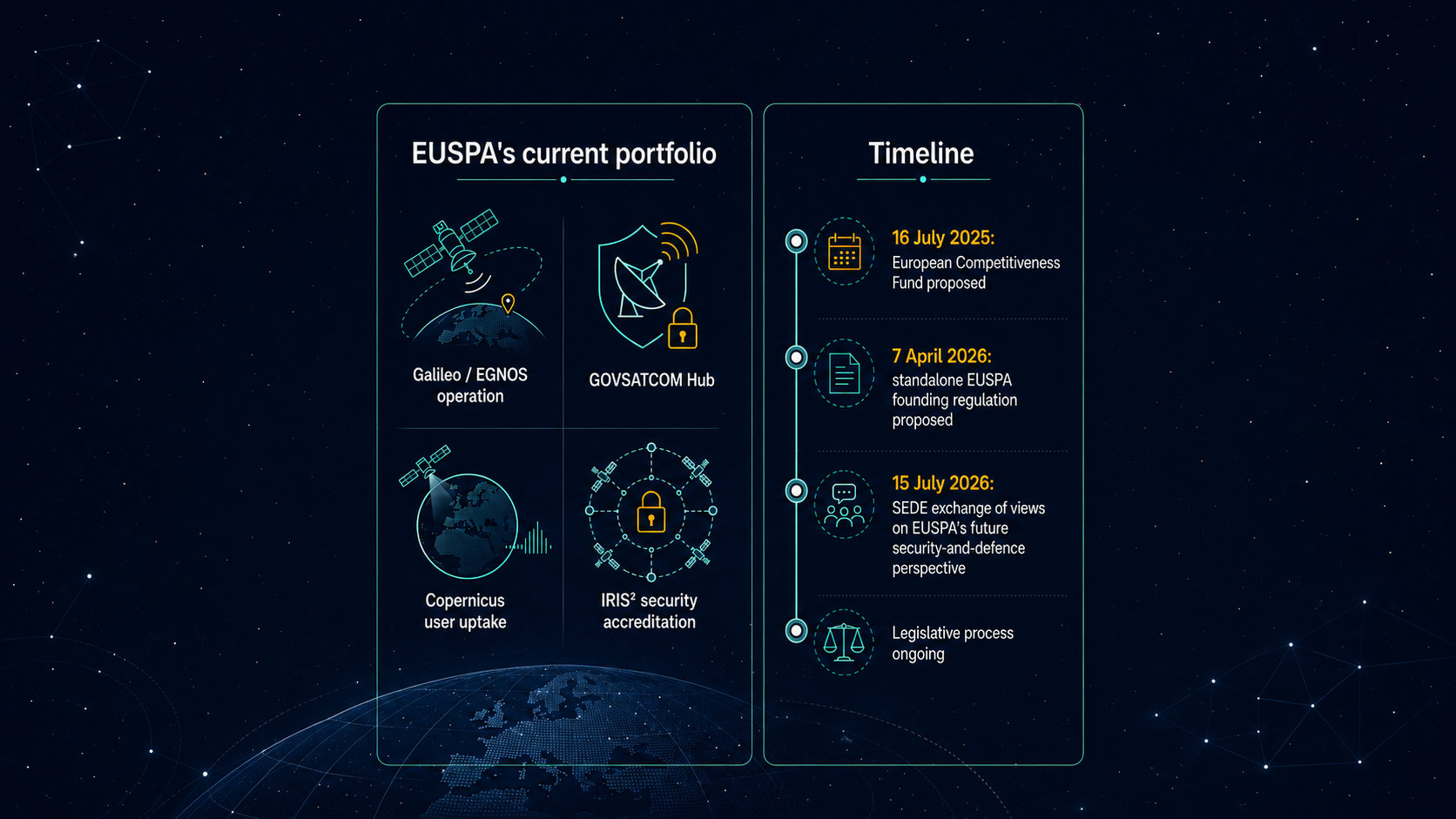
EUSPA operates Galileo and EGNOS services and manages the GOVSATCOM Hub. It also supports Copernicus user and market uptake, working alongside security-accreditation responsibilities for the programme, and holds preparatory and security-accreditation duties relating to IRIS², the EU's secure connectivity constellation, whose 12-year concession with the SpaceRISE consortium was signed in December 2024. Galileo's Public Regulated Service (PRS) — an encrypted, robust navigation signal — is available to government-authorised users, a category that extends beyond defence to civil protection units, fire brigades, customs officers and the police. None of this portfolio is new; what is new is a defence-committee session framed explicitly around the agency's "future role," rather than a review of its existing one.
Why a separate legislative file makes the timing matter
On 7 April 2026, the European Commission proposed a standalone founding regulation for EUSPA, renaming the agency the European Union Space Services Agency while retaining the EUSPA acronym. This is a distinct legislative file from the European Competitiveness Fund Regulation, which the Commission had proposed the previous year, on 16 July 2025, though the Commission has framed the renamed agency's future activities as operating consistently with the Competitiveness Fund. Both files are moving through the ordinary legislative procedure. A defence committee taking an interest in EUSPA's "future role" while the standalone founding regulation is still pending suggests the agency's governance, not only its programmes, is part of what is being negotiated.
This is a structural observation, not a prediction of outcome. No formal SEDE committee conclusion or recommendation on EUSPA's mandate was published as of this writing, and the legislative timeline for the standalone regulation through Parliament and Council remains unresolved. This article does not impute what the SEDE committee's eventual position, or the regulation's final text, will be.
Space Insights editorial reading: the same institutional shift shows up from a different angle in ESA's 2026 Space Economy Report, published the same month: defence now accounts for 53 per cent of global space budgets, and Europe's own budget growth in 2025 was driven mainly by national defence spending (see Space Insights' separate coverage of the report). A defence committee taking a direct interest in a civil space agency's mandate is one visible expression of that broader defence-space budget shift. This is an editorial connection Space Insights draws between the two developments, not a link stated in either source; the SEDE exchange and the ESA report are separate documents with no stated relationship to each other.
What this means for programme managers and industry watchers
For anyone tracking EUSPA's procurement pipeline — national agencies, primes bidding into IRIS² or GOVSATCOM-adjacent work, or Nordic actors positioning around secure connectivity — a defence committee taking a direct interest in the agency's mandate is a governance signal worth logging, even without a committee conclusion attached to it yet. The exchange adds a security-and-defence perspective alongside the ITRE-led legislative process on the standalone founding regulation; it does not by itself establish that a larger defence mandate has been agreed, or that SEDE's role in EUSPA's governance will expand beyond this one exchange of views.
What remains uncertain
No transcript or official readout of the exchange of views' substantive content was available at the time of writing, so this article describes the session's existence, title and institutional context rather than what was said in the room. Readers should treat any characterisation of "what was decided" with appropriate caution until the Parliament publishes its adopted minutes.
What to watch
The standalone EUSPA founding regulation's next legislative milestones — Parliament committee votes, Council working party positions — will show whether the security-and-defence framing used in this SEDE session carries through into the text itself. Whether EUSPA's leadership is called before SEDE again, and whether that becomes a routine rather than a one-off engagement, is the practical indicator to track over the coming months.
Related signals - ESA's 2026 Space Economy Report: defence now 53 per cent of global space budgets (Space Insights, this week) - Germany's €35 billion space security and defence investment plan by 2030 (national context for the wider EU defence-space budget shift)
Sources
- 1.SEDE Committee draft agenda, 15 July 2026 (SEDE-OJ-2026-07-15-1) — European Parliament
- 2.The European Commission moves to strengthen EUSPA's support in the implementation of the EU's space ambitions — European Commission, DG DEFIS
- 3.European Competitiveness Fund — European Parliament, Legislative Train Schedule
- 4.What is the Galileo Public Regulated Service? — EUSPA
Get briefings like this every Friday.
Subscribe