Helsing's $1.8 billion Series E, announced 13 July 2026, sits on a separate track from KIRK, the Helsing-OHB joint venture formed two months earlier. Space Insights.
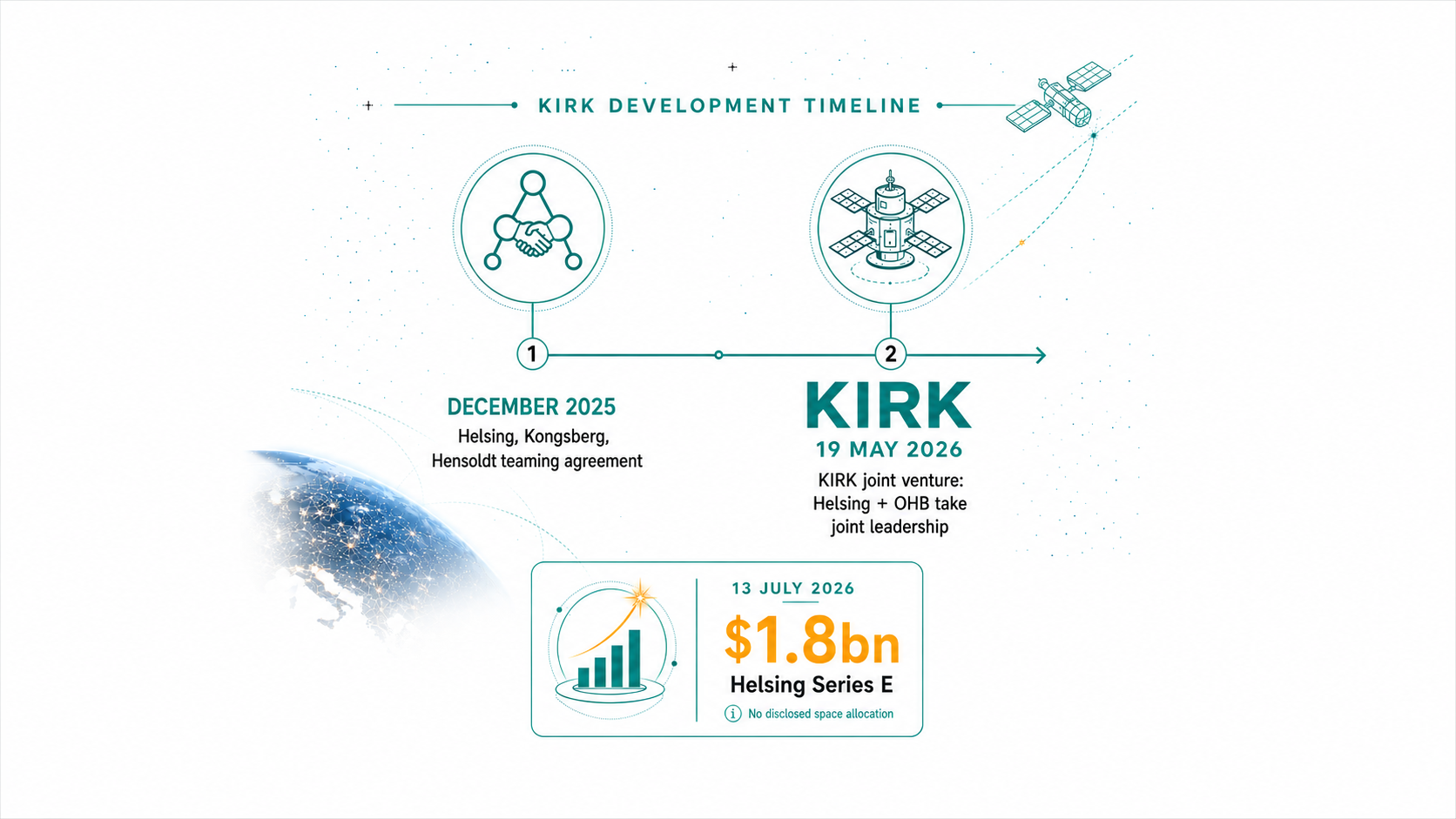
On 13 July 2026, Helsing announced a $1.8 billion Series E funding round at an $18 billion valuation, which Defense News described as the largest defence-technology funding round in Europe to date. New and existing investors, including Dragoneer Investment Group, Lightspeed Venture Partners, Disruptive, Iconiq, the growth-equity arm of Goldman Sachs Alternatives, JPMorganChase, the Canada Pension Plan Investment Board, General Catalyst, Plural and Stepstone, participated. Helsing states the company remains predominantly European-owned following the round, and that investor demand significantly exceeded the available allocation.
What the round is framed around, and what it does not disclose
Helsing's own Series E announcement frames the raise around continued development and integration of AI platforms for partner nations' defence capabilities. It does not disclose an allocation to any specific hardware programme. Separately, on a different day, Helsing announced its first US manufacturing base, in Martinsburg, West Virginia — a factory state officials describe as a $50 million investment that will produce the company's HX-2 strike drone, reaching a capacity of more than 2,000 drones a month once fully operational. The two announcements were made close together in time but were issued separately; neither discloses a shared financing structure, and neither the Series E nor the West Virginia announcement discloses any connection to Helsing's space-industrial activity.
Helsing's space track runs on a separate, and more advanced, timeline
In December 2025, Helsing signed a teaming agreement with Kongsberg Defence & Aerospace and the sensor group Hensoldt to develop a sovereign European space-based tactical targeting system. That consortium has since grown. On 19 May 2026, Helsing and OHB — Europe's largest space group — established a joint venture, working title KIRK, taking joint leadership of the consortium; Kongsberg and Hensoldt remain partners within it. On 12 June 2026, seven space start-ups and mid-sized companies signed memoranda of understanding with the KIRK consortium, aimed at drawing early-stage New Space technology into the initiative.
The consortium's stated technical approach centres on software-defined satellites and an AI-based targeting layer designed to reduce the latency between data collection and target engagement. Kongsberg's Trond Hegrestad, the company's Vice President of small satellites, described the constellation to Janes on 16 December 2025 (published 17 December) as containing "a substantial number" of small satellites in low Earth orbit; other reporting on the same announcement has characterised the plan as involving "a large two-digit number of satellites," without an exact figure disclosed by either company.
Why the funding round and the space consortium should be read separately
A capital injection of this scale materially strengthens Helsing's overall financial capacity. But nothing in the Series E announcement, in Helsing's own public disclosures, or in the KIRK consortium's own announcements indicates that any portion of the new $1.8 billion has been allocated to KIRK, its satellite programme, or its stated targeting capability. Reading the raise as a funding event for the space consortium would not be supported by what either party has actually said.
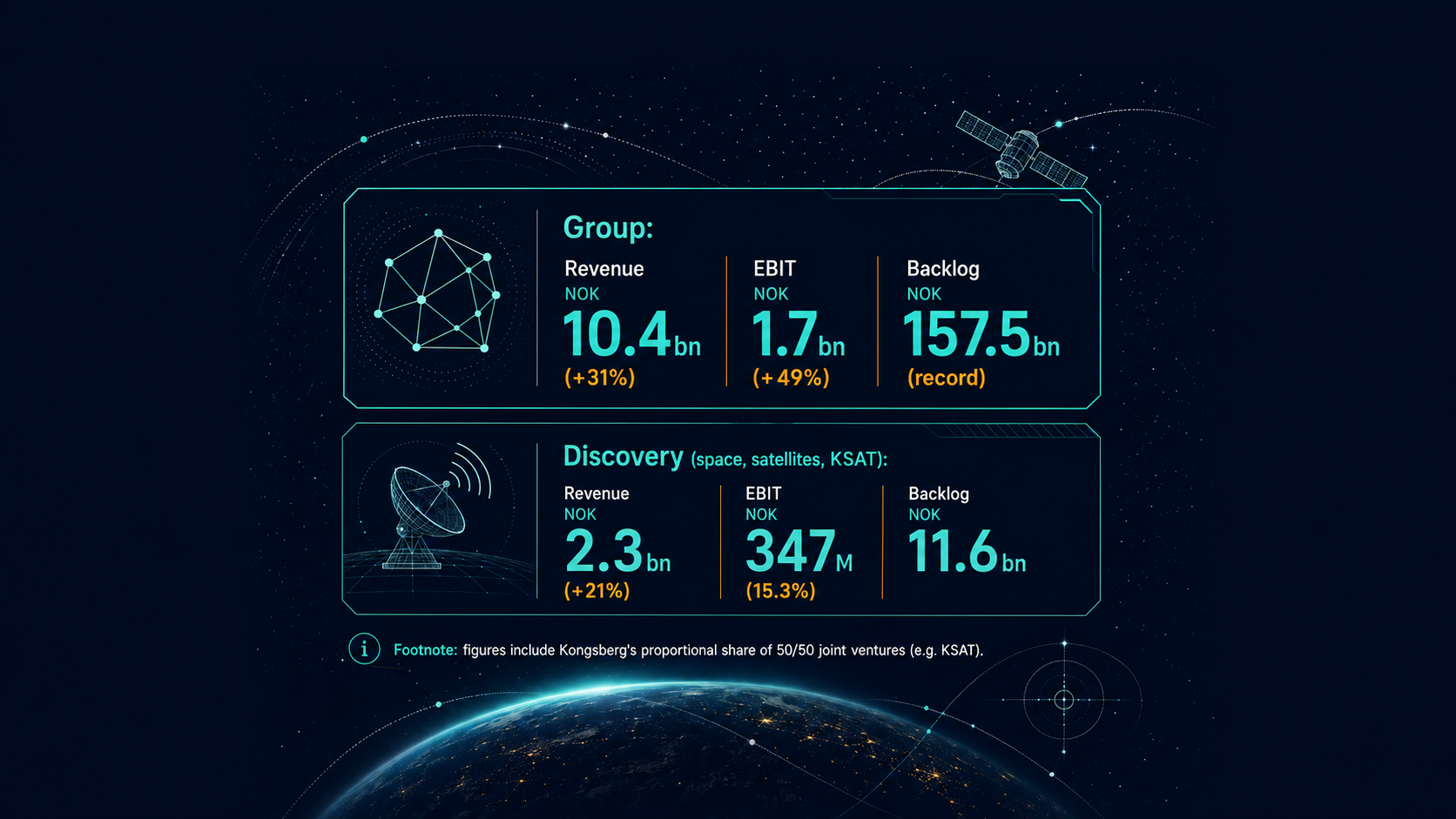
What is defensible to say is narrower: KIRK now has a joint-venture structure between two substantial European companies, a four-party consortium (Helsing, OHB, Kongsberg, Hensoldt), and an emerging network of start-up MoUs — a materially more developed industrial structure than the December 2025 teaming agreement alone. Kongsberg's own Q2 2026 results, reported separately this week, show a record group order backlog, but Kongsberg's disclosures do not identify KIRK or the satellite constellation as a distinct order or financial line item, so the backlog should not be read as financial backing for the consortium specifically.
What remains uncertain
No public source reviewed discloses a total programme budget, a customer award, a confirmed satellite count, a production schedule or a binding launch manifest for the KIRK consortium's constellation. This article does not estimate figures none of the parties has published.
What to watch
The next measurable indicator for KIRK will be whether the consortium discloses a funded contract, a specific procurement decision, a production milestone, or a launch manifest — none of which had been published as of this writing. For the Series E, the comparable indicator is whether Helsing's future disclosures ever attribute a specific allocation to a hardware or space programme, which the July announcement did not do.
Related signals - Kongsberg's Q2 2026 results: record order backlog, driven primarily by air-defence and Joint Strike Missile contracts, with its Discovery business area (home to its satellite work) reporting separately (Space Insights, this week) - Bloomberg's reporting on Europe's rocket-shortage exposure in the space-defence race
Sources
- 1.Helsing raises US$1.8bn in Series E — Helsing
- 2.Helsing raises $1.8 billion in Europe's biggest defense-startup round — Defense News
- 3.Helsing Expands U.S. Market, Selecting West Virginia For Its First U.S. Resilience Factory — Helsing
- 4.Kongsberg and Helsing team up to realise European space ambitions — Helsing
- 5.Helsing and OHB establish joint venture 'KIRK' for tactical space-based reconnaissance systems — Helsing
- 6.Space joint venture of OHB and Helsing bridges the gap to start-ups — Helsing
- 7.Helsing and Kongsberg working on 'large two-digit number of satellites' for ISR/T constellation — Janes
Get briefings like this every Friday.
Subscribe