The ECJ clarified how actively the Commission must probe conflicts of interest in EU-funded procurement; its link to Bromo remains unconfirmed. Space Insights.
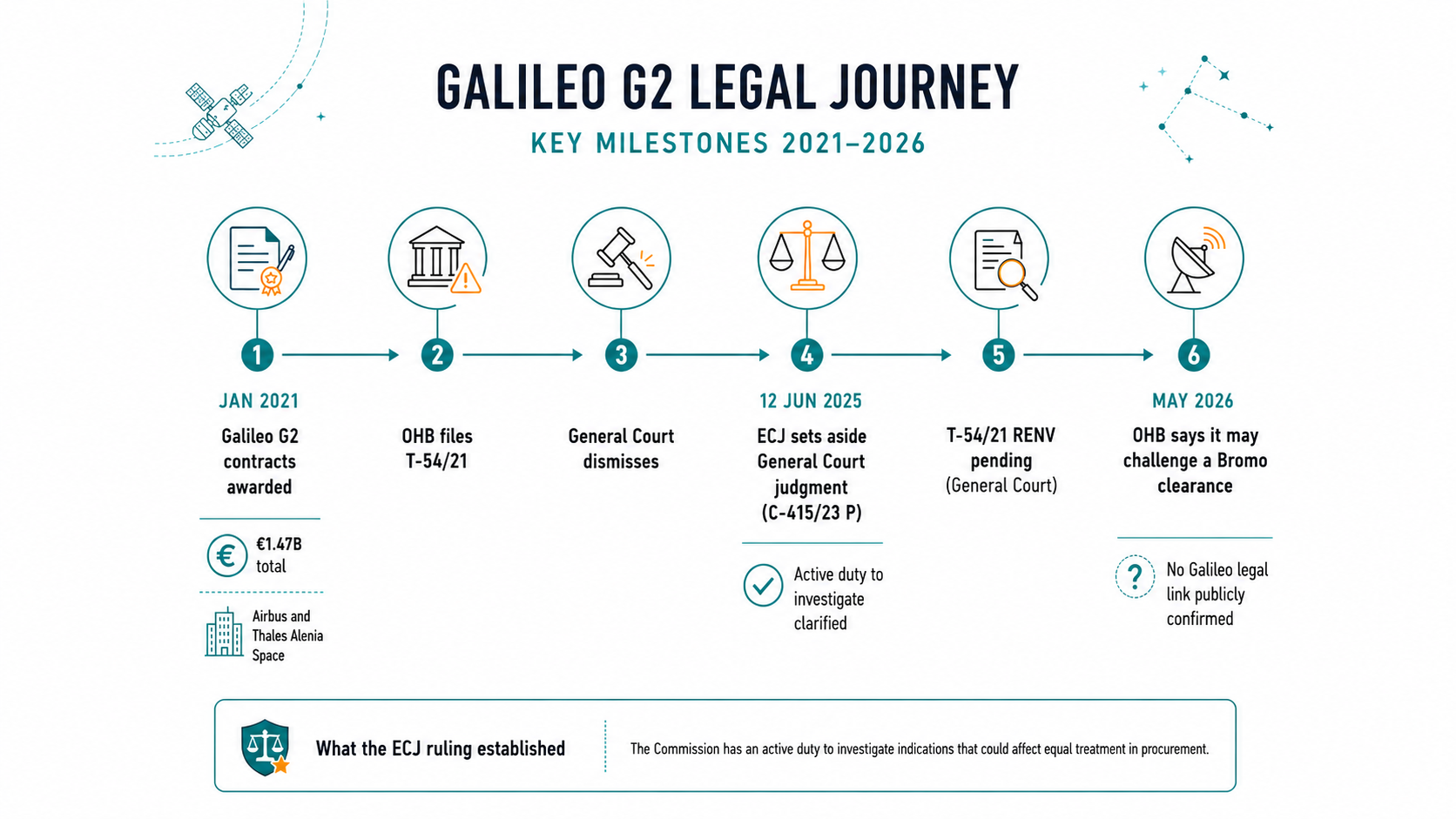
The second generation of the Galileo satellite navigation constellation was one of the largest institutional space procurement processes of the past decade. In January 2021, after a competitive tender, the European Commission awarded contracts totalling €1.47 billion: two contracts, covering six satellites each, went to Airbus Defence and Space and Thales Alenia Space respectively. The Commission did not disclose the individual contract values. OHB System AG, which served as prime contractor for the Galileo First Generation Full Operational Capability fleet (the European Space Agency states OHB produced 34 satellites for that phase), was one of the bidders for the second-generation work; its offer was not selected.
OHB filed a legal challenge before the General Court of the European Union as Case T-54/21. That challenge has now produced, via the European Court of Justice, a ruling that is materially significant not only for the Galileo case itself, but for the standard of scrutiny EU-budget-funded procurement authorities must apply when conflict-of-interest concerns are raised.
The allegation
OHB's challenge rested on an allegation of a conflict of interest. The company claimed that during the period when the Galileo second-generation procurement was being prepared and tendered, Airbus hired OHB's then-chief operating officer and placed that individual directly in the department responsible for developing Airbus's competing bid. OHB alleged that Airbus may have benefited from sensitive tender information to which its former COO had previously had extensive access. The underlying facts remain disputed; the case is sub judice, and the ECJ has not ruled on whether the alleged access in fact occurred or conferred any advantage.
Space Insights is not in a position to assess the truth of the underlying allegation. What the ECJ's ruling addressed is the procedural question of whether the Commission was required to investigate the allegation before concluding that no conflict of interest affected the procurement outcome.
What the General Court had decided, and why the ECJ set it aside
The General Court's initial dismissal concluded, in substance, that the Commission had adequately discharged its obligations without needing to open a fuller investigation into OHB's allegation. The ECJ found that the General Court had failed to verify adequately whether the Commission had complied with the principle of equal treatment in reaching that conclusion.
The European Court of Justice, in its judgment of 12 June 2025 in Case C-415/23 P, set aside the General Court's judgment. The ECJ held that the Commission's obligation to investigate conflicts of interest in EU-budget-funded procurement is active and objective: wherever a contracting authority has before it objective and consistent indications that a tenderer may have obtained an unfair advantage through access to confidential information, it is required to examine those indications and take appropriate measures. The contracting authority cannot dismiss the concern on procedural grounds without conducting the substantive examination the indicators warrant.
The ECJ also clarified the standard of equal treatment: the Commission must protect the principle of equality of opportunity for all tenderers at every stage of the procurement procedure, not only at the formal submission stage. That extension is significant for any procurement in which pre-bid engagement, recruitment of personnel, or access to technical information occurs across competing organisations.
The case was returned to the General Court for fresh reexamination as T-54/21 RENV. As of the week of 14 July 2026, that reexamination is pending and no ruling has been issued. The merits of OHB's original allegation, including whether Airbus in fact obtained or benefited from any unfair advantage, remain to be assessed by the General Court under the standard the ECJ has now established.
The Galileo ruling and Bromo: a relevant context, not yet a confirmed legal link
OHB CEO Marco Fuchs stated publicly in May 2026 that if the European Commission's competition directorate approved Project Bromo, the company would consider a legal challenge in the European courts. Reuters's report of that statement does not specify a particular legal doctrine or mechanism Fuchs said OHB would invoke. Public sources reviewed do not establish that OHB has formally identified the Galileo judgment as the legal basis for a future Bromo challenge; the connection between the two is a Space Insights editorial reading, not a claim OHB itself has made. (The Bromo contestation context is covered in depth in the separate Bromo synthesis article this week.)
One structural argument the Galileo ruling could plausibly support, though OHB has not been reported to have made it explicitly, is that a consolidated prime holding simultaneous positions across Galileo, Copernicus and potentially IRIS² would, by the nature of its scale and information access, raise the same equal-treatment questions the ECJ addressed in the Galileo case, extended from a single procurement to a structural, industry-wide condition. The judgment concerns the Commission's obligations in an EU-funded procurement involving several companies that are also relevant to the wider Bromo market debate; procurement-law scrutiny of a single tender and merger-control review of a corporate combination are, however, separate legal processes, and the Galileo ruling does not itself constitute a legal basis for blocking Bromo's clearance.
What the ruling means for European space procurement more broadly
The ECJ's holding in C-415/23 P does not apply only to Galileo or to Bromo. It clarifies a general principle for EU-budget-funded procurement: contracting authorities must actively investigate conflicts of interest wherever objective and consistent indications exist. For an industry in which the same handful of companies hold positions across multiple simultaneous EU-funded institutional programmes, that principle has structural implications.
Companies holding roles in Galileo, Copernicus, IRIS² and other EU-budget-funded procurement simultaneously will operate, from this ruling forward, in an environment where contracting authorities carry a clarified legal obligation to examine the information-access conditions that their industrial relationships create. The ruling did not create this obligation from nothing; it clarified the level of scrutiny required when objective and consistent indications are present, regardless of how the Galileo reexamination or the Bromo review resolve. It applies specifically to EU-budget-funded procurement procedures where such indications arise, not automatically to every space-related procurement in the EU, including nationally funded defence programmes outside that scope.
Sources
- 1.European Court of Justice Case C-415/23 P — Press Release 68/25 — Court of Justice of the European Union
- 2.Case T-54/21 RENV — list of pending cases — InfoCuria / Court of Justice of the European Union
- 3.Commission awards €1.47 bn in contracts to launch the 2nd Generation of Galileo Satellites — European Commission
- 4.Galileo satellites in OHB — European Space Agency
- 5.Germany's OHB to consider legal action if EU clears Airbus, Thales, Leonardo satellite merger — Reuters
- 6.OHB Raises Concerns About Planned European Space Joint Venture — SpaceNews
Get briefings like this every Friday.
Subscribe