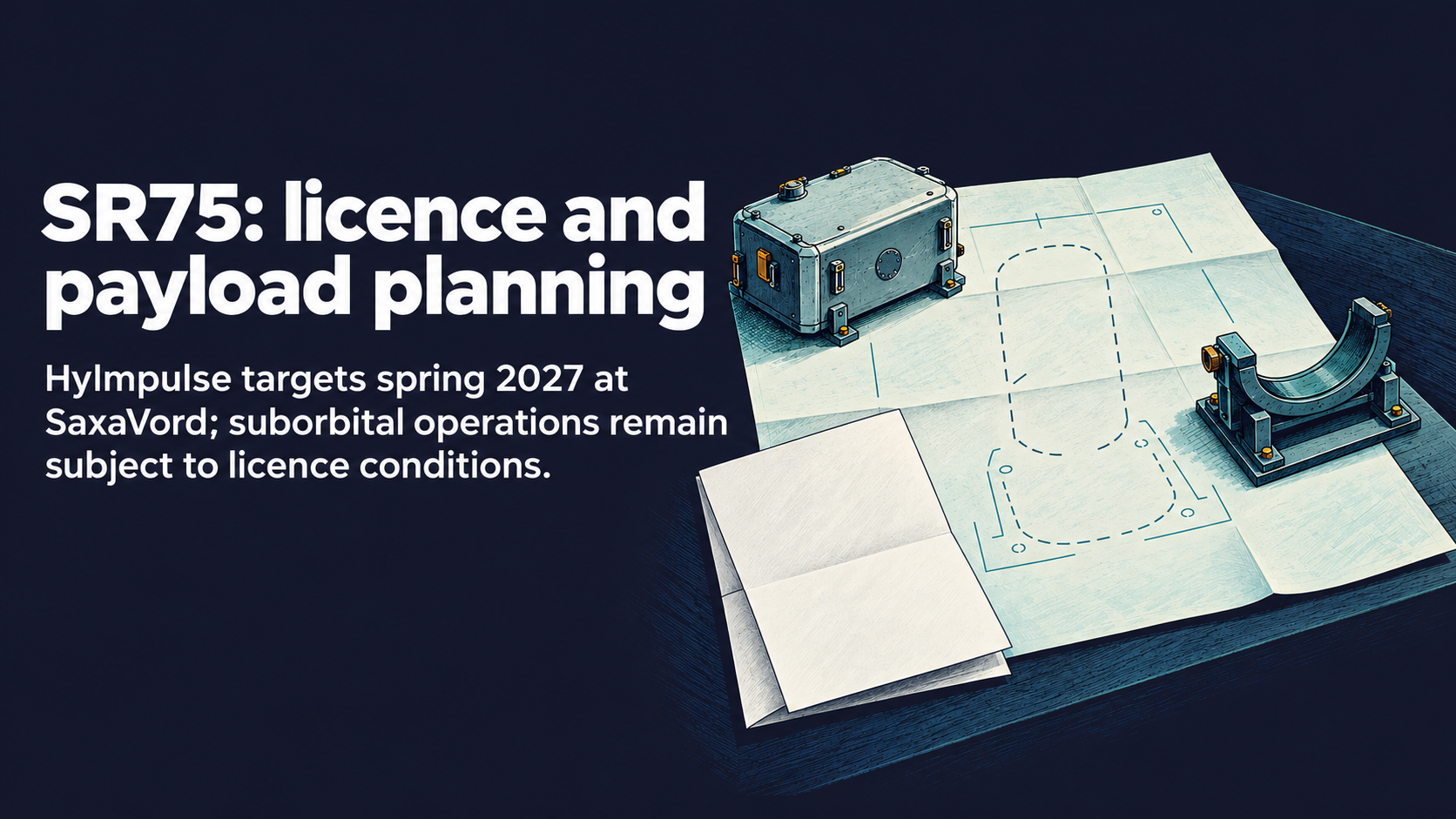
Space Insights editorial illustration of payload campaign planning; not an actual SR75 payload or integration system.
HyImpulse’s SR75 has a UK launch licence and a company target of spring 2027 for its first European flight. Together, those developments give payload teams a more specific planning baseline: a named vehicle and site, documented operating conditions and an updated campaign horizon. The Civil Aviation Authority’s licence is dated 28 September; HyImpulse’s public company update describes final operational work with the regulator and SaxaVord Spaceport. CAA licence, HyImpulse update.
The mission is suborbital. SaxaVord’s 19 March announcement described SR75’s second flight, following its first launch in Australia, and targeted the Scottish mission for later in 2026. The latest spring 2027 target updates that earlier timetable. SaxaVord’s agreement assigns it launch infrastructure and operational support, establishing a service relationship alongside the vehicle programme. SaxaVord agreement.
For an experiment team, these records become more useful when read together. The vehicle determines the flight environment being purchased; the spaceport agreement identifies supporting services; the current target sets the period around which equipment and personnel may need to be available. A change in one element can alter preparation even when progress continues in another.
The licence gives the campaign a defined operating scope
The licence names HyImpulse UK Ltd and authorises SR75 launch and suborbital operations from SaxaVord. Terms 1.2 and 3.1 require specified conditions to be met to the regulator’s satisfaction before the authorisations are exercised. They address insurance, final range plans, launch-information sharing and any international arrangements considered necessary. These are stated requirements; the document does not record their subsequent completion. Licence, terms 1.2 and 3.1.
This makes the company’s reference to final operational activities meaningful without turning it into a judgement about readiness. The useful next update would connect the flight window with the customer’s own preparation sequence: payload acceptance, integration and campaign access. Those are the interfaces around which a customer can organise work, although the public announcements do not supply that detailed customer schedule.
Funding and flight preparation provide different evidence
HyImpulse’s press-release index records a 2 September announcement of more than EUR 50 million to scale its suborbital and orbital launch operations. It separately records the launch-licence announcement on 1 October. The financing covers a broader business scope than this particular SR75 campaign. HyImpulse announcements.
Reading the funding, site agreement, licence and revised target as separate records prevents the timetable from disappearing inside a general account of company progress. It also preserves the value of each development: funding supports the programme, the agreement identifies the site relationship, and the licence defines the authorised activity and conditions.
For payload buyers, the next practical evidence is a campaign plan that joins those elements to their own delivery obligations. HyImpulse’s current statement places that work in preparation for spring 2027. A dated customer integration schedule would make the relationship between that target and payload readiness more concrete.
Sources
- 1.SR75 Spaceflight Operator Licence, 28473-1292-L-001 — UK Civil Aviation Authority
- 2.HyImpulse public company update: UK launch operator licence — HyImpulse
- 3.SaxaVord and HyImpulse sign launch agreement — SaxaVord Spaceport
- 4.HyImpulse press-release index, 2 September and 1 October 2026 entries — HyImpulse
Get briefings like this every Friday.
Subscribe