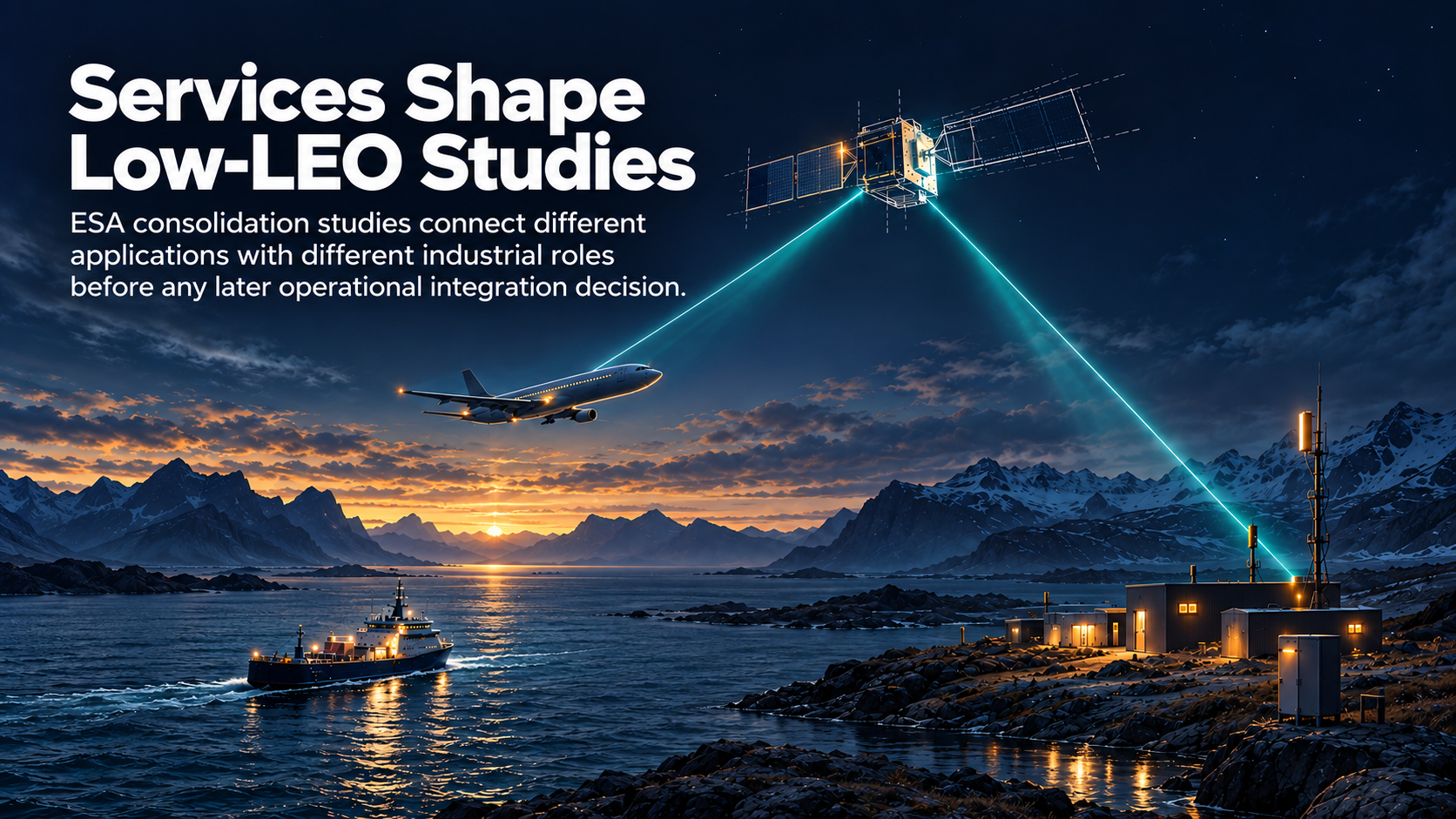
Space Insights editorial illustration of Low-LEO service studies; not a depiction of an operational IRIS² service.
For a specialist assessing ESA's Low-LEO work, the useful starting point is the intended service and the team defining it. Two studies announced on 17 September 2026 make that distinction concrete: Kinéis's ALCYON combines maritime and aviation surveillance, while Sateliot's RESCUE-NET explores direct-to-device and secure Internet of Things connectivity for governmental users.
Both sit within a wider consolidation phase. ESA signed 18 contracts involving nearly 80 companies at its European Space Astronomy Centre in Madrid that day. The contracts total EUR 20 million and cover service concepts and the missions needed to demonstrate them. Their significance for prospective partners lies in the requirements being developed before later implementation decisions. ESA's announcement.
ALCYON connects payload roles to service operations
Kinéis describes ALCYON as a study to specify a future in-orbit demonstrator. Its maritime application uses the VHF Data Exchange System, or VDES, which adds two-way vessel data exchange to the capabilities associated with the Automatic Identification System. Its aviation application concerns receiving Automatic Dependent Surveillance–Broadcast, or ADS-B, signals from space.
The disclosed consortium follows those applications. Kinéis is prime contractor and system operator. Thales Alenia Space France covers the space segment and ADS-B payloads; Satlab supplies the VDES payload expertise; Sternula addresses VDES operations; and ESSP covers air-traffic surveillance services. Kinéis says the consolidation phase lasts four months. Kinéis's study and team description.
The roles connect payload engineering with service operation. For a prospective partner, that distinction identifies the relevant counterpart and where application requirements enter the proposed mission design.
RESCUE-NET starts from a different connectivity problem
Sateliot's RESCUE-NET addresses future direct-to-device and secure IoT services. Its stated scenarios include continuity of service, emergencies and remote locations where terrestrial connectivity is unavailable. The company will study how non-terrestrial-network capabilities based on 3GPP standards can support those governmental uses. Sateliot's announcement.
This creates a different set of integration questions from ALCYON's surveillance applications. The relationship between a device, a terrestrial network and a satellite service becomes part of defining the use case. A potential contribution may concern connectivity integration or application requirements as well as equipment carried in orbit.
For a specialist choosing which industrial discussion to pursue, the two examples make the distinction practical. A common programme name does not make all teams equivalent customers. The service definition helps locate the relevant interface, while the consortium disclosure indicates which responsibilities already have named owners. RESCUE-NET's announcement provides less team detail than ALCYON's, so the comparison is clearest at the level of applications and disclosed responsibilities.
Two complementary components within Low-LEO
ESA's programme explanation distinguishes the European Commission's Low-LEO component under the IRIS² concession from ESA's complementary work under Element 3 of its Programme Related to EU Secure Connectivity. The Commission's component concerns operational services. ESA's component develops and validates complementary services through pre-operational missions, with potential integration into the operational baseline requiring further decisions. ESA's component explanation.
That distinction gives the studies their purpose. ESA describes a process beginning with governmental service requirements, followed by assessment of maturity, overlap and interoperability. Implementation then uses the mission infrastructure needed to validate the chosen service. The application is therefore an input to the mission's design and evaluation.
For the reader, there are two different relationships to follow: participation in defining and demonstrating a service, and any later place in operational provision. A team's consolidation role supplies evidence about the first. Subsequent mission and programme decisions will establish the second.
The next contracts will test the service designs
ESA plans follow-on implementation during 2027 to 2029. The next procurement records will make the selected missions, deliverables and participation conditions more specific. They will also show which elements of the present studies continue into validation with user groups.
The strongest interpretation of the September portfolio is that it makes several application-specific industrial relationships visible early. Study teams may still change, and some concepts may overlap or stop after consolidation. ALCYON and RESCUE-NET provide two documented examples within the broader portfolio, giving suppliers and users a basis for assessing relevant partners without treating a study role as an assured operational assignment.
Sources
- 1.ESA starts next phase of IRIS² evolution through Low-LEO activities — European Space Agency
- 2.Low-LEO: A strategic layer for the evolution of IRIS² — European Space Agency
- 3.Kinéis selected by ESA to prepare the future of maritime and aeronautical surveillance from space — Kinéis
- 4.Sateliot selected by ESA to contribute to the Low-LEO layer of Europe's IRIS² sovereign connectivity programme — Sateliot
Get briefings like this every Friday.
Subscribe