Isar Aerospace's Spectrum has recorded three scrubs and one autosequence abort since January; the company's mission log has shown no newer public launch window since 15 June. Space Insights.
If you consult a launch-tracking site for Isar Aerospace's second Spectrum flight, you may find a provisional August date. One aggregator's launch-status header currently reads "Date/Time TBD", while its FAQ separately lists a placeholder date at the end of August. If you consult Isar Aerospace, you will find something else. The company's mission updates log for "Onward and Upward" ends on 15 June, marked scrubbed, with teams having detected "off nominal behavior in the vehicle's fluid systems" and analysing data to isolate the root cause.
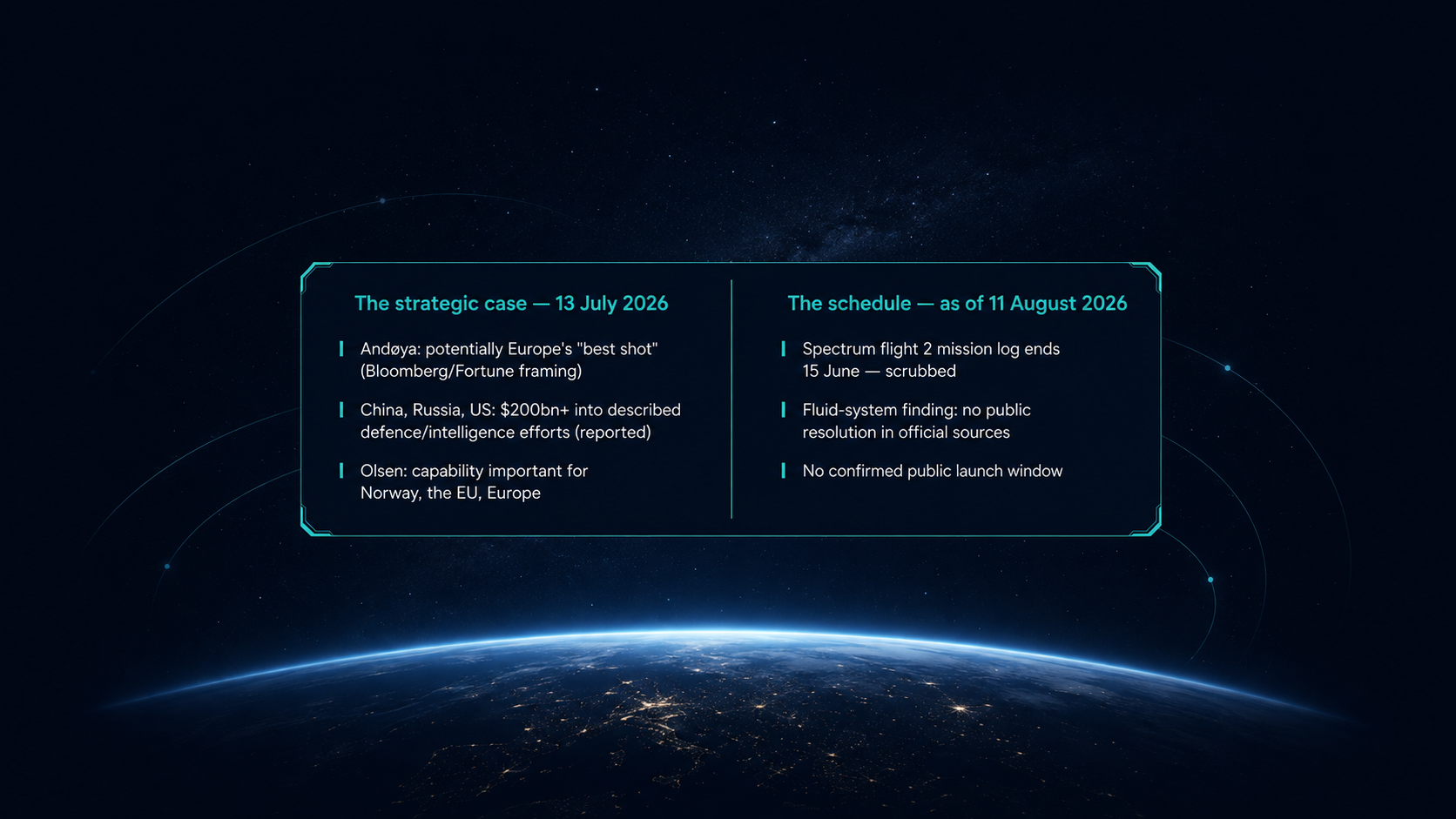
As of 4 August, that remains the most recent public statement. ESA's own Boost! programme page also still shows the 15 June window. No newer public launch window is visible on the official Isar, ESA or Andøya pages reviewed.
The campaign in full
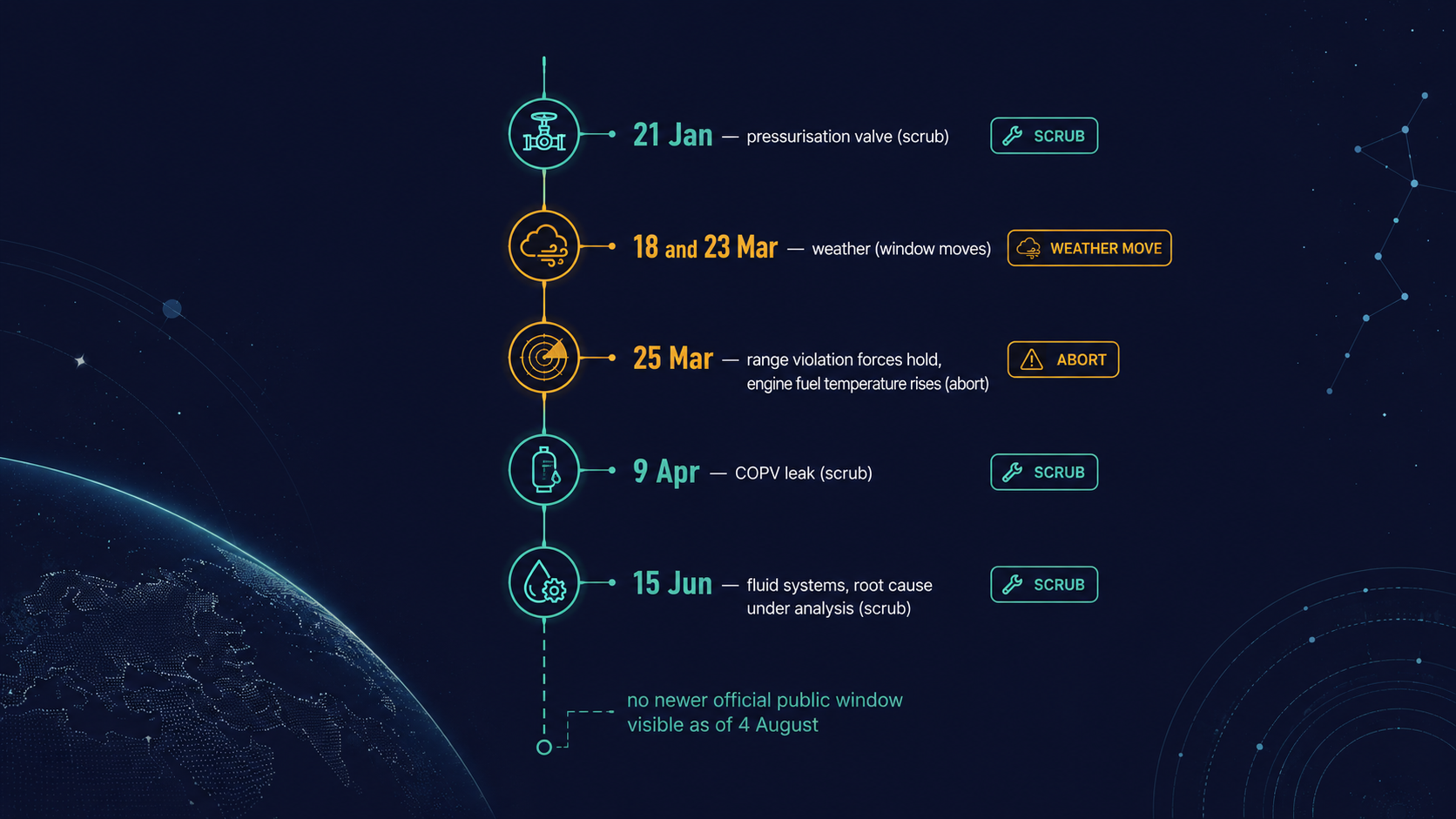
The gap between the aggregator's inconsistent projections and the company's silence is easier to read against the whole campaign. From Isar's own log:
- 16 January — launch targeted for no earlier than 21 January, 21:00 CET, from Andøya Space.
- 19 January — payload integration complete: five cubesats and one experiment.
- 21 January — scrubbed, pressurisation valve issue.
- 30 January — new window announced for no earlier than 19 March, following resolution of the valve issue.
- 18 March — moved to 23 March, unfavourable weather.
- 23 March — moved to 25 March, strong winds.
- 25 March — propellant loading started; aborted during autosequence after a range violation caused by an unauthorised boat, which forced a 15-minute hold. Isar's 26 March statement explains the technical consequence: the hold produced an increase in engine fuel temperature. One attempt, not two.
- 9 April — scrubbed to evaluate a leak in a composite overwrapped pressure vessel.
- 15 June — scrubbed. Off-nominal behaviour in the vehicle's fluid systems; root cause analysis under way.
Three scrubs and one abort on attempt days, plus two weather-driven window moves, across five months.
What the list does and does not show
A list of four events invites a single conclusion, and the single conclusion would be wrong. The causes are not one cause.
An unauthorised vessel entering the range is not an engineering problem. It is a maritime coordination problem. Two of the March slips were weather. Those three tell you about operating a launch site on the Norwegian coast, not about a rocket.
Two are vehicle systems outright: a pressurisation valve in January and a composite overwrapped pressure vessel in April. A third, the fluid-system anomaly in June, is the one still open. The public updates use three different vehicle-related descriptions, but the record does not establish whether the underlying causes are connected or entirely separate. Either way, this is the pattern worth watching — not because it implies anything is wrong with Spectrum's design, but because a qualification campaign is precisely where such issues are supposed to surface, and each one costs a window.
What no source supports is any inference about whether the June anomaly is serious. Isar has not said. The company's own wording — "off nominal behavior" — is narrower than "fault" or "failure", and we are not going to translate it into either.
What is assigned to the mission
Isar reported payload integration complete on 19 January. Five cubesats and one non-separable experiment are assigned to the mission:
- CyBEEsat, TU Berlin
- TriSat-S, University of Maribor
- Platform 6, EnduroSat
- FramSat-1, NTNU, Trondheim
- SpaceTeamSat1, TU Wien Space Team
- Let It Go, Dcubed
No later public update reviewed clarifies the payloads' current integration status. ESA describes these as "six passengers, five commercial and educational cubesats and an experiment", supported through its Boost! programme, which has also funded scaling-up of Isar's production facilities.
Six European payload teams — four university or student teams, one commercial cubesat developer and one commercial experiment provider — have now gone more than six months since integration was reported complete, on a vehicle that has not yet flown. For the university and student teams among them, that is a long time to hold a project in a configuration they cannot modify.
Why this flight carries more than its manifest
Two pieces of context matter, and both come from ESA rather than from the launch trackers.
The first is the European Launcher Challenge. ESA states the programme requires participants to reach orbit no later than 2027; a successful second flight would demonstrate Spectrum's orbital capability within that wider programme timetable. ESA does not present this specific attempt as the deadline itself, only as one demonstration inside it.
The second is what the first flight established. Isar chief executive Daniel Metzler's framing, cited by ESA, is that the March 2025 flight proved launch vehicles "can be designed, built, and launched from continental European soil". Reaching orbit is the part that remains.
So the second flight is carrying a qualification, a payload manifest, and a programme timetable at the same time. That is a lot of weight for a vehicle with one flight behind it, and it is a fair part of why each scrub matters more than a scrub normally would.
What to watch
Whether Isar publishes anything at all. Seven weeks of silence after a scrub with an open root cause is the signal here. A new window, or a statement on the fluid-system finding, would change the picture more than any aggregator date.
Whether any of the current third-party projections for August materialise without company confirmation. If the flight happens on a date Isar never announced, that says something about how these projections are assembled.
And whether the ELC 2027 timetable starts to appear in the company's own language. It is currently ESA's framing, not Isar's.
Get briefings like this every Friday.
Subscribe