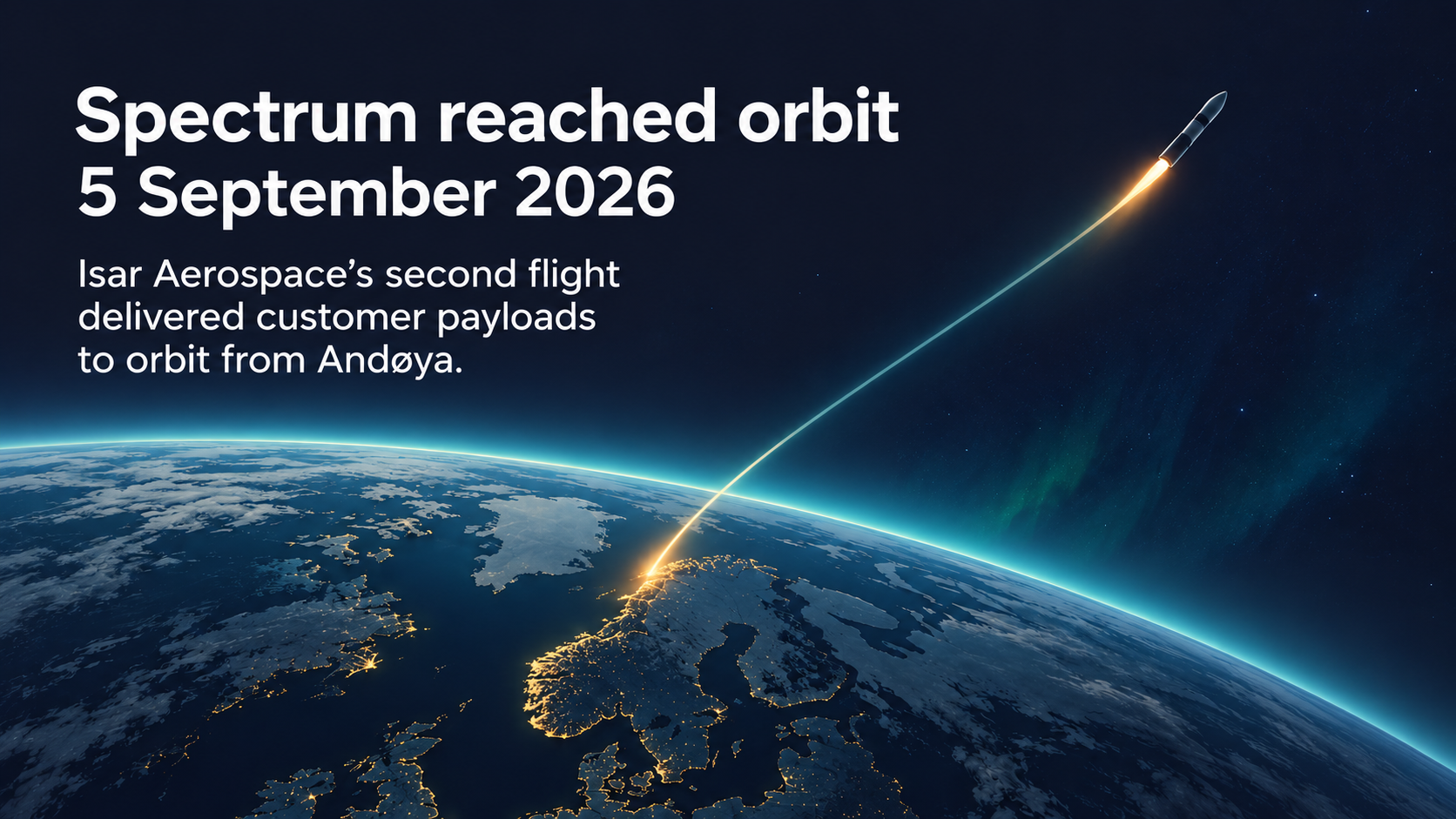
Spectrum reached orbit from Andøya on 5 September 2026, on Isar Aerospace's second flight. Two separate statements sit behind that: Isar's 9 September update confirmed all customer payloads had been released, and said most satellites had established contact and begun operations. Payload release and satellite contact are not the same milestone, and the second one is most rather than all. Space Insights.
Isar Aerospace's Spectrum reached orbit from Andøya on 5 September, on its second flight. In a 9 September update, the company confirmed that all customer payloads had been released. Most satellites had established contact and begun operations. That is the achievement around which the next assessment of Isar should be built.
Our earlier coverage followed the unresolved question of the second flight. The new result changes that starting point. Customers considering Spectrum now have a completed orbital mission to assess alongside the company's future plans. For the team at Isar and its partners at Andøya, it is a completed orbital mission with a direct customer outcome.
A flight with customers on board
The mission carried five CubeSats, from TU Berlin, the University of Maribor, EnduroSat, NTNU and the TU Wien Space Team, alongside a Dcubed technology demonstration. Isar reported that the demonstration completed its objectives. The payloads were selected through DLR's Microlauncher Competition, supported by ESA's Boost! programme.
That combination gives the flight two useful dimensions. It demonstrates an orbital launch capability and provides a result for organisations whose own work depends on reaching space. The customer outcome makes the announcement particularly relevant to satellite teams weighing their launch options.
For those teams, our assessment is that the decision can now move to a more specific set of questions. How does a proposed mission fit the service? What integration work would it require? Which delivery date can the parties agree? A completed flight gives those discussions a firmer technical reference and a basis for examining a future mission in detail.
Production becomes the next observable step
Isar says Spectrum vehicles three to seven are already in production. Its new 40,000-square-metre facility near Munich is intended eventually to support output of up to 40 vehicles annually.
The production sequence offers a practical way to follow the next phase. Completion of a vehicle, a customer payload integration milestone and an announced flight date each add different information. Taken together over subsequent missions, they would allow customers to judge how the service is developing around their own delivery requirements.
This is also where our coverage should advance. The next useful reporting will connect manufacturing progress to specific missions and customers. An annual capacity target describes the scale the company is building towards; successive deliveries will establish the operating record that customers can use in planning.
The institutional context
ESA announced Isar's €197.8 million European Launcher Challenge contract on 27 August. Under the programme, funding is tied to milestones, including an orbital demonstration before 2028. That creates a separate institutional framework within which Isar's progress will be assessed.
The commercial and institutional perspectives address related decisions. A customer needs to understand the service available for its mission. A public programme needs to assess progress against its contractual milestones. Following both gives readers a more complete picture of how a European launch capability develops from a successful flight into a continuing service.
The most useful next evidence would be a documented programme milestone assessment and concrete information about the following Spectrum mission. Those records would clarify the institutional and delivery implications of the orbital result, each on its own terms.
What this changes for the reader
For a satellite programme manager, the immediate value is a new basis for evaluating a potential launch provider. For suppliers, the follow-on vehicles identify production work to track. For organisations following Norwegian space infrastructure, Andøya now has this completed customer mission as an operational reference.
The successful flight deserves attention on that basis. The next chapter is about how Isar and its partners build on it: matching production, launch operations and customer missions into a service that organisations can plan around.
Get briefings like this every Friday.
Subscribe