MaiaSpace has removed its planned suborbital demonstration flight and now targets an orbital attempt in H2 2027, according to a company spokesperson; Themis and Isar show two different forms of schedule uncertainty in the same week. Space Insights.
MaiaSpace has removed the suborbital demonstration flight it had planned for its Maia rocket and, according to a company spokesperson cited by European Spaceflight, will proceed directly to an orbital launch attempt targeting the second half of 2027. European Spaceflight reported the change on 29 July; as of this writing, it is not yet reflected on MaiaSpace's own news page, which still shows the Loft Orbital launch agreement as its most recent post.
The original plan was a two-stage Maia flying with reduced propellant to at least 100 km altitude, as a demonstration ahead of an orbital attempt. The spokesperson's stated reasoning for dropping it is that "the value of a suborbital flight was eventually reduced" in light of the ground and integrated testing already planned.
What replaces the flight
The test campaign that remains is substantial, and understanding it is necessary before judging the decision.
Subsystem testing is under way at MaiaSpace's Vernon facilities, where recent tests have been completed. Complex integrated testing is planned across the end of 2026 and into 2027. That includes upper-stage hot-fire testing with the Prometheus engine at Vernon, while first-stage testing is to be conducted directly at the launch pad. MaiaSpace, an ArianeGroup subsidiary, will launch from the Guiana Space Centre, using the facility formerly used for Soyuz.
MaiaSpace argues that its planned ground and integrated tests have reduced the additional value of a suborbital flight. The public information reviewed is not sufficient to assess whether those tests provide equivalent verification to a flight demonstration; the counter-argument is that ground testing does not reproduce flight, and a suborbital flight would have surfaced integration problems that no static campaign finds.
Reasonable engineers disagree about that trade. We are not going to adjudicate it.
The schedule behind the decision
What is not in dispute is the direction of the schedule. Per the same source, MaiaSpace targeted the second half of 2026 as of June 2025. By February 2026 that had moved to before April 2027. It now stands at the second half of 2027.
Roughly a year of slippage in thirteen months. That is not unusual for a first-generation launcher and it is not, by itself, a criticism. It is, however, the context in which a test phase was removed, and the two facts belong in the same paragraph.
MaiaSpace's own announcement confirms the Loft Orbital agreement directly: it covers multiple missions beginning in 2028, and describes Loft Orbital as the fourth commercial customer to sign with MaiaSpace in fourteen months. The announcement does not publish individual flight dates, so whether any of those missions align with the revised H2 2027 target for the inaugural flight is not established.
Three programmes, three different positions
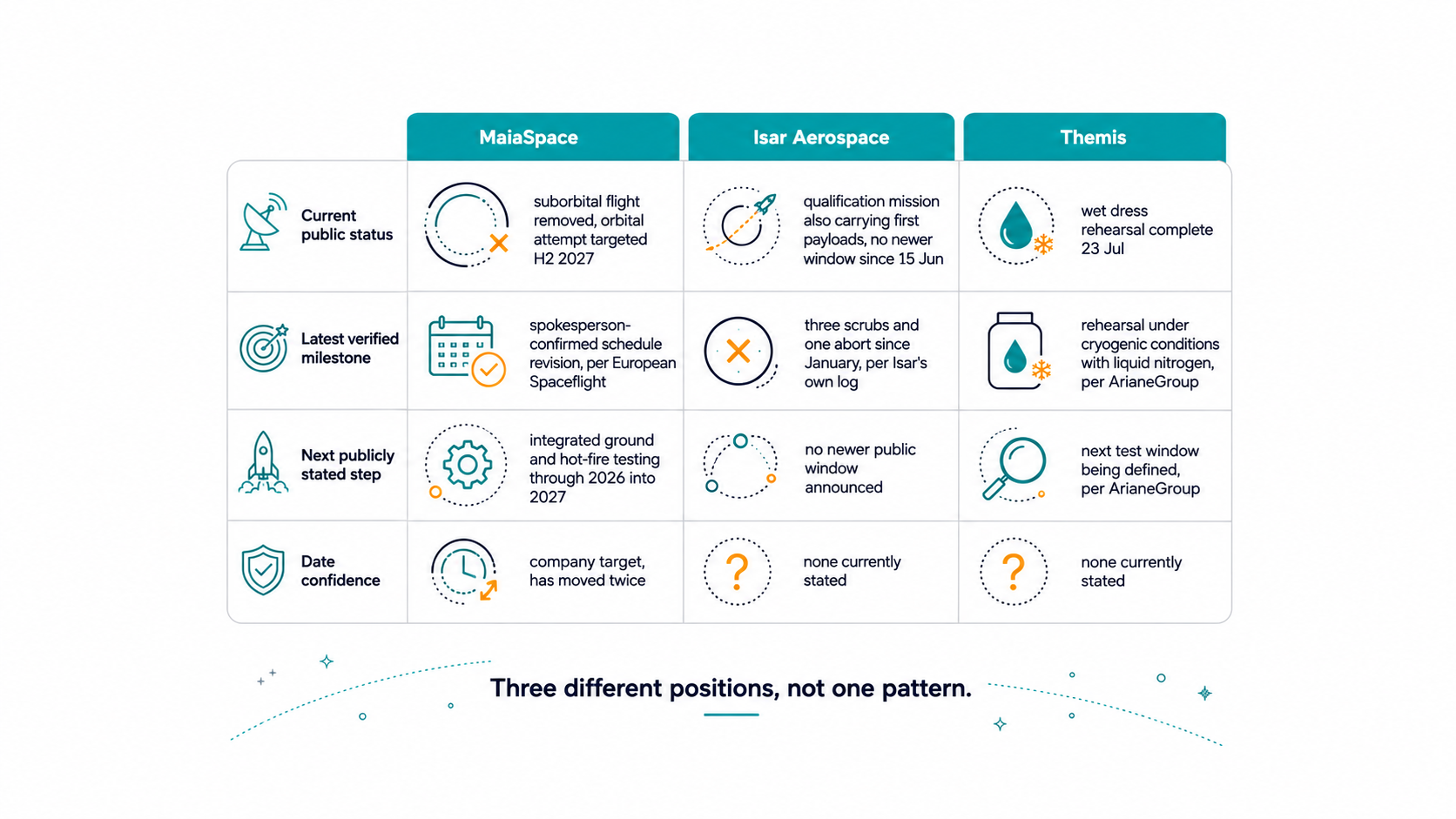
MaiaSpace's decision became public in the same week as the Themis rehearsal; Isar's campaign remains in the position it has held since 15 June. The three are worth reading together, with one caveat stated up front: only MaiaSpace and Themis had active news that week. Isar's combined-milestone design is long-standing, not a decision taken in the last seven days.
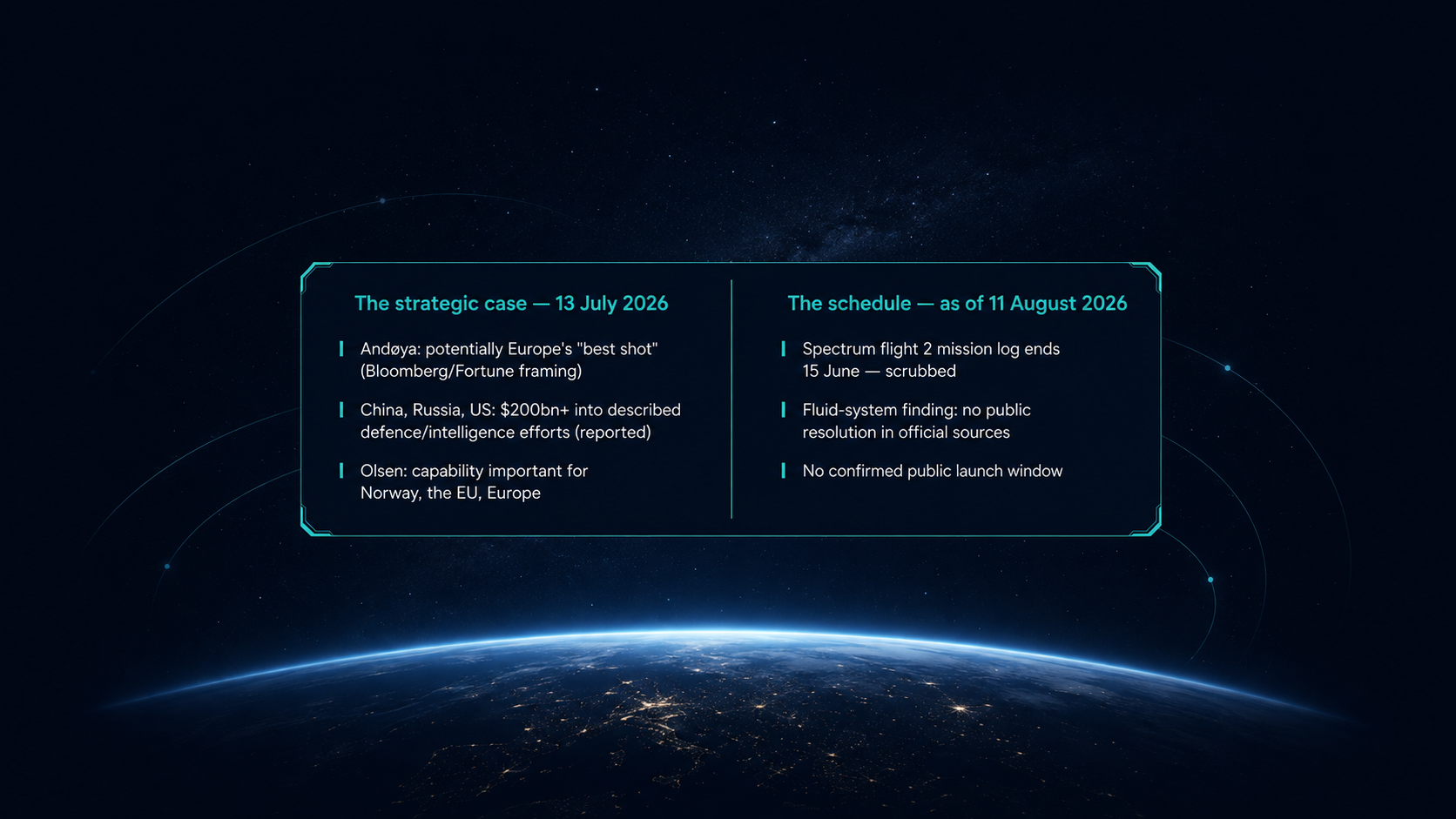
Isar Aerospace's second Spectrum flight, from Andøya, was designed from the outset as both the vehicle's qualification mission and its first flight carrying payloads. The campaign has since recorded three scrubs and one autosequence abort, and Isar has announced no newer public window since scrubbing on 15 June with a fluid-system root cause still under analysis.
ArianeGroup's Themis reusable booster demonstrator completed a wet dress rehearsal at Esrange on 23 July, under cryogenic conditions using liquid nitrogen rather than operational propellants. ArianeGroup says teams are working to define the window for the next test. No date is set, and combined testing began in September 2025.
Three programmes, three positions on how to test: a qualification mission also carrying first payloads, a removed flight phase, and a rehearsal complete with the next window still being defined. Two of the three currently have no announced next date at all.
What the comparison shows, and what it does not
It would be lazy and unfair to present this as corner-cutting. Each of these three has a specific, defensible rationale for the specific choice it made. Test campaigns are reordered constantly, in every launch programme, in every country.
The programmes are not making the same decision. MaiaSpace has removed a flight phase and set a later target for its inaugural attempt. Isar's campaign was designed from the outset to combine qualification with a payload-carrying flight. Themis has completed a rehearsal and is defining its next window. Three different forms of schedule handling, not three instances of one choice.
Space Insights' editorial reading: taken together, the three show how closely test milestones and public schedules are now being watched across European launcher development, at a moment when sovereign European launch capacity is a stated policy priority. The sources reviewed for this piece do not establish that a single, shared pressure caused all three decisions, and we are not going to claim that they do.
What to watch
Whether MaiaSpace's H2 2027 target survives the integrated test campaign at the end of 2026. A fourth revision would change the reading of the suborbital cancellation considerably.
Whether Prometheus hot-fire testing at Vernon completes on the stated timeline, since it now carries more of the verification burden than it would have alongside a flight demonstration.
And whether the Loft Orbital missions acquire published dates. Customer commitments are the least sentimental indicator available, and this one now has a primary source behind it, even without individual flight dates yet.
Get briefings like this every Friday.
Subscribe