OHB's capital raise, Bundeswehr bid and legal posture complicate Bromo's scale argument, without proving a coordinated strategy. Space Insights.
According to Financial Times reporting, on 24 June 2026, Airbus CEO Guillaume Faury and Leonardo CEO Lorenzo Mariani publicly urged the European Commission to approve Project Bromo, framing the consolidation as a strategic necessity for European space industry competitiveness. The Financial Times reported that the companies were nearing a formal competition-law application but had not yet filed it, as of its reporting in early July 2026.
In the same period, OHB SE took several separate commercial and legal steps that, considered together, strengthen its position in the Bromo debate. Space Insights presents these as related developments worth reading together, not as evidence of a coordinated plan.
What Bromo is, and what is at stake in its approval
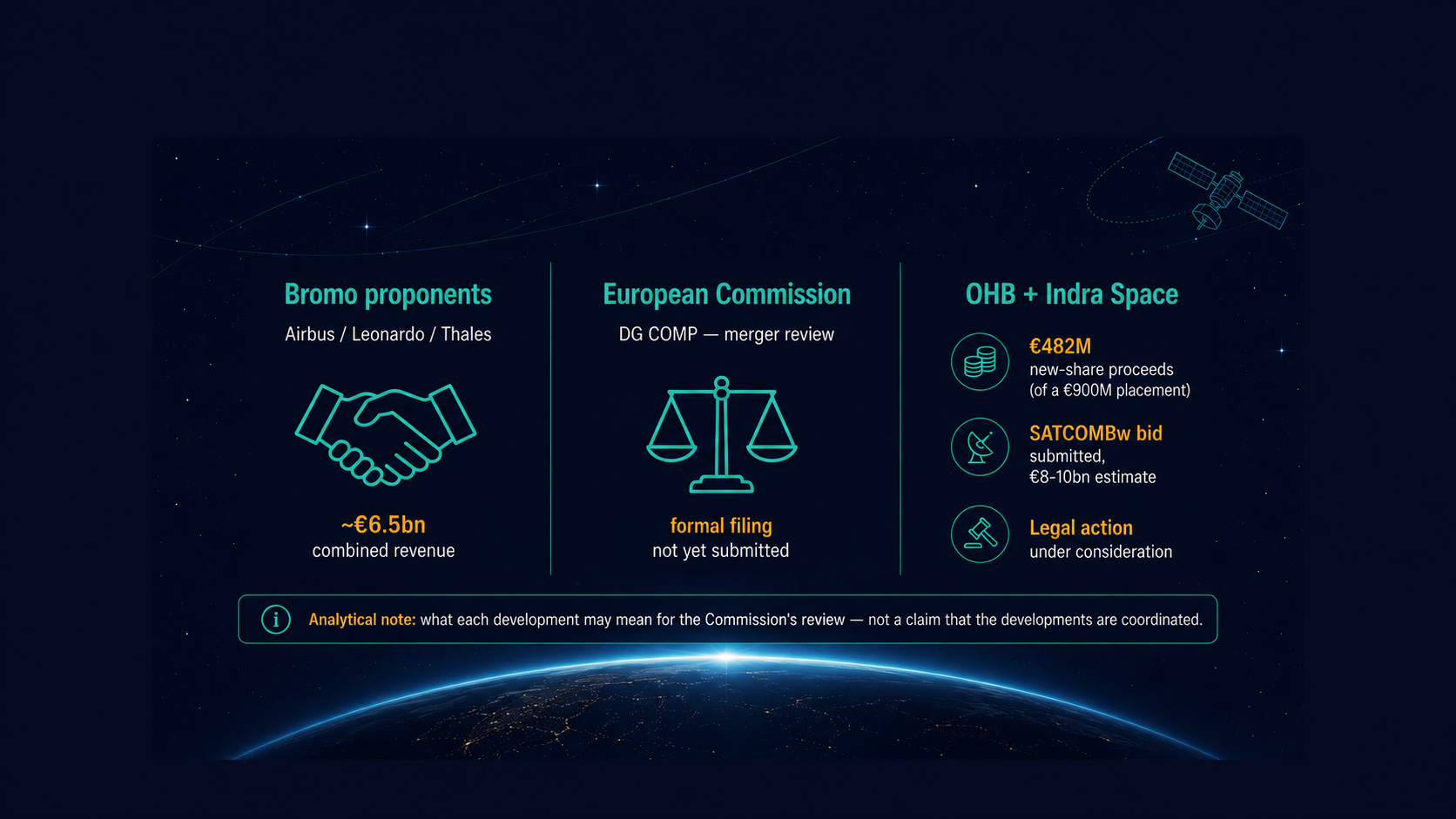
Project Bromo is a proposed joint venture combining space activities from Airbus, Leonardo and Thales. Per the companies' October 2025 memorandum of understanding, Leonardo's contribution comprises its Space Division together with its Telespazio and Thales Alenia Space interests; Airbus contributes its Space Systems and Space Digital activities; Thales contributes primarily its Thales Alenia Space, Telespazio and Thales SESO holdings. The structure gives Airbus 35 per cent, Leonardo 32.5 per cent and Thales 32.5 per cent, reflecting asset valuations rather than equal partnership. The combined group would employ approximately 25,000 people and generate roughly €6.5 billion in annual pro-forma revenue, and is expected to become operational in 2027, subject to regulatory approvals and other closing conditions.
The commercial rationale the proponents advance is scale: a European manufacturer capable of competing on procurement volume, engineering depth and cost efficiency against vertically integrated operators such as SpaceX, which builds its own satellites, operates its own launch vehicles and runs its own broadband network simultaneously. The geopolitical rationale is sovereignty: IRIS², the EU's planned sovereign broadband satellite constellation, requires an industrial backbone capable of sustained high-cadence satellite production, and Bromo's proponents argue that no single European manufacturer can provide that backbone at the required rate.
That framing understates one detail. IRIS²'s SpaceRISE consortium, the industrial group contracted to build and operate the constellation, already includes Airbus Defence and Space, Thales Alenia Space, Telespazio, OHB and other companies together as core suppliers. The three-primes-versus-independent-manufacturers dichotomy that Bromo's proponents use is, on this evidence, a simplification of a more layered supply structure that already includes OHB.
OHB's CEO Marco Fuchs argues the opposite case: that a consolidated prime does not close the gap with SpaceX but instead creates a domestic monopoly over institutional European contracts, squeezing the mid-tier suppliers whose specialisms make European satellite manufacturing competitive.
Four developments strengthening OHB's position
Between late May and late June 2026, four separate developments, each commercially or legally grounded on its own terms, have in combination strengthened OHB's position as the Bromo debate moves toward formal review.
Capital raise. On 22 June, OHB completed a €900 million share placement: approximately €482 million from new shares issued by the company, and approximately €418 million from the sale of existing KKR-linked shares, as KKR reduced its position (retaining approximately 20 per cent). OHB's order backlog at end of March stood at €3.354 billion, with approximately €2.683 billion attributable to the Space Systems division. The new capital gives OHB additional financial headroom to pursue major contracts independently, addressing one of Bromo's implicit arguments: that fragmented European manufacturers lack the balance sheet to compete for large institutional programmes.
Bundeswehr joint-venture bid. OHB Rheinmetall Space Networks GmbH was registered in Bremen on 11 June 2026, following approval by Germany's Federal Cartel Office (Bundeskartellamt) on 16 April 2026. The joint venture has submitted a bid to serve as systems integrator and main contractor for SATCOMBw Level 4, the Bundeswehr's planned next-generation secure communications architecture, whose publicly reported estimated value is €8 to 10 billion; no award outcome has been announced. According to OHB programme descriptions, OHB would handle the space segment and ground infrastructure while Rheinmetall Digital would be responsible for the user and network segment. Were the bid successful, OHB would be operating one of the largest European military satellite programmes simultaneously with its civil institutional work, without Bromo.
Legal action threat. In May 2026, Fuchs told Reuters that OHB would consider a legal challenge in the European courts if the Commission cleared Project Bromo. Reuters's report does not specify a particular legal doctrine or mechanism Fuchs said OHB would invoke.
ECJ judgment. Separately, OHB obtained a significant European Court of Justice judgment in 2025. On 12 June 2025, in Case C-415/23 P, the Court ruled that the Commission has an active duty to investigate conflicts of interest wherever objective and consistent indications of an unfair advantage exist, and may not dismiss such concerns on procedural grounds. The case concerned OHB's allegation that Airbus hired OHB's former chief operating officer and placed him on the Galileo bid team, giving Airbus access to OHB's pricing and technical data, an allegation now under fresh reexamination at the General Court as T-54/21 RENV, where no ruling has yet been issued. Public sources reviewed do not establish that OHB has formally identified this judgment as a legal basis for a future Bromo challenge; the connection between the two is a Space Insights editorial reading, not a claim OHB itself has made. (The Galileo ECJ case and the procurement standard it established are covered in depth in the separate Galileo ECJ article this week.)
What Spain's Indra Space adds to the picture
OHB is not the only company contesting Bromo. Spain's Indra Space has also publicly raised competition concerns about the proposed combination. Indra's position adds geographic breadth to the objection: it is not only a German firm protecting national industrial interests, but a second independent European manufacturer, from a different member state, arguing that the consolidation's institutional-market effects are adverse.
What the Commission faces in its assessment
No formal filing with the European Commission's Directorate-General for Competition is visible in public sources reviewed as of early July 2026, and no official Commission decision date has been confirmed. The assessment will need to weigh the industrial-scale rationale the proponents advance against the competition-structure concerns the objectors have raised.
Space Insights cross-signal editorial read *This is a Space Insights editorial reading connecting the S1/S2/S3/S5 cluster for W29, not a single primary source statement. The primary sources for each event are cited separately in the respective articles.*
What these four developments accomplish, considered together, is to complicate the proponents' core narrative: that Bromo is the only path to European space industry competitiveness. Each one, capital, joint-venture bid, legal threat, and ECJ judgment, is a separate, commercially or legally grounded fact. Read together, they support OHB's argument that an independent European manufacturer can still raise capital, contest major defence programmes and hold open a legal option, without consolidation. Whether that amounts to a deliberate, coordinated strategy is not established by public sources; Space Insights treats it as a pattern worth noting, not a confirmed plan. The Leonardo CEO change (covered in the separate Leonardo article this week) adds a further variable: the Bromo negotiating table now has an occupant appointed by a board whose own composition a significant minority of shareholders formally contested, adding a continuity question to the commercial and regulatory variables the Commission will weigh.
Whether that cumulative picture changes the Commission's assessment is a question for the Commission, not for this week's signals report.
Sources
- 1.Airbus and Leonardo call for European space champion to take on SpaceX — Financial Times
- 2.Airbus, Leonardo and Thales sign Memorandum of Understanding to create a leading European player in space — Leonardo SpA
- 3.OHB Upsized Private Placement EUR 900 Million Successfully Completed — OHB SE (via EQS News)
- 4.S&C Advises OHB SE on EUR 900 Million Re-IPO — Sullivan & Cromwell LLP
- 5.Q1 2026 Financial Results – Strong, Profitable Growth — OHB SE
- 6.OHB Rheinmetall Space Networks GmbH Established — OHB SE
- 7.Formation of an industrial network for SATCOMBw 4 — Rheinmetall
- 8.Germany's OHB to consider legal action if EU clears Airbus, Thales, Leonardo satellite merger — Reuters
- 9.Judgment of the Court of Justice in Case C-415/23 P — Court of Justice of the European Union (EUR-Lex)
- 10.Commission takes next step to deploy the IRIS² secure satellite system — European Commission
Get briefings like this every Friday.
Subscribe