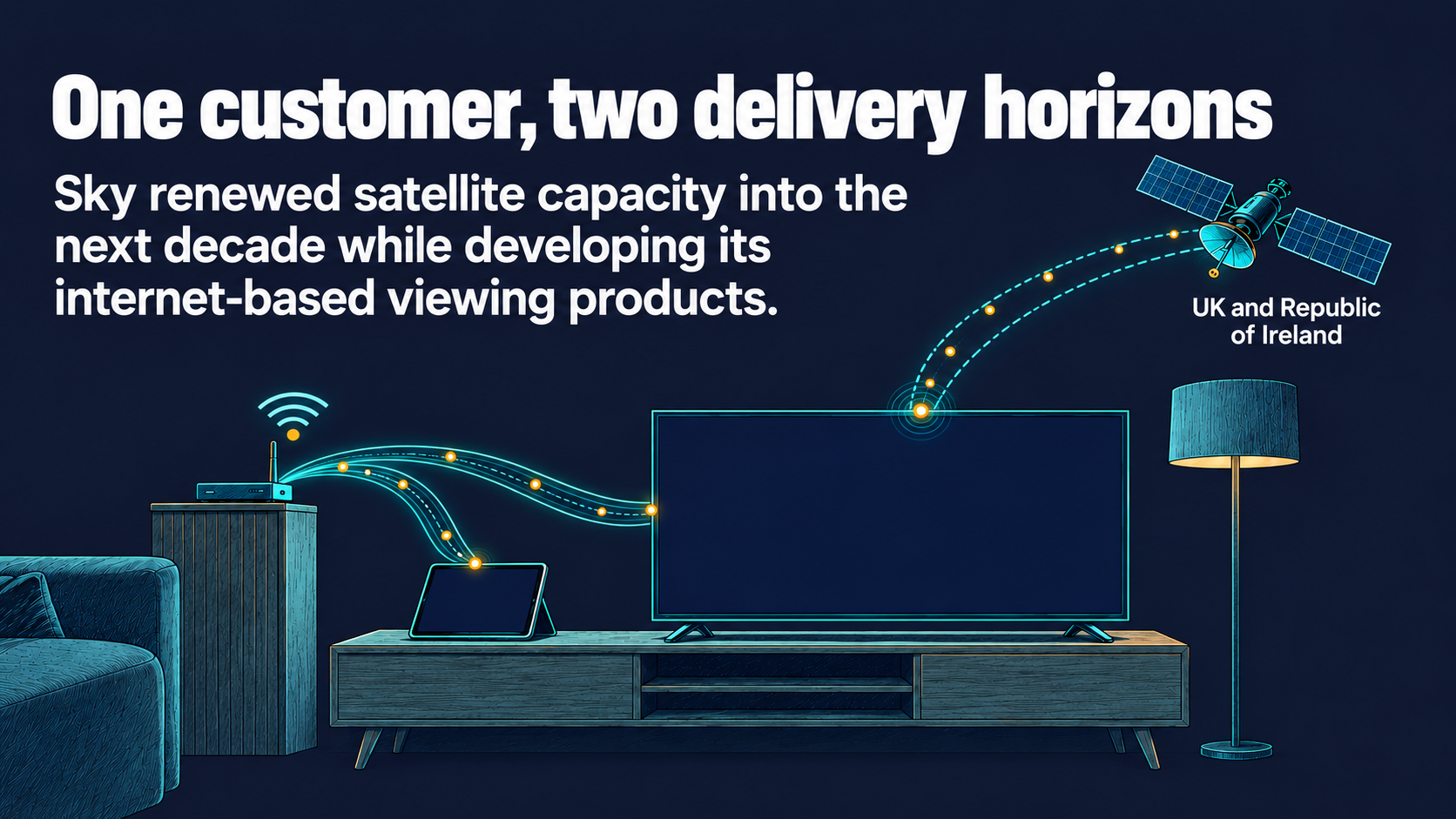
Space Insights editorial illustration of Sky's satellite and internet delivery routes.
Sky's September announcements give satellite suppliers two different views of the same customer. On 30 September 2026, SES announced a multi-year capacity renewal for Sky's direct-to-home television services in the United Kingdom and Republic of Ireland, extending into the next decade. Earlier that month, Sky had introduced an upgraded mobile app for customers of its Glass and Stream products. Customer continuity and product development are advancing alongside each other. SES's renewal announcement, Sky's app announcement.
For a capacity provider, the useful distinction is between the technology receiving new features and the infrastructure a customer continues to purchase. A product roadmap describes one; a contract establishes the other. Reading both produces a firmer basis for a commercial discussion than treating every streaming development as a timetable for satellite withdrawal.
Two delivery routes serve one customer relationship
The SES agreement covers continued use of satellite capacity at 28.2 degrees East for television distribution across the UK and Ireland. In the announcement, Sky's Group Chief Operating Officer, Nick Herm, connects that purchase to the reliability, reach and service quality expected by its satellite customers. He places it alongside wider choice in how customers access Sky. SES and Sky.
Sky's streaming development has a different focus. Its 8 September Sky Go update connects Glass and Stream customers' television experience with mobile and tablet viewing, including continuing programmes across devices and accessing saved content. The product work concerns how customers find and use entertainment across screens. Sky Go update.
The underlying alternative to a satellite dish is already a marketed product. Sky's February 2025 Glass announcement describes television delivered over Wi-Fi, with the service built into the screen. That record supplies the technological context for the September app work: these are developments around an established internet-delivery route. Sky Glass product description.
The combination is commercially useful because the customer can buy continuity in one route while improving the experience in another. A supplier assessing Sky therefore needs a more specific unit of analysis than the company's newest product: the service being supported and the households that use it.
The contract horizon informs a different decision
A capacity agreement extending into the next decade gives SES a defined customer requirement over multiple years. It provides a planning horizon for the contracted television service, while the streaming announcements describe development of a parallel offer. Those records answer different questions about demand.
For commercial teams, this suggests a practical distinction in account planning. A proposal supporting satellite distribution can be evaluated around service continuity, coverage and delivery quality. A proposal aimed at a streaming product has to connect to that product's experience and delivery requirements. Both discussions can concern the same customer without representing the same purchase.
The renewal is also consistent with maintaining service for an existing customer base through a technology transition. That interpretation fits the evidence just as well as a broader expansion narrative: the disclosed commitment is to continue satellite delivery. The more informative future disclosures would identify changes in the capacity purchased, the service supported or the renewal period.
Follow the purchase alongside the product
Sky's next product update will show how its viewing offer develops. Future capacity disclosures will show how satellite provision evolves alongside it. Keeping those records together would reveal whether the two tracks remain complementary and where their requirements change.
For the space sector, the September pair makes a specific form of demand visible: a customer developing internet-based products has also renewed the satellite infrastructure serving its existing viewers. The resulting opportunity is grounded in an identifiable service commitment and its duration.
Get briefings like this every Friday.
Subscribe