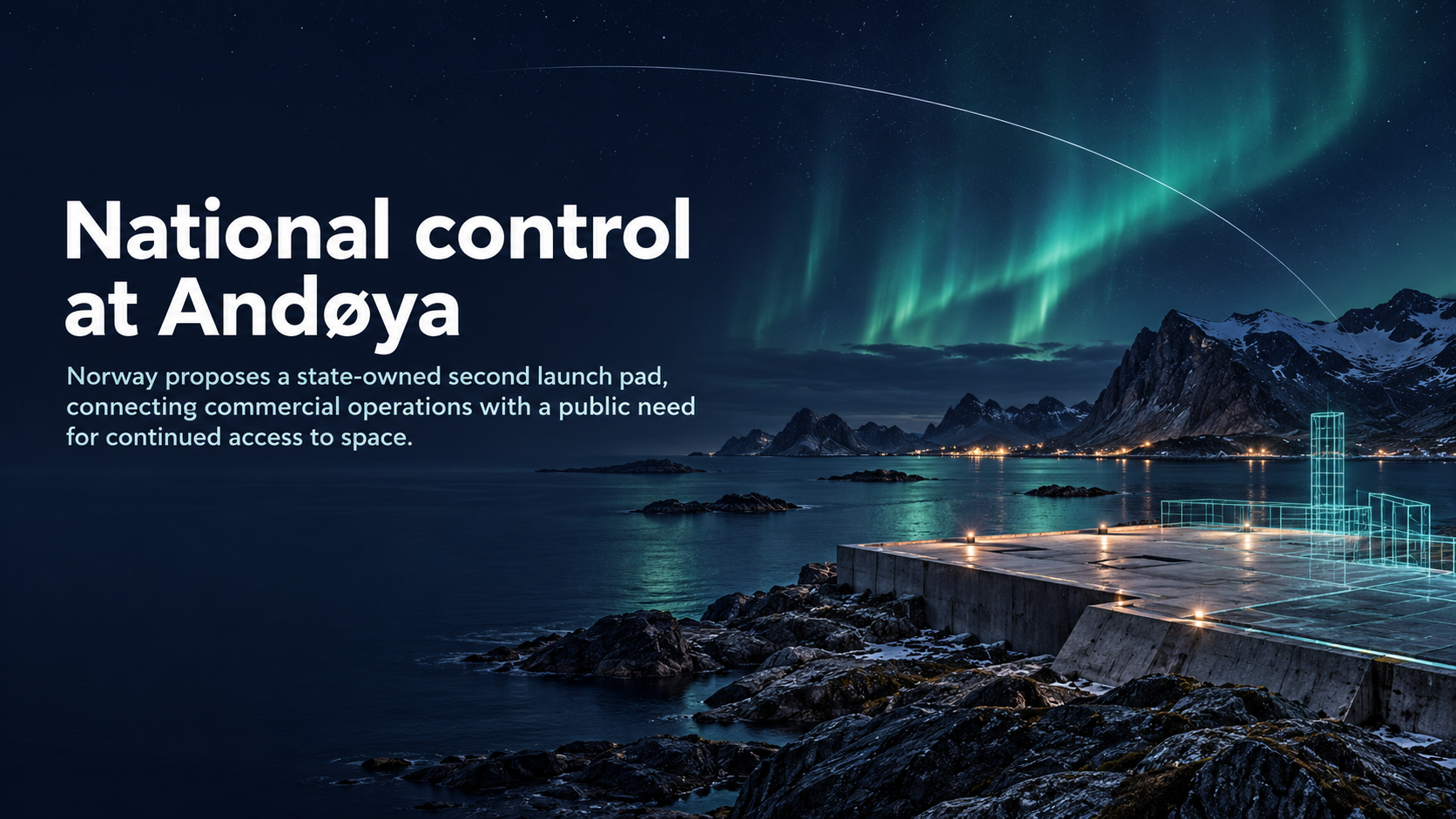
Space Insights editorial illustration of launch infrastructure; not a rendering of the proposed Andøya launch pad.
Norway's proposed expansion at Andøya, expected to cost NOK646 million in total, gives national control a concrete asset: a second launch pad owned by the state and leased to the spaceport operator. The government puts security and European access to space at the centre of its case for the investment, bringing defence and industrial policy into the same project. Government announcement.
The proposal follows an orbital flight from the existing site. On 5 September, Isar Aerospace reported that Spectrum's second flight had reached orbit and deployed payloads from its dedicated Andøya launch complex. The starting point is a spaceport already used by a commercial launcher, with a further public investment now proposed around it. Isar flight announcement.
A public asset with a launch-access mission
The 7 October announcement proposes NOK323.3 million for 2027, shared between the Defence and Trade and Industry budgets. That allocation forms part of an expected NOK646 million total over 2027 and 2028, with completion targeted for 2028. Forsvarsbygg would establish the infrastructure; Andøya Spaceport would lease it through a long-term agreement. Defence Minister Tore O. Sandvik explicitly connects the arrangement to national control and European security. Government announcement.
The budget proposition explains the operational need behind that argument: satellites support critical civilian functions and defence, and short-notice launch access can help replace lost capacity or meet new needs. It proposes that the state build and manage the infrastructure while the Andøya operator retains launch control and agreements with launch companies. The detailed management model remains under clarification. Defence budget proposition.
Read together, those provisions make the public investment case broader than additional commercial throughput. Norway wants infrastructure it can retain under national control, while commercial launch operations continue through an operator. For companies assessing the expansion, the state's reason for funding the asset therefore includes continuity of access alongside the business of selling launch services.
The flight and the facility answer different readiness questions
Isar's September mission supplies a concrete demonstration of orbital flight from the existing complex. It gives the proposed expansion a different context from a spaceport awaiting its first successful orbital mission. Isar's own announcement also identifies the next industrial task: scaling launch-vehicle production and delivering its order pipeline. Isar flight announcement.
The combination is useful because dependable launch access involves both a place to fly from and vehicles ready to use it. Norway's proposal addresses the infrastructure side of that relationship. Repeated missions and vehicle production will establish how frequently the demonstrated capability can be used. The strategic argument for retaining a facility can consequently advance before the full operating rhythm has been established.
Esrange offers another route to securing access
In Sweden, SSC has secured the full payload capacity on two Firefly Alpha launches from Esrange, which it owns and operates. The September agreement allows SSC to allocate that capacity to government and commercial customers. Firefly targets the missions no earlier than 2028 and identifies Swedish national-security and commercial rideshare customers as the intended users. SSC agreement, Firefly announcement.
The two developments show different ways to secure northern European launch access. Norway is proposing public ownership of additional infrastructure; SSC has contracted capacity on specific future flights using a US launcher. National control of a facility and control over flight capacity can sit within different industrial partnerships. That makes the ownership and purchasing arrangements a more informative measure of access than the launch site's European location alone.
Sources
- 1.Isar Aerospace reaches orbit and deploys payloads on second flight — Isar Aerospace
- 2.Mot nye høgder på Andøya — Norwegian Government
- 3.Prop. 1 S (2026–2027), Forsvarsdepartementet — Norwegian Government
- 4.Statsbudsjettet 2027: foreign affairs and defence case — Stortinget
- 5.SSC Space signs contract with Firefly for two Alpha launches from Esrange — SSC
- 6.Firefly Aerospace signs contract with SSC Space for two Alpha launches — Firefly Aerospace
Get briefings like this every Friday.
Subscribe