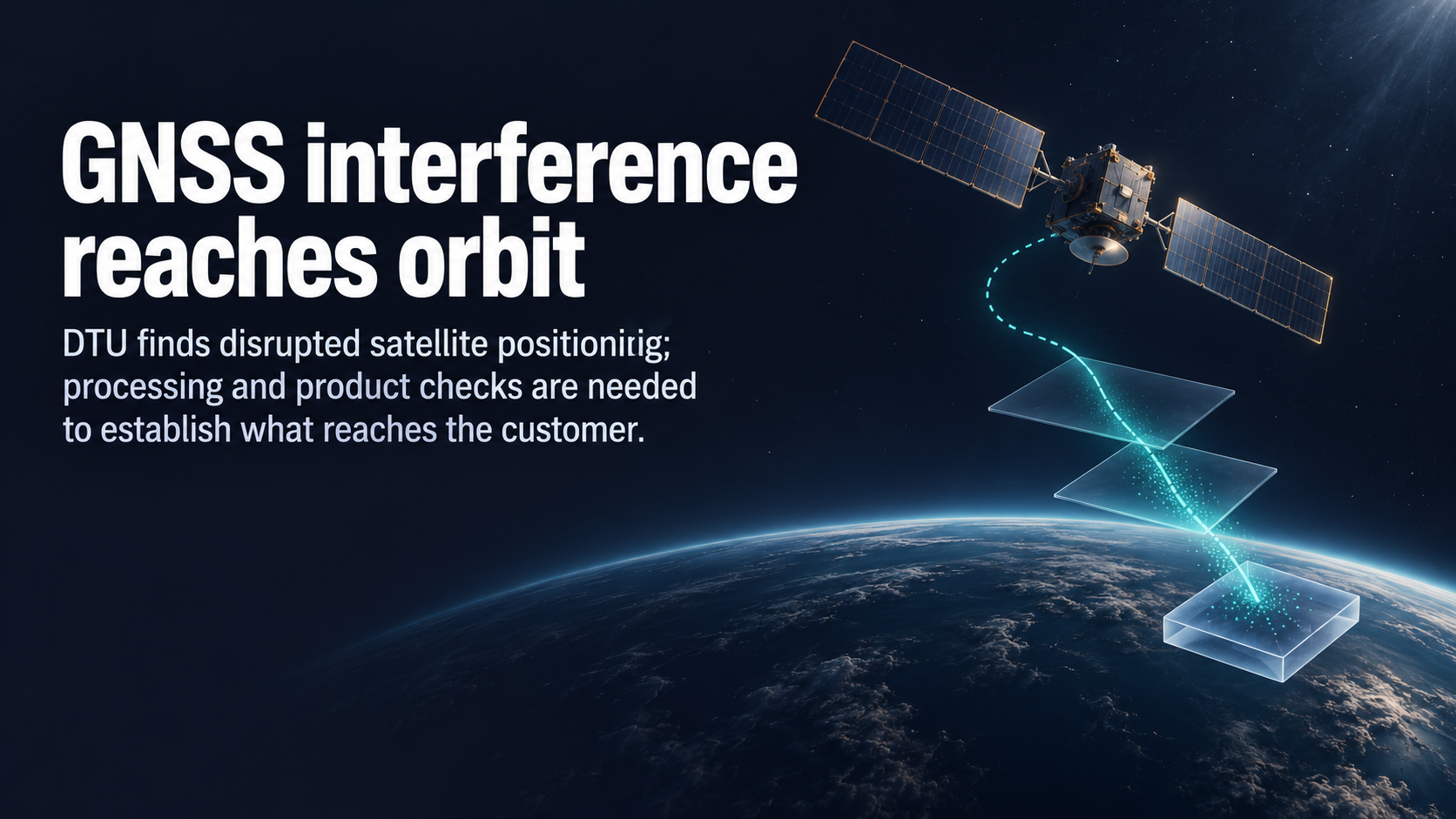
Space Insights editorial illustration of satellite positioning and product-quality checks; not a measurement of interference or an operational processing diagram.
GNSS interference affecting aircraft and ships over Europe also reaches satellites in orbit. DTU Space reports cases in which spacecraft temporarily lost accurate positioning information from their navigation receivers. For an Earth observation business, the exposure extends into the system that establishes where its measurements were taken. DTU's 13 October report.
The commercial significance depends on what survives processing. A reception problem can be recorded aboard a satellite while the final product still meets its accuracy requirement. Establishing that outcome takes evidence from the orbit solution and the product itself. This is where a broad claim of resilience can become a measurable statement about a delivery.
The finding is wider than one receiver
The DTU study draws on several years of observations from different spacecraft and receiver designs. Similar anomalies across those systems support the researchers' interpretation that the external signal environment is involved. Effects vary with the spacecraft and its GNSS configuration; the October announcement describes research into an existing phenomenon. Research paper, discussion and limitations.
Lead author Kian Bostani Nezhad notes that operators are likely to recognise the problem in their own spacecraft records, although “it is rarely discussed publicly”. That makes the research useful beyond the operations team: it gives product managers and customers a public basis for asking how positioning disturbances are handled. DTU report.
The source of the disturbance and its effect on a product are separate investigations. DTU says its SAT-JAM map shows where satellites experience interference, but cannot by itself identify the exact transmitter or establish intent. It provides delayed research observations. The evidence supports examining an operational dependency without assigning responsibility to a particular actor. SAT-JAM documentation.
A measurable interruption in the processing chain
One finding concerns cycle slips: breaks in the continuity of carrier-phase measurements used for precise positioning. The paper explains that these discontinuities must be identified and repaired before precise point positioning can be achieved. This gives mission and product teams a specific mechanism to examine, beyond the general observation that reception has worsened. Research paper, discussion.
Copernicus already publishes an approach to assessing precise orbit products. Its checks include the observations used in processing, measurement residuals and comparisons with independently calculated orbits. These are established quality controls, with evidence about the processed result rather than only the incoming navigation signal. Copernicus precise orbit determination.
Read together, the research and that quality process suggest a practical test. For a period with degraded reception, examine whether orbit-quality measures remain within the relevant requirements, then examine the validation of the resulting Earth observation product. The answer can distinguish successful handling of a disturbance from a delivery that needs qualification.
What would change the customer's assessment
A customer buying a positioning-sensitive data product has a more useful question than whether interference was detected at all: what evidence shows that the delivered product remained fit for its intended use during the affected interval?
A documented example connecting receiver observations, orbit-quality results and product validation would answer that question. It could demonstrate that existing processing preserved quality, or reveal a specific limitation the customer needs to understand. The research does not yet establish such an outcome for a particular customer delivery.
For suppliers, the opportunity is to make resilience demonstrable at the level of the product they sell. An interference map identifies an environment to investigate; evidence from the processing and validation chain establishes what that environment meant for the customer.
Get briefings like this every Friday.
Subscribe