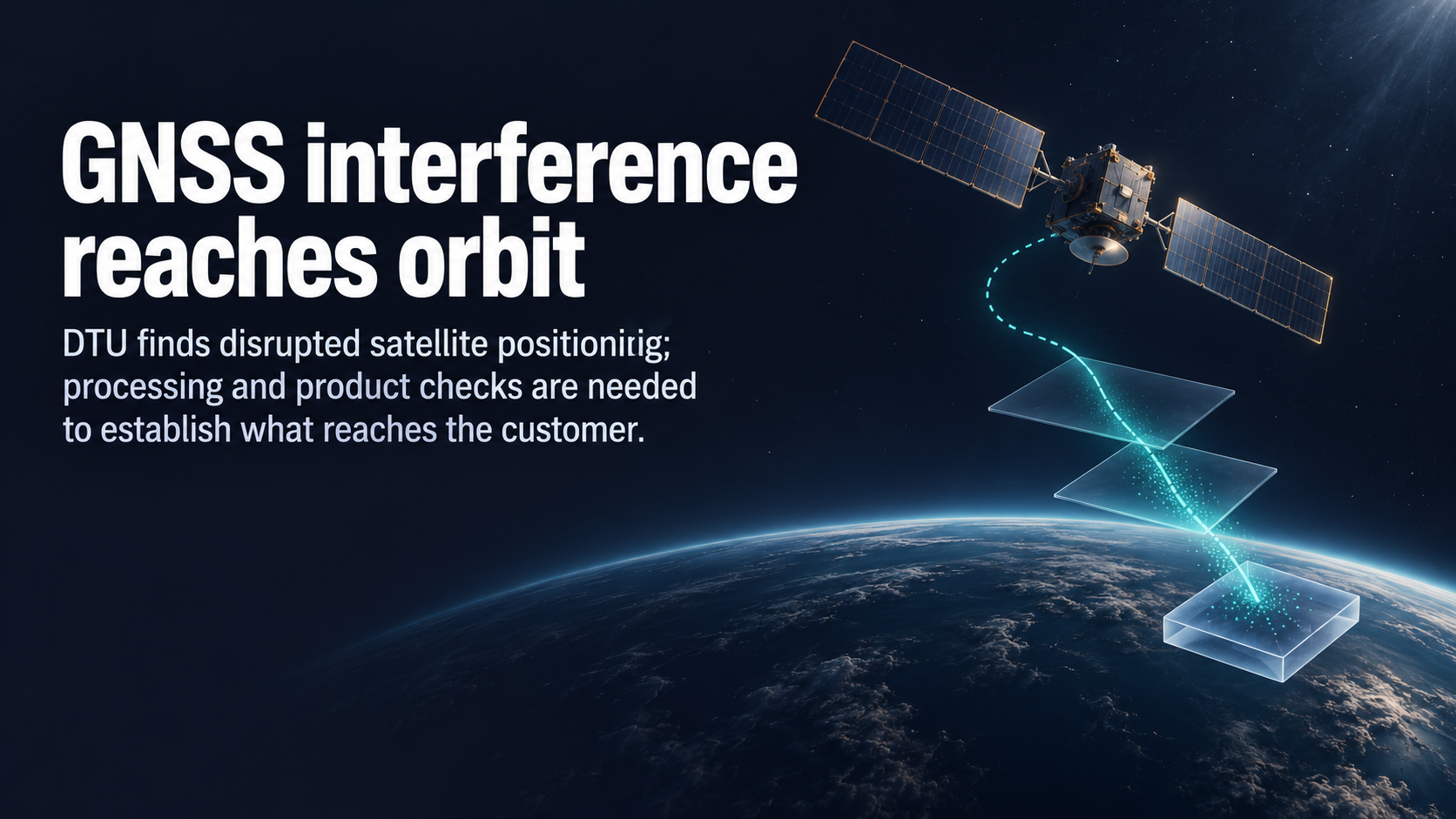
Space Insights editorial illustration of satellite data supporting solar-panel maintenance; not a depiction of an operational Galp system.
Galp's solar-panel challenge starts from an existing capability: the Copernicus Atmosphere Monitoring Service already forecasts atmospheric dust, including Saharan dust affecting the Iberian Peninsula. The missing step is an estimate of what that dust means for a particular plant's production, and whether cleaning is worth doing. ESA's published challenge connects satellite observations with rainfall, asset data and energy prices to address that decision. Published challenges, section 2.2.1.
For an Earth-observation team, this is a useful view of where a prospective customer's problem begins. A better environmental measurement may help. The product opportunity lies in connecting that measurement to an action whose value the plant operator can assess.
ESA's Space for Sustainable Industry and Digital Business Transformation Contest invites six-month proof-of-concept studies and closes on 4 November 2026. Its challenge owners include Coca-Cola, P&G, Galp and Tomorrowland/Love Tomorrow. Three of their published problems show how differently a space capability can contribute to an industrial product. ESA call.
Galp: the value of a forecast depends on the maintenance choice
The difficult product step is connecting conditions in the atmosphere to losses at a plant. Rain can change the cleaning requirement; the value of recovered generation depends on energy prices. A dust signal alone leaves those parts of the decision unresolved.
A useful six-month demonstration could therefore compare cleaning recommendations against a defined baseline, using the same weather and operational records. The test would show whether additional information changes the recommended action and its expected value. This would test the recommendation against evidence from the plant itself.
This also makes the partnership need concrete. A team strong in observation and forecasting may need plant-performance data and maintenance expertise before it can test the decision it promises to improve. Access to those inputs is part of the feasibility of the demonstration.
Love Tomorrow: change the site plan before the site exists
Love Tomorrow describes a temporary city whose power, water, mobility, weather and other systems are planned in separate tools. Its challenge seeks a shared predictive environment to test their interaction before deployment and compare planned with actual performance. Published challenges, section 2.3.4.
The product test here is a planning comparison. A demonstrator could hold a weather scenario constant, change a site configuration and show the consequences across the connected systems. Planners would then have a reason to use the model before equipment arrives. The satellite contribution earns its place through the planning result it helps produce.
That is a different demonstration from Galp's plant-level prediction. It calls for a model able to compare choices across interacting systems, together with a way to check those choices against eventual operations.
P&G: transfer a process that changes the resource balance
P&G seeks lower-energy recovery of valuable molecules from dilute water streams. The challenge identifies water recovery, life-support and closed-loop technologies developed for space as possible routes to industrial applications. Published challenges, section 2.4.2.
A useful experiment would make the trade-off measurable: molecule recovery, energy and water use, and performance over repeated cycles under stated conditions. The contribution could come from a separation process or material. A satellite-data interface would have little relevance unless it helped solve that particular recovery problem.
Choose a result that six months can establish
The three opportunities imply distinct outputs: a maintenance recommendation, a comparison of site plans and a process-performance result. Each makes it possible to define success before choosing the demonstration's components. For founders and product leads, that is valuable information about the capability and operational access their proposed team needs.
The immediate deadline is 4 November. Funding eligibility is limited to the countries listed in the call, and the full proposal requires written national-delegation authorisation. Winning teams would receive a Cooperative Agreement for the study and access to the participating corporate partner; commercial adoption would follow a separate decision. Application requirements.
A focused proposal can use those six months to resolve one consequential uncertainty for the named user. The strongest starting point is a result the user can assess with its own operational evidence.
Get briefings like this every Friday.
Subscribe