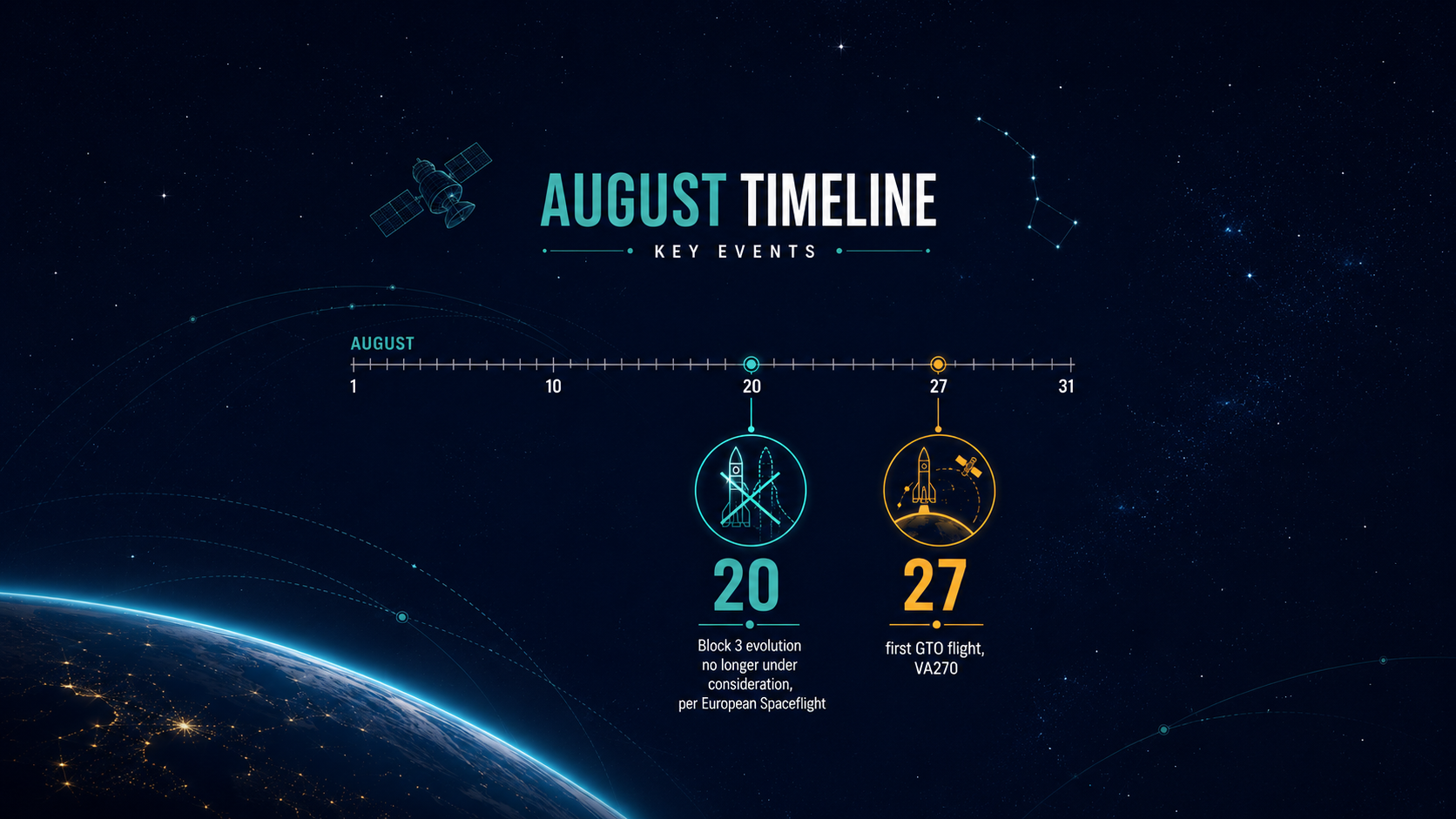
VA270 was the ninth Ariane 6 launch and the first to a geostationary transfer orbit, the profile telecommunications operators buy. In the same month ESA confirmed it is no longer considering the Block 3 evolution, leaving the current configuration and its near-term upgrades as the path on public record. Space Insights.
MTG-I2 launched on Thursday 27 August 2026 at 22:11 CEST from Europe's Spaceport in French Guiana, aboard Ariane 6, flight VA270. ESA records it as the ninth launch of Ariane 6 and the first to take a satellite to geostationary transfer orbit.
The payload completes a set. Meteosat Third Generation now has its first imager, launched in 2022, the sounder launched in 2025, and MTG-I2 as the second imager, providing continuity and operational resilience. The first two are already commissioned and handed over to Eumetsat, which operates the system in service. Commissioning of MTG-I2 runs over the coming weeks and months, after which it delivers high-resolution images of the atmosphere over Europe and northern Africa every two and a half minutes.
Why the orbit, not the payload, is the read
For a meteorological programme, the milestone is the trio. For European launch, it is the profile flown to get there.
Geostationary transfer orbit is the commercial workhorse case, in a framing neither source uses: it is the trajectory telecommunications operators buy, and demonstrating it is a different proposition from the low Earth orbit and sun-synchronous missions a vehicle can accumulate while its commercial manifest waits. Until 27 August, Ariane 6 had not flown it.
That is now on the record, with a European institutional payload rather than a test article, and with a commissioning campaign attached rather than a demonstration objective.
What sits beside it on the record
European Spaceflight reported on 20 August that an ESA spokesperson confirmed the agency is no longer considering the Ariane 6 Block 3 evolution, and that there is no programme need or justification for it at this time. "Shelved" is the publication's word rather than the agency's. Block 3 was the evolution beyond Block 2, which the reporting describes as the rocket's final major version, and was built around the ICARUS lightweight upper stage and its carbon-composite structures.
Work on the current configuration continues. Per the same reporting, the P160C boosters and a lighter Vulcain aft bay are the near-term upgrades — VA270 itself flew on the earlier P120C motors — the Astris orbital transfer vehicle is planned for around 2029, and the agency's stated position is that Ariane 6 will continue to evolve whenever new mission requirements justify further developments.
The Space Insights read
Placing these two items side by side is our reading. Neither ESA nor the reporting on Block 3 refers to the other.
What the record shows in a single month is a launcher demonstrating the orbit at the centre of its commercial case, and the Block 3 evolution of that same launcher no longer under consideration. Those are compatible facts. A vehicle can be commercially viable in its current configuration and still have the evolution beyond that configuration set aside, which is close to what the agency itself says: further development follows new mission requirements.
For an operator choosing a launch provider for a geostationary mission in the next three years, the useful reading is narrow: the profile is now demonstrated, and the path on public record is the current configuration with its near-term upgrades rather than the Block 3 evolution.
Get briefings like this every Friday.
Subscribe