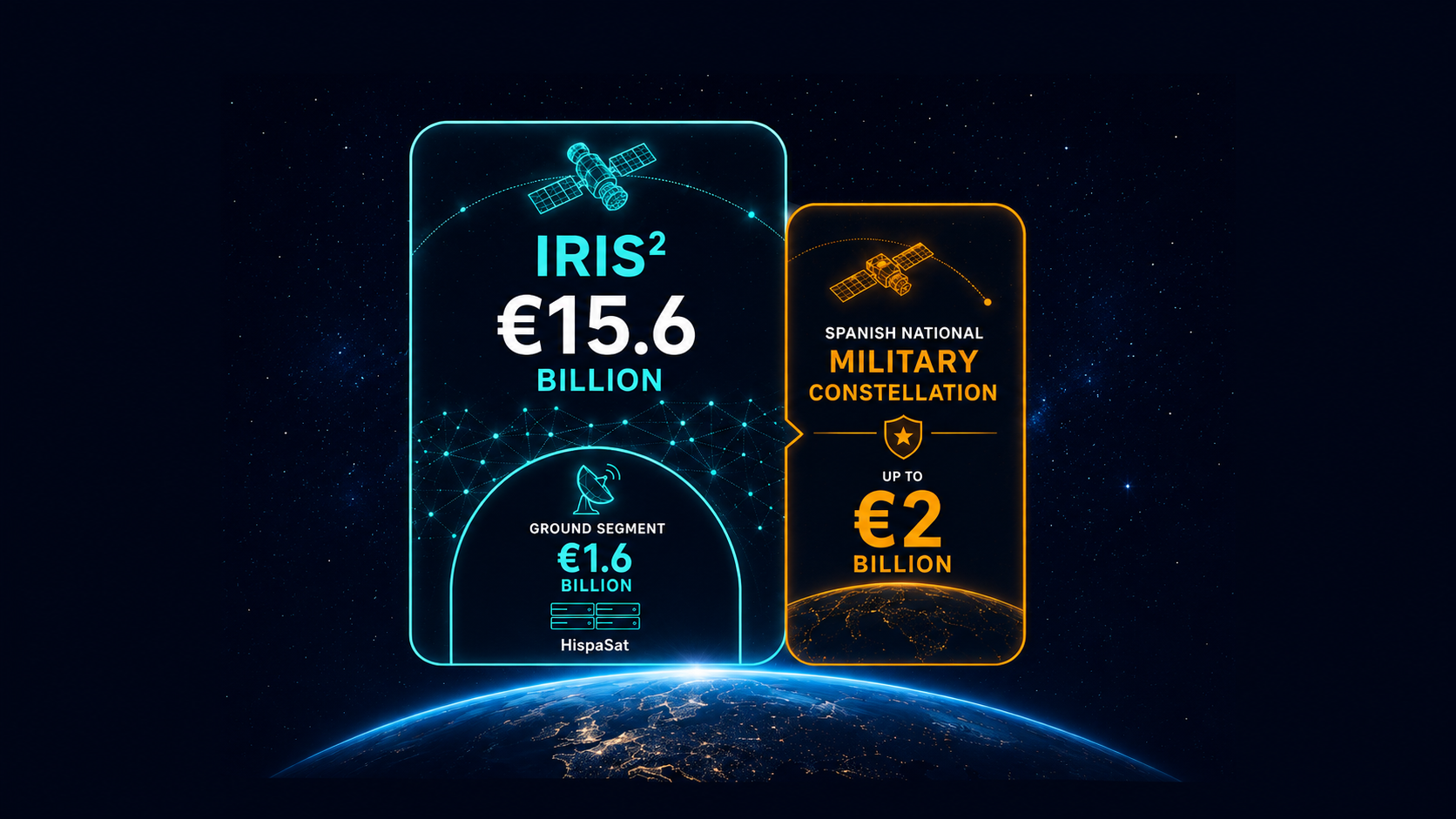
The €1.6 billion ground-segment primeship sits inside IRIS², whose planned investment exceeds €15.6 billion; the defence ministry's up-to-€2 billion programme sits beside it, with integration stated as a possibility rather than a commitment. The $18 billion and $2.3 billion figures in English-language coverage are conversions of the euro sums, not additional money. Space Insights.
HispaSat, an Indra Group company operating under the group's Indra Space umbrella, has been named prime contractor for the IRIS² ground segment, covering antenna infrastructure, control systems and ground network connectivity, at a value exceeding €1.6 billion. Indra Group's 7 August release describes it as the largest and most complex system developed to date in Europe for a space programme.
Two further commitments sit in the same release. HispaSat will lead development of the constellation's very low Earth orbit layer, below 750 km, which is intended for direct-to-device and Internet of Things connectivity. And it has committed an investment of up to €600 million of its own in exchange for exploitation rights in regions of high strategic and commercial interest.
The figure sits inside a larger one. IRIS²'s total planned investment exceeds €15.6 billion, composed of up to €4 billion from the SpaceRISE consortium members and €11.6 billion of public investment from the European Commission and ESA. First launches are scheduled for 2029, with initial services from 2030. The consortium is three operators: Eutelsat of France, HispaSat of Spain, and SES of Luxembourg.
A note on the figures
Coverage of this announcement renders the programme total in dollars: Breaking Defense's headline gives it as $18 billion. That is a conversion of the €15.6 billion, not a separate or larger commitment. The same applies one level down, where SpaceNews renders the Spanish defence allocation as up to $2.3 billion, which is the euro figure converted rather than a second sum. Anyone assembling a picture of IRIS²'s cost from mixed-currency reporting will overstate it, and this publication has met the same conversion trap on Poland's national contribution in W35 and on Eutelsat's capital commitments in W34.
The euro figures are the ones the programme is denominated in.
The second position
Separately, Spain's Ministry of Defence has presented a Special Modernisation Programme with a budget of up to €2 billion for national satellite communications capability, which the government says could later be integrated into IRIS². Indra Group's release describes that programme as financing an additional national contribution and Spain's own satellite capabilities, including nationwide coverage and deployments of interest to its defence.
Those two facts are not in tension, but they are different in kind. The HispaSat primeship is a contract inside the shared programme, held by a Spanish operator on behalf of the whole constellation. The defence allocation is national money for national capability that would sit alongside the programme rather than form part of it.
The Space Insights read
Reading the two together as a single national position is ours. Neither the consortium nor the ministry presents them that way.
This publication drew a distinction on 26 August between financing assets inside the shared programme, as Poland has done, and allocating beside it, as Spain has. Poland's money is not a passive contribution either: per SpaceNews it buys twelve satellites, six in medium Earth orbit and six in low Earth orbit, and a gateway of its own, inside the concession. Spain is doing both: industrial control of the layer the constellation's traffic must transit, and a nationally funded layer whose connection to the programme is stated as a possibility rather than as a commitment.
For a supplier, the practical consequence is where to knock. Ground-segment work on IRIS² routes through a Spanish prime. National military capacity routes through Madrid on a separate procurement with different eligibility. They are not the same opportunity, and one bid is unlikely to satisfy both.
Sources
- 1.HispaSat confirms its commitment to IRIS2 and will be the prime contractor for the ground segment, which exceeds 1.6 billion euros — Indra Group
- 2.EU lays out $18B satellite constellation plan, with Spanish firm winning key role — Breaking Defense
- 3.Spain commits up to $2.3 billion for national military communications for IRIS² — SpaceNews
Get briefings like this every Friday.
Subscribe