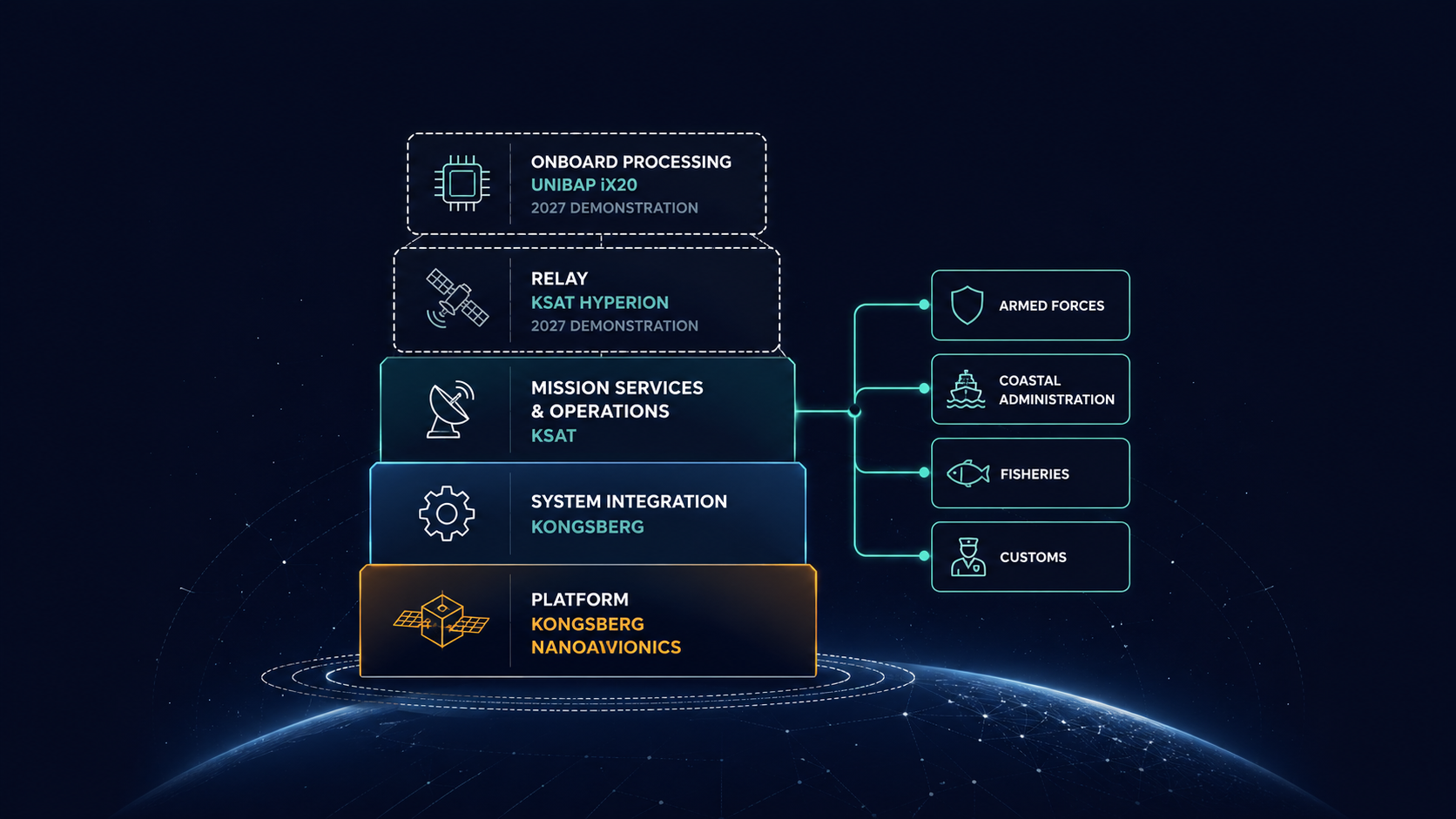
Platform and system integration sit inside the Kongsberg group; mission services and ground operations are KSAT's, a fifty-fifty joint venture with the state-owned Space Norway. The relay and onboard processing layers are not yet flying, and are not all Norwegian: Hyperion is targeted for late 2027, with optical terminals from Rocket Lab and Sony Space Communications and a Swedish compute payload. Space Insights.
Kongsberg has announced that it will add three more N3X satellites in early 2027, taking the maritime surveillance constellation from the three launched in 2025 to six.
The division of labour is stated. Kongsberg NanoAvionics manufactures the satellite platforms. KONGSBERG provides overall system integration. KSAT handles ground services and satellite operations. No contract value is published.
What the constellation does is also stated: detecting and tracking dark vessels, identifying AIS spoofing attempts, and monitoring anomalous maritime activity, with the goal described as national maritime situational awareness for Norway and international partners. The expansion is framed in terms of revisit rate and near real-time coverage rather than new sensing capability.
The named users are four Norwegian state bodies — the Armed Forces, the Coastal Administration, the Directorate of Fisheries, and Customs — with allied and partner nations also named as recipients.
Three more announcements, the same week
Taken alone, a constellation doubling is a procurement note. Three KSAT announcements from the same week change what it describes.
KSAT set out its role delivering Integrated Mission Services for the N3X constellation, the layer between the satellites and the users: satellite operations, mission planning, global ground station access, data processing and data delivery. It opened the first customer demonstration campaigns on Hyperion, the pathfinder mission for HYPER, its planned hybrid radio-frequency and optical relay network. And it agreed with Unibap Space Solutions of Sweden to fly Unibap's iX20 edge computing platform on the first two Hyperion satellites; the first iX20 unit has already been delivered to KSAT for integration.
Set end to end, the chain reads: platform, system integration, mission services, ground operations, relay, onboard processing. Every layer named in a single week, though setting them end to end is a Space Insights reading, not either company's. The first two, platform and system integration, sit inside the Kongsberg group; mission services and ground operations are KSAT's, which is a fifty-fifty joint venture between Kongsberg Defence & Aerospace and the state-owned Space Norway rather than a subsidiary. The last two are not yet flying and are not all Norwegian: the first Hyperion satellites are targeted for launch in late 2027, they carry optical terminals from Rocket Lab and from Sony Space Communications, and the compute payload is Swedish.
Why the chain, not the component, is the read
European capability discussions usually turn on which component a country can build. This is a different shape: a small state with a named supplier at every layer of a surveillance service, from the bus to the processing. The operating layers sit inside one national group; the two forward layers do not.
The consequence a reader can plan around is about procurement rather than technology. A buyer of maritime domain awareness in Europe now has a supplier that can be contracted for the service rather than for a component. The relay path is a separate question: HYPER is a planned network whose pathfinder has not launched, so it is a 2027 proposition rather than a present capability. For anyone selling into the operating part of that chain, the entry points are narrower than they would be for a constellation assembled from several national suppliers.
The schedule is the other planning fact. Three further satellites in early 2027, taking the constellation to six, is roughly six months from the announcement, stated with a revisit improvement attached rather than as an aspiration. The first three have been in orbit since 2025.
The Space Insights read
Reading four separate announcements as one stack is ours. Neither company presents them as a single programme, and the KSAT items are not exclusive to N3X.
Two of this week's signals concern navigation and identification signals that cannot be trusted. This constellation lists AIS spoofing detection among its functions; Poland's National Institute of Telecommunications has been measuring deliberate GNSS interference on the country's northern coast (Space Insights W36 coverage; primary source the institute's published analysis). Nothing connects the two announcements, and nothing in the Kongsberg release presents the expansion as a response to interference. What can be said is narrower and still useful: the ability to tell a real vessel track from a falsified one is being bought at one end of northern Europe and measured at the other, in the same month. The waters are not the same: N3X is stated for Norwegian maritime awareness, and the Polish measurements are from the Baltic coast at Gdańsk.
Get briefings like this every Friday.
Subscribe