Artemis III Booster Segments Ship: ESM-3 and Europe's Role on NASA's Revised Mission Path. Space Insights.
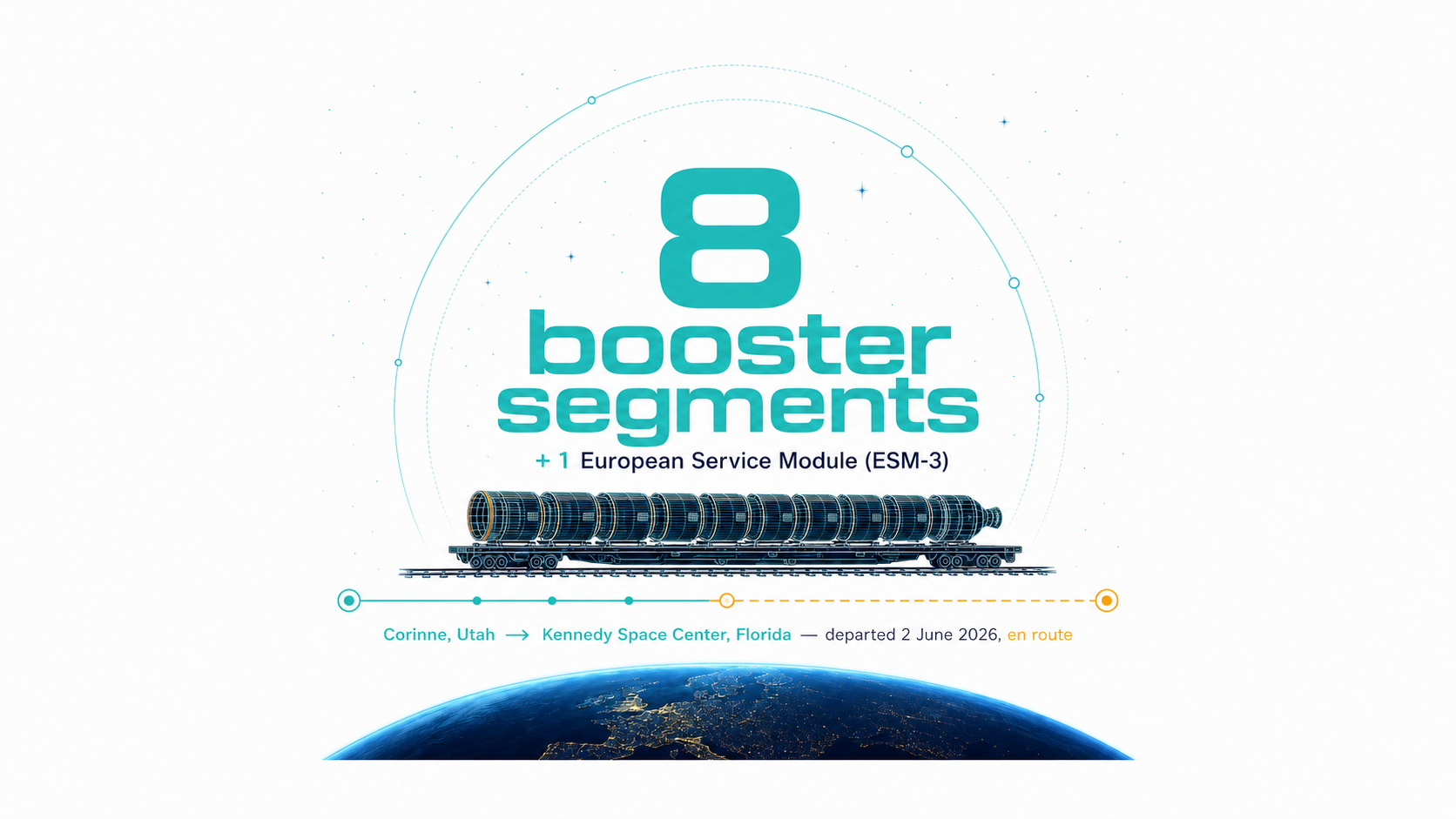
The final motor segments for the Artemis III boosters left Utah for Florida on 2 June 2026. According to NASA, eight booster motor segments shipped by rail from Northrop Grumman's facility in Corinne, Utah, and are en route to the Kennedy Space Center, where they will form the mission's twin solid rocket boosters. It is a routine-sounding logistics milestone for a United States exploration programme. For a European reader, the more useful fact is on the Orion side of the same mission: ESM-3, the Airbus-built European Service Module that propels and powers the Orion spacecraft, is a mission-critical element of a flagship American crewed mission. The module is not on the Utah train; per Airbus and ESA, ESM-3 was delivered to Kennedy in September 2024, so the European hardware is already on site.
That combination — a US SLS launch system and a European-built Orion service module — is the structural feature worth tracking, particularly in a year when European institutions are openly debating how much of Europe's space future should depend on programmes decided elsewhere.
What actually shipped, and what Artemis III is
NASA's Space Launch System (SLS) is the agency's super-heavy-lift rocket for crewed deep-space missions. Its two solid rocket boosters, built by Northrop Grumman as booster lead contractor, are each assembled from five motor segments. NASA states that the boosters together produce more than 75% of the vehicle's total thrust at lift-off, and that with the four RS-25 core-stage engines the SLS generates more than 8.8 million pounds of thrust. NASA notes that the motor segments are the largest of the boosters' three major assemblies; the 2 June shipment of eight segments is the final motor-segment delivery for the Artemis III boosters, now on its way to Kennedy.
A point of disambiguation matters here, and it has changed in 2026. Artemis III is the first crewed mission to follow Artemis II, the crewed lunar flyby that completed its ten-day mission with a splashdown on 10 April 2026. NASA currently lists Artemis III as the next Artemis crewed mission after Artemis II, targeted for 2027 — but under its current (2026) revised mission profile it is no longer the first crewed lunar landing: NASA now describes Artemis III as a crewed flight that will test rendezvous and docking between Orion and the commercial human landing systems, with crew delivered to the lunar surface on a later mission. The booster segments now heading to Kennedy are hardware for that next mission, Artemis III.
Where Europe sits on the launch stack
The European Service Module, or ESM, is the part of the Orion spacecraft that ESA provides to NASA. According to ESA and Airbus, it handles propulsion, electrical power, thermal control, and the air and water for the crew. ESA contracts the work to Airbus, with the modules integrated in Bremen and drawing on suppliers across Europe.
According to ESA and Airbus, ESM-3 is the module assigned to Artemis III; Airbus states that NASA and ESA have contracted for six European Service Modules in total (ESM-1 through ESM-6). The third module is part of that contracted ESM sequence built by Airbus; the European Spaceflight record notes it departed the Bremen integration halls for the United States following a 22 August 2024 ESA press release, and per Airbus, ESM-3 was delivered to NASA's Kennedy Space Center in September 2024. Airbus frames the wider significance plainly: it states that, for the first time, NASA has entrusted a non-US company to build a mission-critical element for a US human spaceflight mission.
That framing is the reason a US booster-logistics milestone belongs in a European intelligence brief. The hardware moving to Kennedy is American. The propulsion and life-support module that will carry the same crew, on the same SLS-Orion launch stack, is European, built under an ESA contract by a European prime — and already waiting in Florida.
Why a routine milestone matters for European planners
The analytical value is not in the shipment itself; rail movements of booster segments are a recurring event in any SLS campaign. The value is in what the milestone confirms about dependency direction.
For Artemis III specifically, European participation runs through the mission-critical node: the service module. The ESM gives Europe genuine leverage — a mission-critical role on a flagship US programme — and a genuine exposure. The cadence, scope and continuation of Orion missions are NASA-led decisions, not European ones. When the US side reshapes the programme, the European industrial base downstream of the ESM contract feels the schedule, not the decision.
This is not abstract for 2026. Under NASA's current (2026) revised Artemis III profile, the agency now describes Artemis III as a crewed rendezvous-and-docking test, with the first crewed lunar landing moved to a later mission. What has shifted in the sources is the public mission profile and the timeline, not the contracted hardware volume — Airbus continues to describe six firm flight models under contract. The European industrial base downstream of the ESM contract therefore tracks a programme whose mission cadence and sequencing are NASA-led, even where the module count is unchanged.
Space Insights cross-file editorial read: how this connects to the European autonomy debate
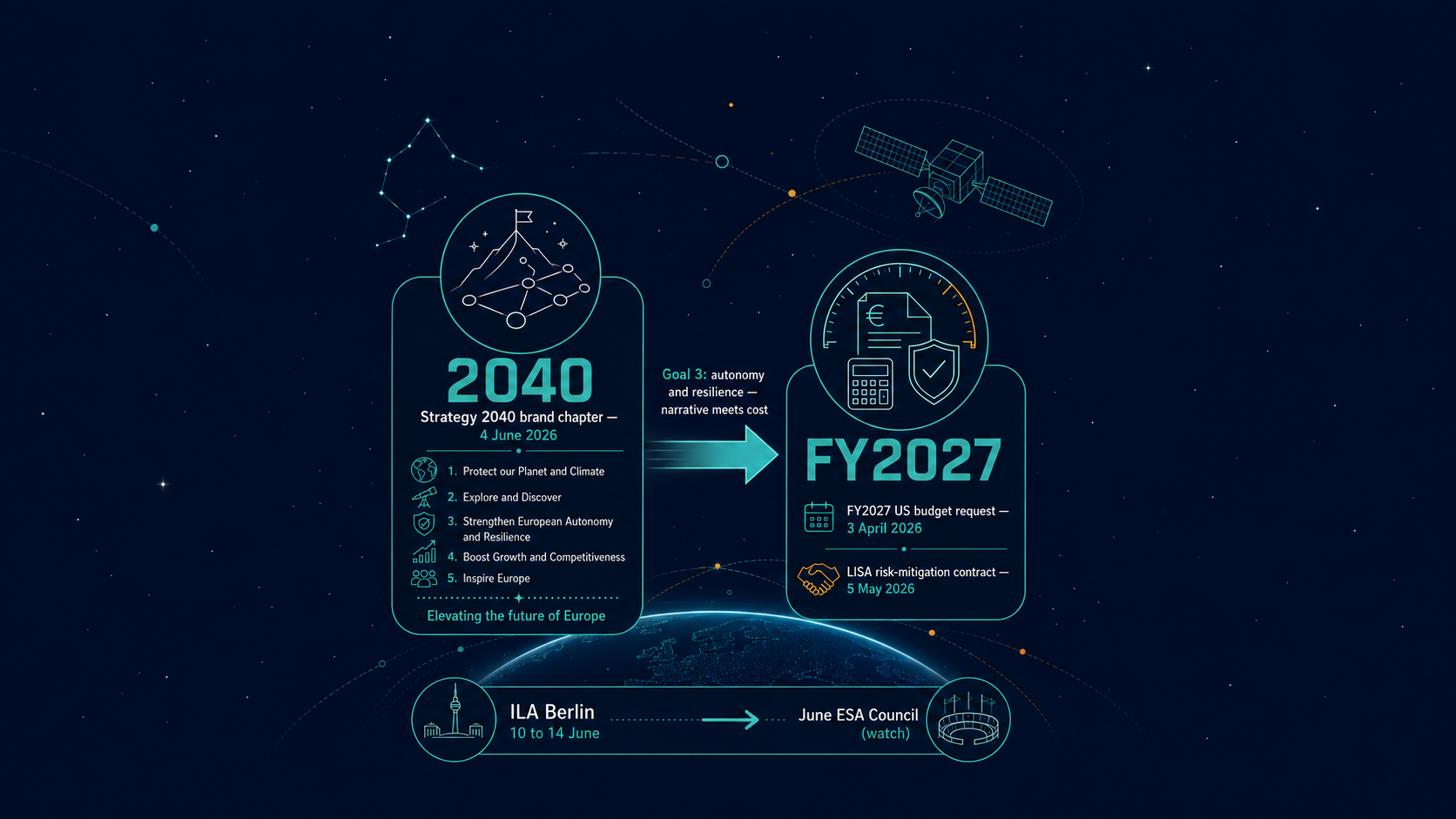
The timing places this signal alongside the wider European conversation about strategic autonomy in space. Space Insights reads the ESM mission-critical role against two other surfaces it is tracking this week: ESA's Strategy 2040 brand chapter, which puts "strengthen European autonomy and resilience" among its five goals, and other W24 signals on US budget pressure affecting transatlantic space cooperation. The June ESA Council is the next institutional venue worth watching as that autonomy question moves from framing towards commitment; this article does not impute any agenda item or decision to the Council, which is flagged as a venue to watch, not an outcome.
The European Service Module is the clearest live example of the participation model working — Europe holds a mission-critical role, with real industrial and technological return, inside a programme it does not control. Read against the autonomy debate, it illustrates both the upside (deep integration into the leading crewed-lunar effort) and the structural limit (Artemis mission cadence and sequencing are NASA-led decisions). The Artemis III booster milestone is a reminder that this dependency is now physical hardware moving toward a launch pad, not a policy abstraction.
This connection across the W24 surfaces — the ESM mission-critical role, the ESA Strategy 2040 brand chapter and the W24 US-budget-pressure signals — is a Space Insights editorial reading, not a connection made by NASA, ESA or Airbus. The source path for the prior surfaces is Space Insights' own W24 coverage (Signal 4, ESA Strategy 2040) alongside ESA's Strategy 2040 communication of 4 June 2026.
What is uncertain
Two things are genuinely open. The first is the future SLS and Orion flight cadence after the 2026 mission-profile revision: the public mission profile has changed — Artemis III is now described as a low-Earth-orbit rendezvous-and-docking demonstration, while Airbus identifies Artemis IV (scheduled for 2028) as the first crewed lunar landing mission of the 21st century — and the sequencing of the six contracted European Service Modules follows that manifest. The sources do not state that the module count is being cut — Airbus describes six firm flight models — so any reading that fewer than six ultimately fly would be an editorial inference, not a sourced fact. The second is the Artemis III launch date itself; booster hardware moving to Kennedy is a preparation milestone, not a confirmed launch schedule, and crewed mission dates have moved before.
What is not uncertain is the structural position: for the foreseeable Orion missions, Europe's industrial stake in crewed lunar exploration is concentrated in the service module, and the programme's direction is set on the US side. That is the fact European planners should carry forward from a shipment of eight booster segments.
Get briefings like this every Friday.
Subscribe