ESA's New Brand Chapter: Strategy 2040 Turns Autonomy Into a Planning Frame. Space Insights.
On 4 June 2026 the European Space Agency opened what it calls a new chapter for its brand, built on Strategy 2040 and the five goals that framework sets out. The refreshed identity is a communications exercise on its surface, but the substance worth tracking is the third of those goals, "strengthen European autonomy and resilience", because it arrives in the same month that, in Space Insights' reading, autonomy looks less like a slogan and more like a budget question. The rebrand lands days before ESA's planned presence at ILA Berlin and against a live US budget proposal — a US executive request, not an enacted appropriation — that, as analysed by The Planetary Society, would remove or put at risk NASA support for several ESA-linked missions.
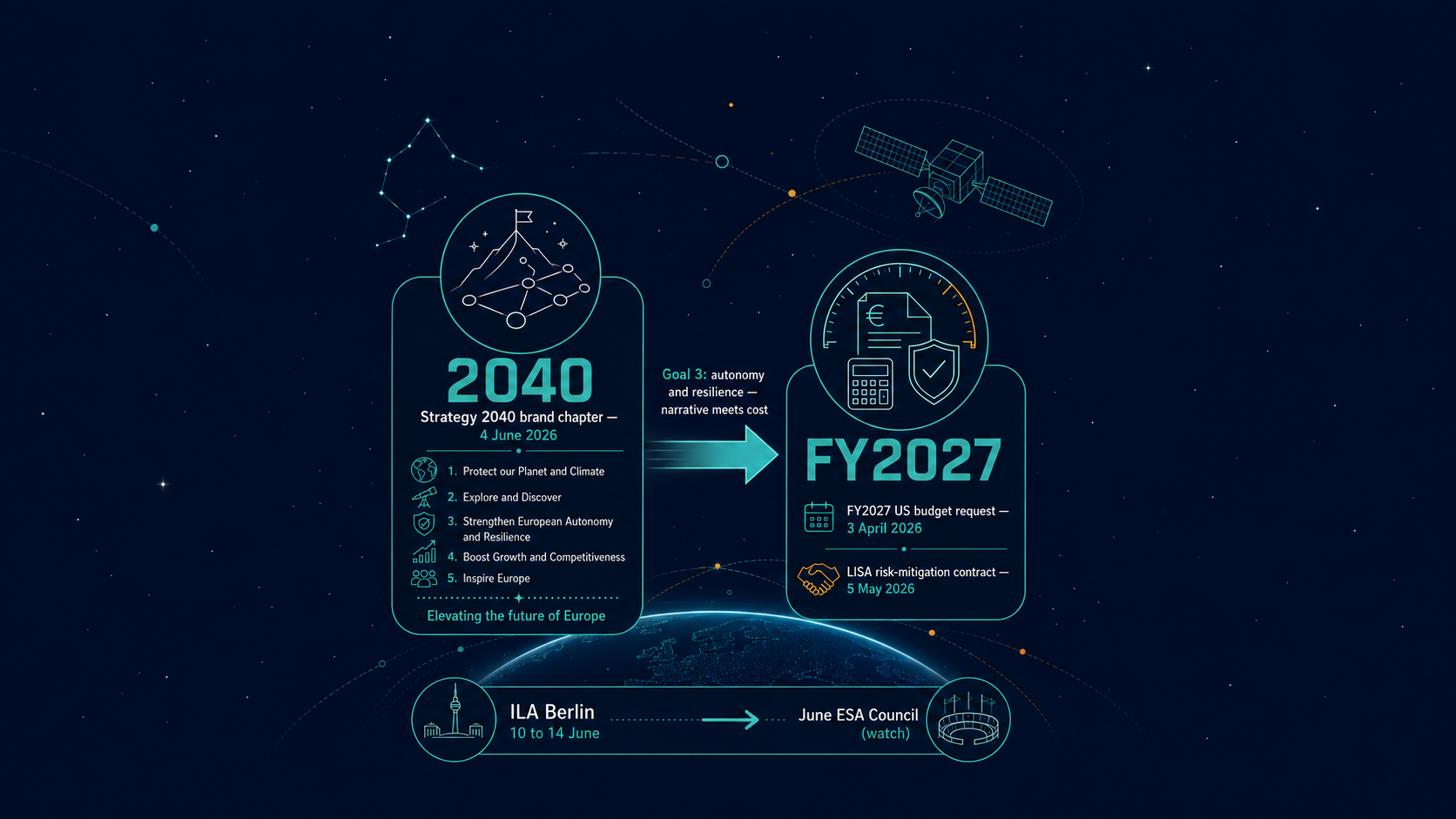
ESA Strategy 2040 is the agency's long-term vision, organised around five goals: protect our planet and climate; explore and discover; strengthen European autonomy and resilience; boost European growth and competitiveness; and inspire Europe. The brand chapter is the narrative and visual expression of that strategy, carrying the ambition line "Elevating the future of Europe" and a new visual identity whose central device is a 23.4° tilt drawn from the Earth's axis.
What ESA actually announced on 4 June
ESA's own communication describes the move as a brand transformation rooted in Strategy 2040, with the stated purpose of translating the agency's strategic goals into a single, unified narrative that connects every mission and programme to its impact on society. The unifying ambition is "Elevating the future of Europe". The updated logo now carries a descriptor for clarity, and the new visual identity places the 23.4° axial tilt at its centre.
The 4 June brand communication is a communications framework rather than a programme or funding document: on the terms of that page it sets out narrative and visual identity, and it is not the vehicle through which ESA announces new programmes, contracts or architecture. That distinction matters for how the announcement should be read: the brand chapter indicates the vocabulary ESA intends to use across its missions, not what those missions will be funded to do.
What gives the rebrand more than cosmetic weight is timing. Two unrelated calendars converge on the same fortnight, and both touch the autonomy goal directly.
Why the autonomy goal is the one to watch
The third Strategy 2040 goal, "strengthen European autonomy and resilience", is among the goals under the most direct external pressure this month, and that pressure is documented rather than rhetorical.
The FY2027 US budget request, released on 3 April 2026, proposes withdrawing NASA funding from several missions where the agency partners with ESA. According to The Planetary Society's analysis of that request, the affected missions include the Laser Interferometer Space Antenna (LISA), the Rosalind Franklin rover, Athena (ESA's planned X-ray observatory), the EnVision mission to Venus, and Mars Express. LISA is a space-based gravitational-wave observatory; Rosalind Franklin is ESA's Mars rover. These are civil science missions, and the proposal is a US executive budget request, not an enacted appropriation. Per the same analysis, Congress allocated funding for the LISA mission in the FY2026 cycle after a similar earlier proposal, which is a reminder that an executive request and a final appropriation are different instruments.
In parallel with the unresolved US budget process, ESA has begun risk-mitigation work on LISA. As reported by European Spaceflight and announced by Thales Alenia Space, the agency, supported by its Member States, issued a call for proposals for LISA telescope development in September 2025 and, on 5 May 2026, signed a €26.1 million phase-1 contract with Thales Alenia Space for that telescope, with a European Charge Management Device tender announced in November 2025. Per the same reporting, ESA structured these efforts with decision points that leave room for the US budget to settle while building European alternatives in parallel.
Space Insights cross-file editorial read: the brand line and the budget pressure, read together
Space Insights reads the three surfaces together: the Strategy 2040 brand chapter (4 June 2026, ESA), the FY2027 US budget request (released 3 April 2026, as analysed by The Planetary Society) and ESA's LISA risk-mitigation contracting (the €26.1 million Thales Alenia Space telescope contract of 5 May 2026). On this reading, "autonomy and resilience" is visible not only as a brand line but also as a procurement and risk-mitigation question: one concrete cost point is already visible in LISA mitigation contracting. For European suppliers, the read is concrete in at least one documented case: in the LISA case, where a transatlantic dependency sits on a mission named in The Planetary Society's analysis of the FY2027 request, ESA's documented action has been to develop European alternatives for elements at risk from a potential loss of NASA support.
This linkage across the brand chapter, the US budget request and the LISA contracting is a Space Insights editorial reading, not a connection drawn in ESA's 4 June brand communication, which does not reference the FY2027 budget request. The source path is ESA's Strategy 2040 and brand communications, The Planetary Society's FY2027 budget analysis, the Thales Alenia Space 5 May 2026 release and European Spaceflight's reporting on the LISA risk-mitigation contract.
How ILA Berlin and the June Council frame the next two weeks
The brand chapter is the first of three near-term surfaces. The second is visibility. ESA is announced as a lead partner in the Space Pavilion at ILA Berlin International Airshow, scheduled for 10 to 14 June 2026 under the theme "Space4Future", coordinated with BDLI and DLR under the patronage of the German Federal Ministry of Research, Technology and Space. Per ESA's event communication, the pavilion is due to be inaugurated on 10 June by German Federal Minister Dorothee Bär alongside ESA and DLR leadership, with ESA directors, astronauts and experts billed to appear through the week. ILA is the planned showcase where the new narrative is set to meet a large industrial and political audience; the event falls after this article's publication, so it is flagged as a forward surface to watch rather than a completed one.
The third surface is the institutional one: the June ESA Council. The Council is the standing venue at which Member States consider programme matters, and it is a venue to watch for how Member States discuss programme priorities — it may offer the next institutional vocabulary around the autonomy question. This article does not impute any agenda item, assessment, or decision to the June Council; it is flagged as a venue to watch, not an outcome. Larger contribution choices are normally made through ESA ministerial-level processes rather than through a brand communication, when Member States set contribution levels for the next period. The brand can frame autonomy; Member State programme and contribution processes determine how far that autonomy is funded.
Read in sequence, the fortnight has a clear structure. The brand chapter sets the vocabulary. ILA Berlin broadcasts it. The June ESA Council is the next institutional date on the calendar. The ordering is itself the editorial point: ESA is presenting the strategy narrative to its audience in the same window in which the institutional calendar turns to programme and contribution questions.
What remains uncertain
Two things are genuinely open. First, the US budget process is unresolved. The FY2027 request is a proposal, and the Congressional appropriations cycle, not the executive request, determines what NASA can ultimately fund on joint missions. The earlier-cycle precedent on LISA suggests Congress and the executive can diverge, but no outcome should be assumed.
Second, Member State posture behind the autonomy goal is not yet publicly legible. ESA's risk-mitigation contracting shows the agency acting in at least one case, but the scale of Member State commitment to substituting for any lost NASA contributions across the full mission list is not yet readable, and will become clearer only through the institutional calendar ahead, most decisively at ministerial level. The brand chapter tells you ESA's chosen framing for 2040. It does not tell you which missions Member States will choose to underwrite when the autonomy goal carries a price tag rather than a tagline.
The reasonable editorial read is to track the Council and the ministerial vocabulary, not the brand launch. The rebrand is the framing; the budget venues are where European autonomy is either funded or deferred.
Sources
- 1.A new chapter for ESA's brand — European Space Agency
- 2.ESA Strategy 2040 — European Space Agency
- 3.ESA at ILA Berlin International Airshow 2026 — European Space Agency
- 4.The FY 2027 NASA budget request — The Planetary Society
- 5.Thales Alenia Space signs phase 1 contract with ESA for the development of the telescopes onboard LISA mission — Thales Alenia Space
- 6.ESA Begins Developing Replacements for NASA's Contributions to LISA — European Spaceflight
Get briefings like this every Friday.
Subscribe