Vast and Axiom Space Open European Offices: US Commercial LEO Operators Move Toward European Customers. Space Insights.
Two US commercial space-station companies established European offices on consecutive days in early June 2026. Vast announced a Paris headquarters alongside a two-mission agreement with France on 1 June; Axiom Space registered a wholly owned Swiss subsidiary, Axiom Space Switzerland, based in Lucerne, on 2 June. Both companies are developing commercial LEO destinations intended to serve the post-ISS market; NASA plans to retire the International Space Station (ISS) around 2030. The European read is not about office locations. It is about who is positioning for the customer base that the post-ISS low Earth orbit (LEO) market will be built on.
The same week added a third data point: on 2 June, the UK Space Agency signed a Memorandum of Understanding (MoU) with Vast. Three public European engagement signals across the 1 to 2 June window (with Vast's own UK MoU release following on 5 June), all relevant to European national-agency, ESA-linked and research-institution demand, is the development worth reading carefully.
What each company actually announced
Vast is a private US company developing Haven-1, a single-module commercial space station designed for up to four crew in low Earth orbit. On 1 June 2026, Vast announced a two-mission agreement with France: an ISS mission commanded by veteran ESA astronaut Thomas Pesquet, and a mission to Haven-1 carrying ESA reserve astronaut Arnaud Prost as flight test engineer. Both missions, using SpaceX Crew Dragon, are scheduled for 2027. Vast CEO Max Haot stated the agreement "reinforces Vast's commitment to launch and operate the world's first commercial space station". The company located its European headquarters in Paris.
Axiom Space, the Houston-based company developing Axiom Station, took a different structural route. On 2 June 2026 it announced Axiom Space Switzerland, a wholly owned subsidiary in Lucerne, expected to begin operations in summer 2026. The subsidiary's stated focus is advanced microgravity research, in-space manufacturing, orbital compute and joint development with European institutions, ESA and ESA member states. Axiom Station, the company's commercial station, is manufactured by Thales Alenia Space in Turin — so Axiom already carries a European industrial footprint.
The UK engagement sits alongside both. The UK Space Agency–Vast MoU, announced 2 June, frames UK support for Vast in securing the sponsorship to fund a Haven-1 mission for ESA reserve astronaut John McFall, plus broader collaboration on LEO research, education and supply-chain links. McFall, an NHS surgeon and the first person with a physical disability medically cleared for long-duration spaceflight, could fly as early as 2027.
Why the office locations are a procurement signal, not real estate
The choice of jurisdiction is the analytical content. Per Payload's coverage, Axiom Space CEO and President Dr Jonathan Cirtain set out the reasoning; Payload reported his explanation as a regulatory-flexibility argument — Switzerland's non-EU status, which it framed as reducing exposure to EU export-control and procurement frameworks, combined with ESA membership that preserves the science and research access the company needs. Switzerland is an ESA member state but not an EU member — a position that, on Payload's account, lets a US company engage ESA programmes and European research institutions without sitting inside the EU's procurement and export perimeter.
Vast's stated logic ran through customer commitment rather than jurisdiction. Haot indicated the decision to base European operations in France followed from the agreement to fly French astronauts. On that account, the office is the institutional expression of a customer relationship already signed.
Two different routes into the same market. One route is presented, via Payload's reporting, as regulatory flexibility plus ESA access; the other is presented by Vast as customer-led anchoring in France. For European planners mapping where commercial-LEO demand will be sourced, the distinction matters: it shows that US station operators are reading Europe's procurement architecture closely enough to choose entry points by structure, not convenience.
What the post-ISS LEO market means for European demand
The ISS, continuously crewed since 2000, is scheduled for deorbit around 2030. NASA's Commercial LEO Destinations (CLD) programme is the mechanism intended to replace it with privately owned stations the agency uses as a customer rather than an owner. NASA's 2025 CLD acquisition-strategy revision — replacing the planned fixed-price contract route with continued design-and-demonstration support through funded Space Act Agreements — increases the importance of non-NASA demand. European national agencies, ESA-linked institutions and the research and industrial base are part of the non-NASA demand these companies are seeking to access.
For European actors, this opens three concrete procurement questions over the next 12 to 24 months. First, astronaut access: with ESA's own crewed-flight options constrained, commercial stations offer national agencies a route to fly their astronauts, as the France and prospective UK arrangements show. Second, research and manufacturing capacity: microgravity research, in-space manufacturing and orbital compute are services European institutions can buy without owning infrastructure. Third, industrial participation: Axiom Station's manufacture at Thales Alenia Space in Turin demonstrates that "US commercial station" does not preclude European industrial content; Starlab, another post-ISS station, carries European links through the Airbus–Voyager joint venture (per Payload), a further instance of the same point.
The structural tension is genuine and unresolved. Europe is simultaneously debating its own LEO and exploration posture — the subject of ESA's longer-term strategy work — while US commercial operators move to lock in European customers now. Whether post-ISS European LEO demand anchors primarily to US-built stations, to European-built capability, or to a negotiated mix of access agreements and industrial workshare is not yet decided. The June office openings indicate where the commercial pull is coming from; they do not settle where European procurement will land.
Space Insights cross-file editorial read: how this connects to Europe's wider space-market positioning
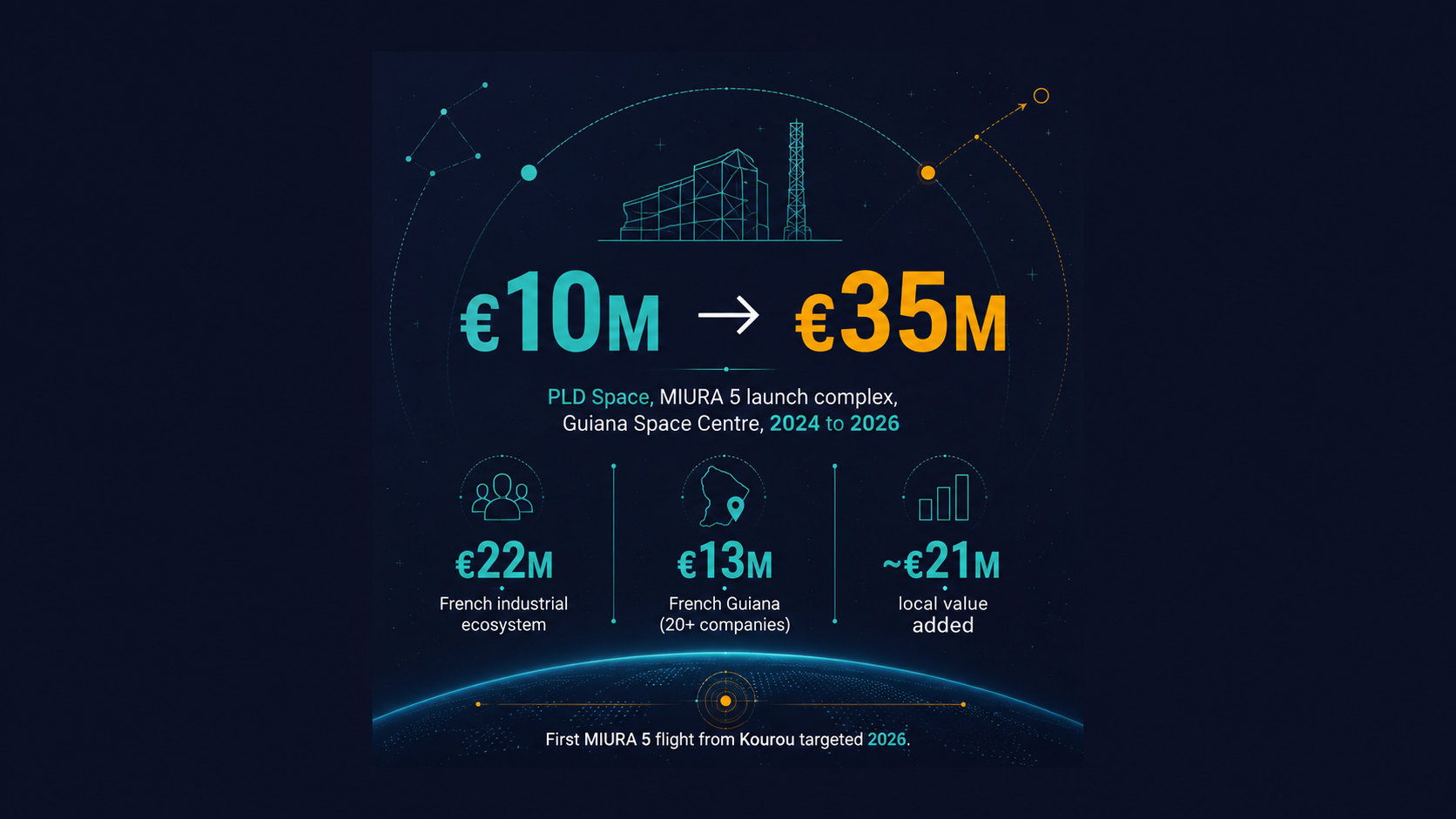
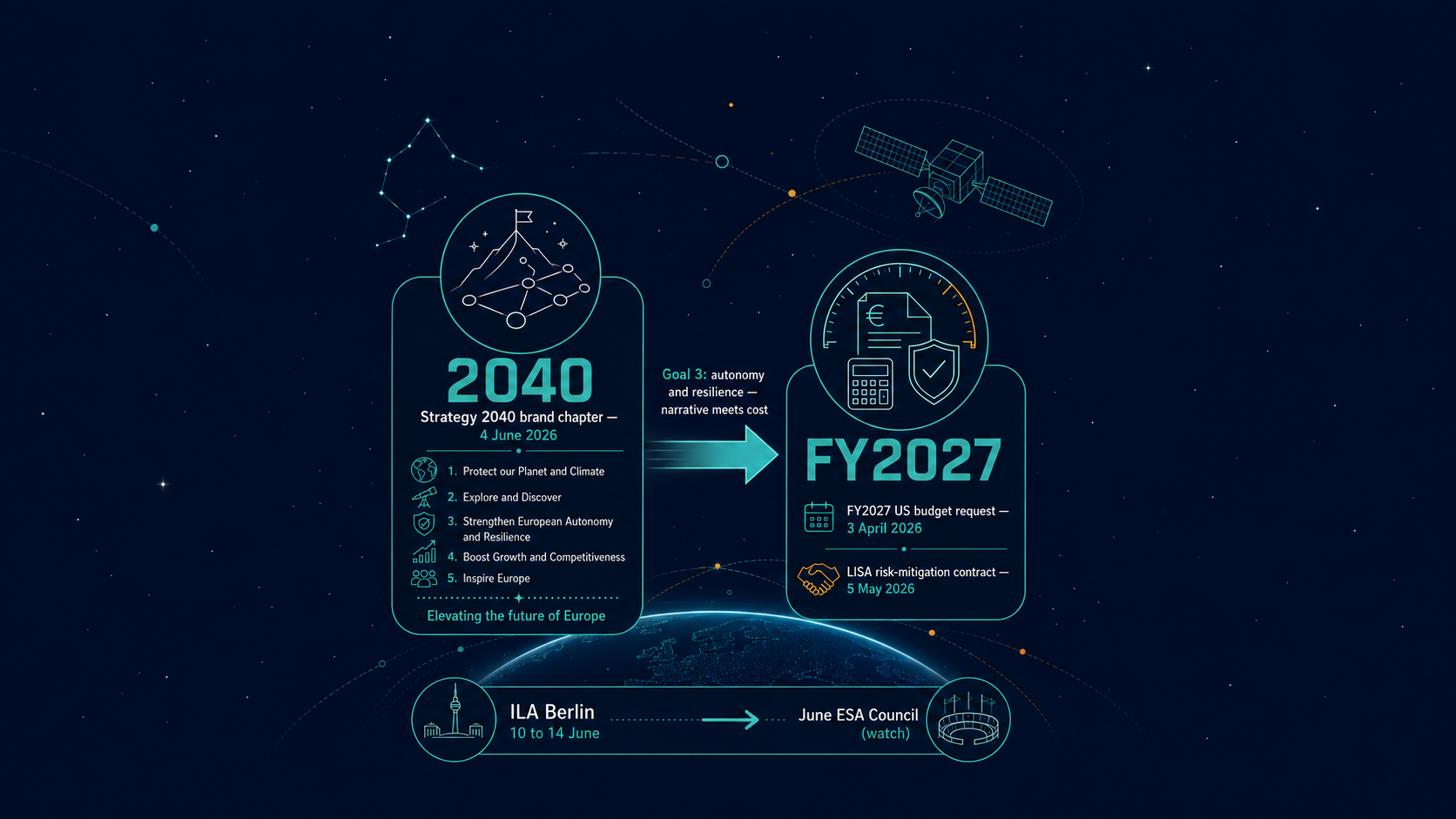
Space Insights reads the commercial-LEO push against two other surfaces from the same editorial week: ESA's longer-horizon strategy framing on the policy-posture side, and continued national investment in launch and manufacturing capability on the European-built-capability side. Read together, the picture is of European demand being courted from outside at the same time as Europe weighs how much sovereign capability to build itself. This connection across the W24 surfaces is a Space Insights editorial reading, not a connection made by Vast, Axiom Space, ESA or NASA. The source path for the prior surfaces is Space Insights' own W24 coverage (Signal 4, ESA Strategy 2040; Signal 20, PLD Space Teruel investment).
This is not a binary. National agencies can buy astronaut seats and research time on US stations while supporting European industrial participation in those same stations and continuing to develop indigenous capability. The France arrangement, the prospective UK mission and the Turin manufacture of Axiom Station are all instances of that mixed model already operating. The open question is the balance — how much access is bought versus how much capability is built — and that balance is a procurement and budget decision, not a foregone conclusion. The bought-access-versus-built-capability framing is a Space Insights editorial read of the week's pattern, not a statement made by any single primary source.
What is uncertain
Several things remain unsettled. NASA's revised CLD acquisition strategy — funded Space Act Agreements to mature station designs through critical design reviews and then flight demonstrations, in place of the previously planned fixed-price contract route — will shape which US stations actually reach orbit, and therefore which European access agreements have a vehicle behind them. Haven-1's launch has already moved to no earlier than the first quarter of 2027, so the 2027 mission dates carry schedule risk. And neither office opening is itself a European procurement commitment: an MoU and a subsidiary registration establish intent and access, not contracts.
It is also unclear how European institutions will weigh US commercial access against the development of European-led LEO capability. That is a policy and budget question that the office openings do not answer and were never going to.
Forward look
Three watch items for the rest of 2026 and into 2027:
- NASA CLD next-phase awards — which commercial stations NASA backs under its funded Space Act Agreements determines which European access agreements have flight hardware behind them.
- Haven-1 first crewed missions (2027) — the French and prospective UK missions are the first test of whether national-agency access agreements convert into flown crew, and on schedule.
- European LEO and exploration posture — how ESA and member states position indigenous capability against bought commercial access will define whether the mixed model is a transition or a settled structure.
The reasonable editorial read is that early June 2026 marks a visible acceleration in US commercial-station engagement with European customers. What it does not yet tell us is how Europe will choose to buy.
Sources
- 1.US Commercial Space Stations Expand to Europe — Payload
- 2.France to fly two astronauts on Vast missions — SpaceNews
- 3.Axiom Space Establishes Swiss Subsidiary to Anchor European Engagement, Space Collaboration — Axiom Space
- 4.Astronaut with physical disability could be first to enter orbit after ground-breaking agreement — UK Government (UK Space Agency)
- 5.Vast Delays Haven-1 Launch to 2027 — Payload
- 6.NASA revises plans for commercial space station development — SpaceNews
Get briefings like this every Friday.
Subscribe