PLD Space's €35M Kourou Bet: Ground Infrastructure Before First Flight. Space Insights.
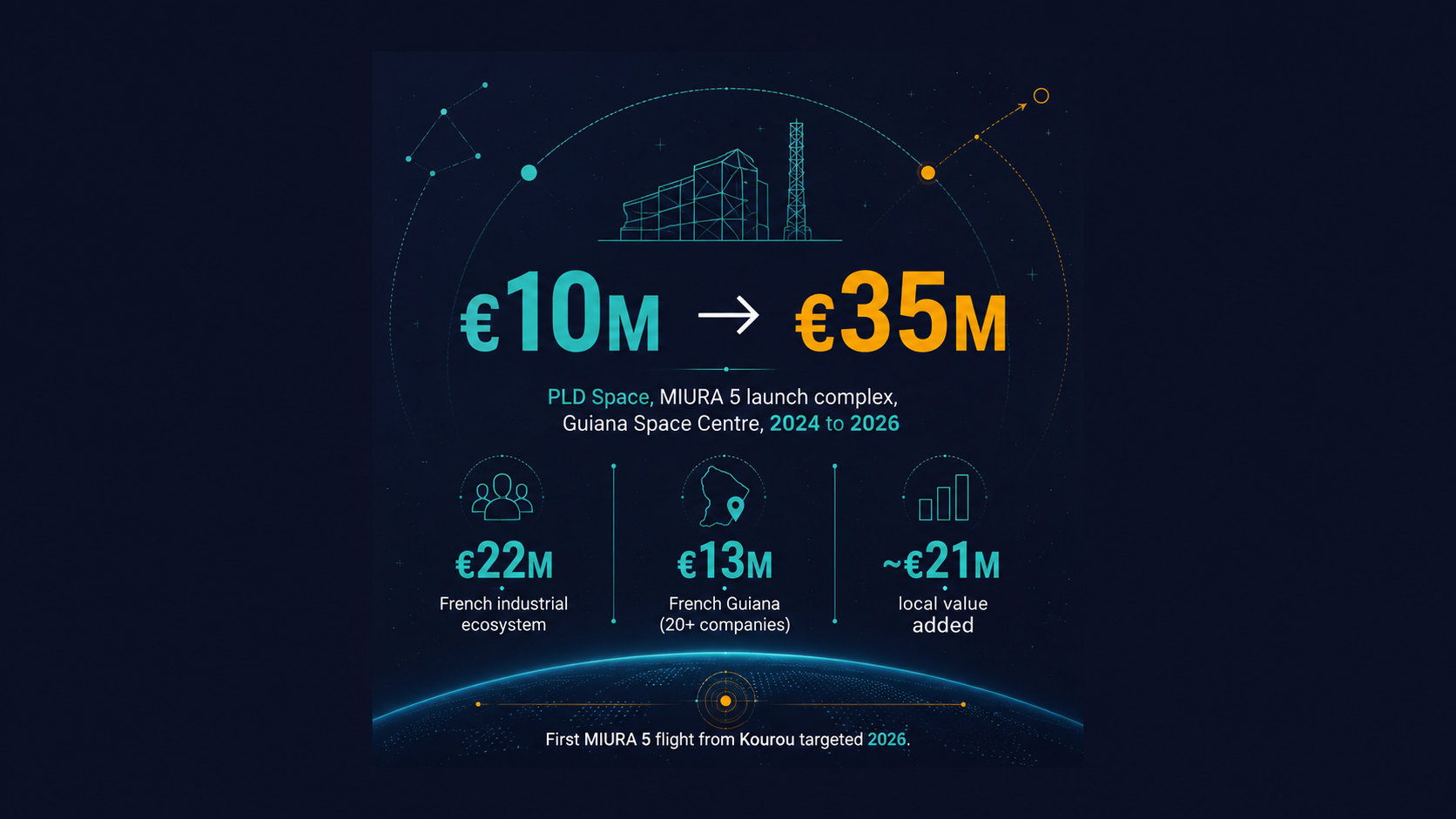
PLD Space has tripled its planned investment in the MIURA 5 launch complex at the Guiana Space Centre, from an originally announced €10 million in 2024 to €35 million spread across 2025 to 2026. PLD Space announced the increase at the Choose France investment event in Versailles on 1 June 2026, per the company's release and subsequent coverage. For a Spanish launch company that is one of the companies preselected for ESA's European Launcher Challenge, the more telling detail is not the headline number but where it is going: into the ground segment, in the year a vehicle programme expects to reach its first flight.
PLD Space is a privately held Spanish launch company, founded in 2011 and headquartered in Elche, developing the MIURA 5 small-satellite orbital launcher. The €35 million is the budget for building and commissioning the company's dedicated launch complex at the Guiana Space Centre (CSG) in Kourou, French Guiana — Europe's operational spaceport. It is not the budget for the rocket itself, and it is not connected to the company's test infrastructure in Spain.
Two PLD Space sites that are easy to confuse
PLD Space operates from two distinct facilities, and conflating them muddles the analysis. Teruel is PLD Space's Spanish test-and-production complex, where MIURA 5's Qualification Model 1 is being put through subsystem qualification. Kourou is where MIURA 5 will actually fly from, and where the €35 million launch complex is being built, at the spaceport's ELM-Diamant site. The investment announced on 1 June concerns Kourou. Teruel proves the hardware; Kourou launches it.
The Kourou spend is also structured to land inside the French industrial ecosystem. Of the €35 million, €22 million is being executed within French industry and €13 million allocated to more than 20 companies based in French Guiana, with roughly €21 million in projected local value added and between 250 and 275 indirect and induced jobs during the construction phase, alongside around 35 direct posts for ongoing operations. Civil works are in their final stage, with completion expected by summer 2026.
What the European Launcher Challenge is, and where PLD Space sits in it
The European Launcher Challenge (ELC) is ESA's mechanism for purchasing commercial launch services rather than developing launch vehicles in-house, intended to broaden Europe's access to space by turning the agency into an anchor customer for newly developed launchers. On 7 July 2025, ESA preselected five challengers: Isar Aerospace (Germany), Rocket Factory Augsburg (Germany), PLD Space (Spain), MaiaSpace (France) and Orbex (United Kingdom). Per ESA's European Launcher Challenge materials, the programme targets up to €169 million in funding per challenger across its two components: provision of launch services to ESA, and a demonstration of upgraded launch capability including at least one test flight. The challenge was confirmed at the ESA Council at ministerial level (CM25) in November 2025; the precise subscribed envelope and individual challenger service-contract outcomes remain subject to the programme process.
That cohort has since narrowed. Orbex (Orbital Express Launch) filed for administration in February 2026 and withdrew from the challenge, leaving four active challengers; ESA Director General Josef Aschbacher has confirmed the withdrawal, and ESA is working with Member States on redirecting the associated funding. The point is not to rank the survivors — the ELC is an in-progress competition and ESA has made no award outcome on who ultimately delivers, so which challengers secure ELC service contracts is a watch item rather than a settled result — but to read what a tripled launch-complex budget says about one participant's sequencing. Money flowing into the launch pad, while qualification continues at Teruel, suggests PLD Space is moving capital into operational readiness alongside vehicle development, rather than opening a fresh development phase.
Why infrastructure spend is the signal, not the rocket
In launch, the vehicle attracts the attention and the ground segment decides the schedule. A flight-ready rocket with no commissioned pad cannot fly; a finished pad with a vehicle still in qualification waits. PLD Space tripling its Kourou commitment, while MIURA 5's Qualification Model 1 is being tested at Teruel, reads as the two tracks being advanced in parallel so that neither the pad nor the vehicle becomes the bottleneck.
The capital behind that move is recent and substantial. PLD Space closed a €180 million Series C in March 2026, led by Mitsubishi Electric as a strategic launch customer, and signed a €30 million venture-debt loan with the European Investment Bank in April 2026. The €35 million Kourou spend sits alongside those financings, but this article does not infer a precise capital-allocation model from the figures.
MIURA 5 itself is a two-stage orbital launcher in the small-launch segment alongside its ELC peers — and the Kourou complex is being built for a launch business, not a single flight.
Forward look
The number that matters next is a date, not a euro figure. PLD Space continues to target the first MIURA 5 flight from the Guiana Space Centre in 2026, with launch-complex civil works due to complete by summer. Whether that maiden flight holds inside 2026, and whether qualification at Teruel converges with commissioning at Kourou on that timeline, is the open question this investment is meant to resolve.
For the wider European launch picture, the read is incremental rather than decisive. One ELC challenger funding its operational base does not settle how Europe's commercial launch supply consolidates, and ESA's challenge remains an open competition with no award outcome assigned. What the €35 million does confirm is that at least one preselected company is now directing fresh capital into operational ground infrastructure. The first flight from Kourou will show whether the spend was timed correctly.
Space Insights cross-file editorial read
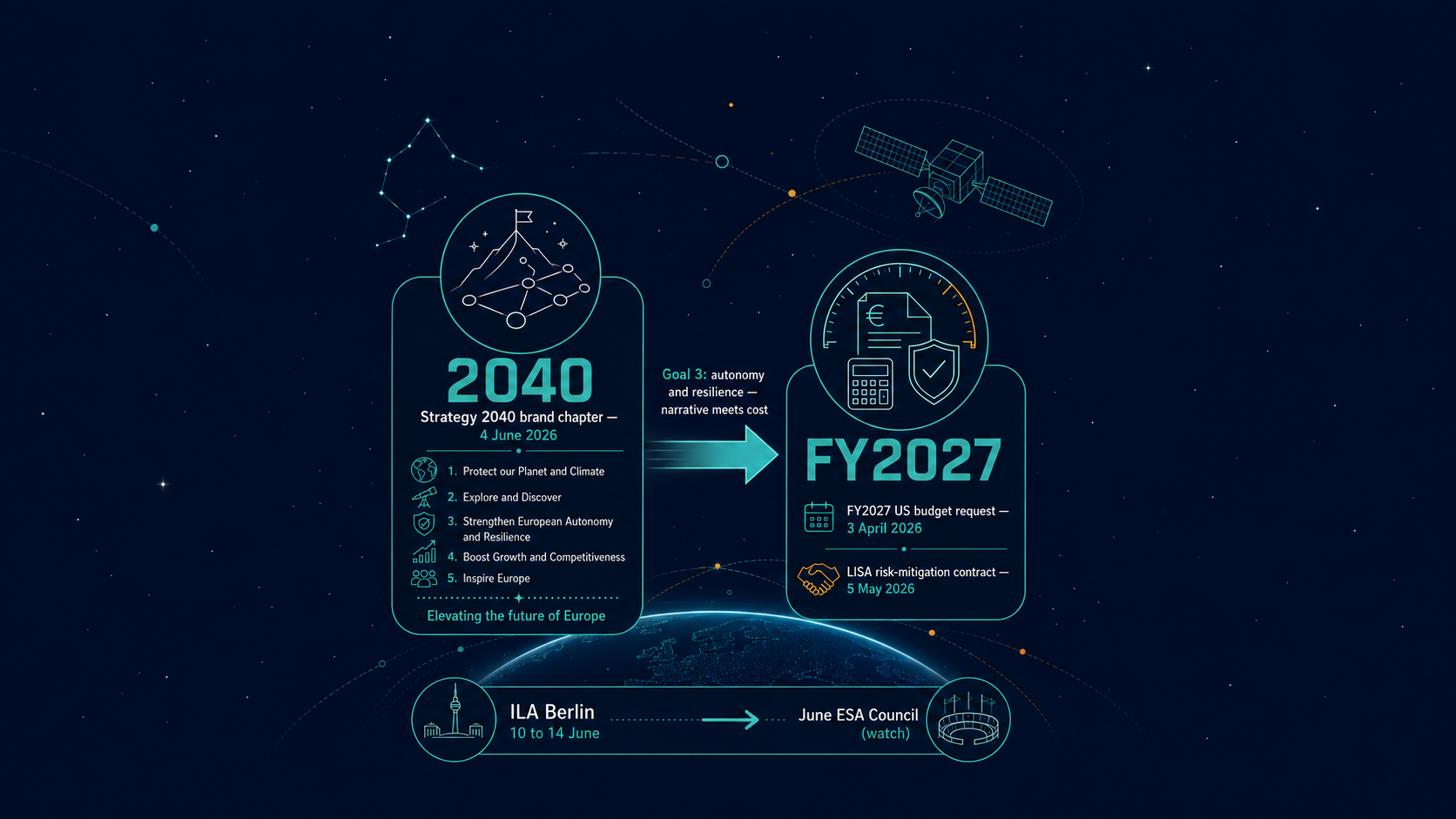
Space Insights reads PLD Space's Kourou ground-segment spend as the commercial-launch-tier instance of the European launch-autonomy thesis that ESA's Strategy 2040 communication sets out at the strategic-framing level: the European Launcher Challenge is the procurement mechanism through which that autonomy framing is being operationalised, and a tripled launch-complex budget is one company's ground-segment investment inside it. This is a Space Insights editorial reading, not a connection made by ESA or PLD Space. The source path for the strategic-framing surface is Space Insights' own W24 coverage (Signal 4, ESA Strategy 2040) alongside ESA's Strategy 2040 communication of June 2026 and the ESA European Launcher Challenge preselection release of 7 July 2025.
Sources
- 1.PLD Space Triples Investment in Launch Facility to €35 Million — European Spaceflight
- 2.PLD Space Boosts Guiana Space Centre Investment to €35 Million — SatNews
- 3.PLD Space Raises Investment To €35 Million For MIURA 5 Launch Complex At Europe's Spaceport — Pulse 2.0
- 4.European Launcher Challenge: preselected challengers unveiled — European Space Agency
- 5.Spain: EIB finances with €30 million PLD Space's small satellite launcher MIURA 5 — European Investment Bank
Get briefings like this every Friday.
Subscribe