Aschbacher's 18 May 2026 LinkedIn op-ed and Agence Europe Bulletin article 13866/29 — the political-leadership surface of the W22 European autonomy file, paired three days later with ESA's GLOBSEC 2026 panel intervention. Space Insights.
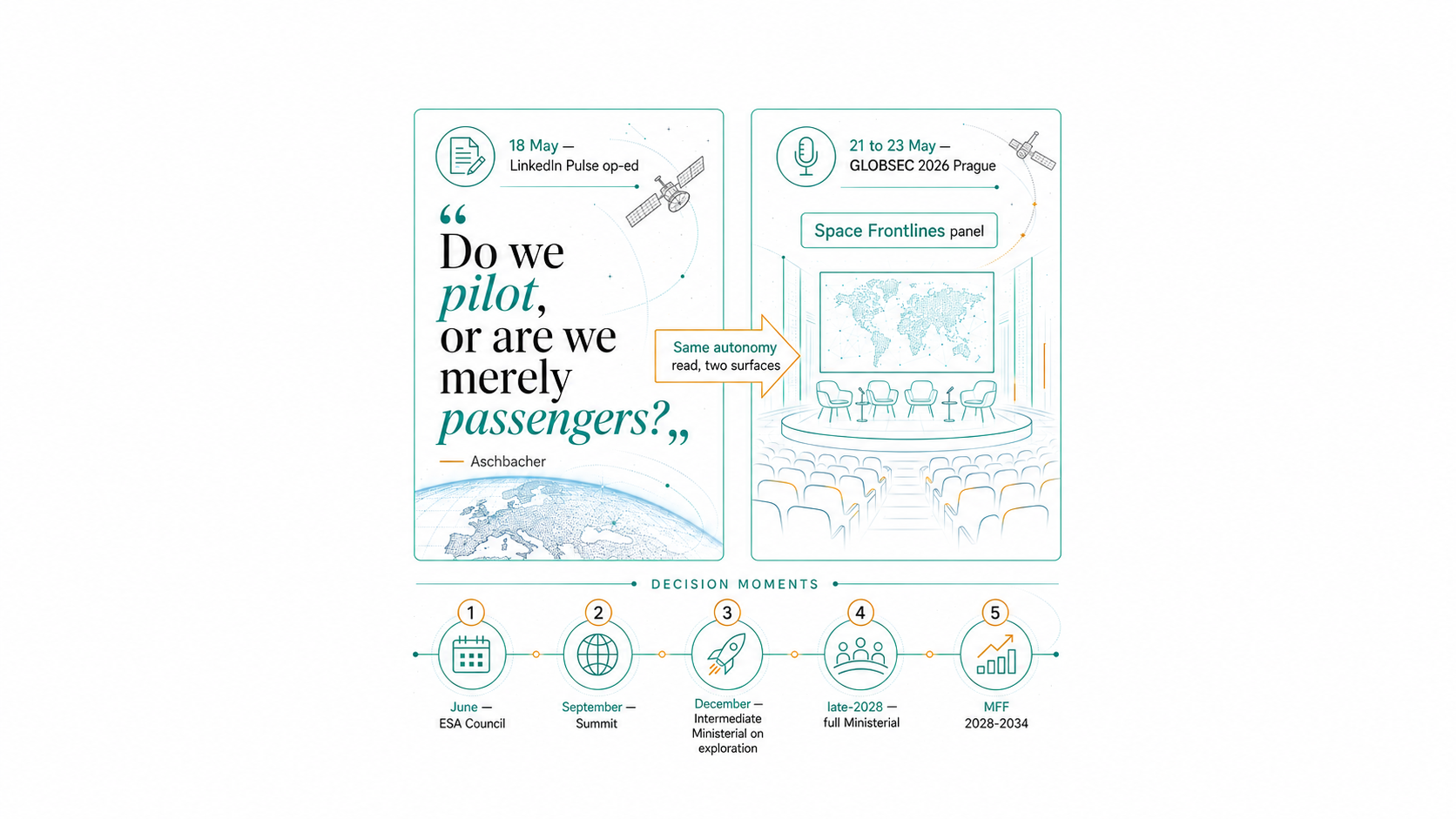
On 18 May 2026 ESA Director General Josef Aschbacher published an opinion piece titled "Are we pilots or are we passengers?" on LinkedIn Pulse, with a parallel Agence Europe Bulletin version (article 13866/29, 12 May 2026). The 18 May LinkedIn publication triggered a wave of trade-press coverage across the following 48 hours. Three days later, on 21 to 23 May, Aschbacher represented ESA at the 21st GLOBSEC Forum in Prague on the panel "Space Frontlines: Shaping European Security". The two interventions, read together, can be read as two institutional surfaces of a single European autonomy thesis inside one week.
For European space-sector planners, the operative content is not the rhetorical force of the op-ed. It is the specific programmes the Director General names, the specific US-side programme moves he names in writing, and the decision moments he points to in the second half of 2026 and across the next two Ministerial cycles. This piece reads the op-ed as a planning document, not as a polemic.
What the op-ed says, in Aschbacher's own words
The opening identifies the trigger. "Recent changes to the Artemis architecture by the United States signal a rapidly shifting landscape in human space exploration. Decisions to pause Gateway and cancel Mars Sample Return disrupt Europe's lunar exploration plans, underscoring a broader reality: Europe has become too exposed to decisions beyond its control." Aschbacher describes the US-side changes as three programme moves: changes to the Artemis architecture, a Gateway pause and a Mars Sample Return cancellation. These are Aschbacher's framings of the US-side moves as named in the op-ed; the formal US-government terminology and technical status of each may differ.
The framing is structural, not personal. Aschbacher's second paragraph opens with the Member-State-level decision frame: "Europe must decide whether it prefers to be dependent on others to send its explorers into space or to assume its role as a fully capable space power." The next sentence is the thesis-setting line that has carried into wider commentary: "As the head of the European Space Agency (ESA), I am convinced that autonomous human spaceflight is not a luxury. It is a necessary anchor for Europe to secure its freedom to unlock the scientific, economic, strategic and geopolitical benefits of space and to inspire a new generation to shape Europe's future."
The op-ed also records: "no single Member State can achieve on their own what we can achieve together" and the warning "not let cooperation slip into dependency."
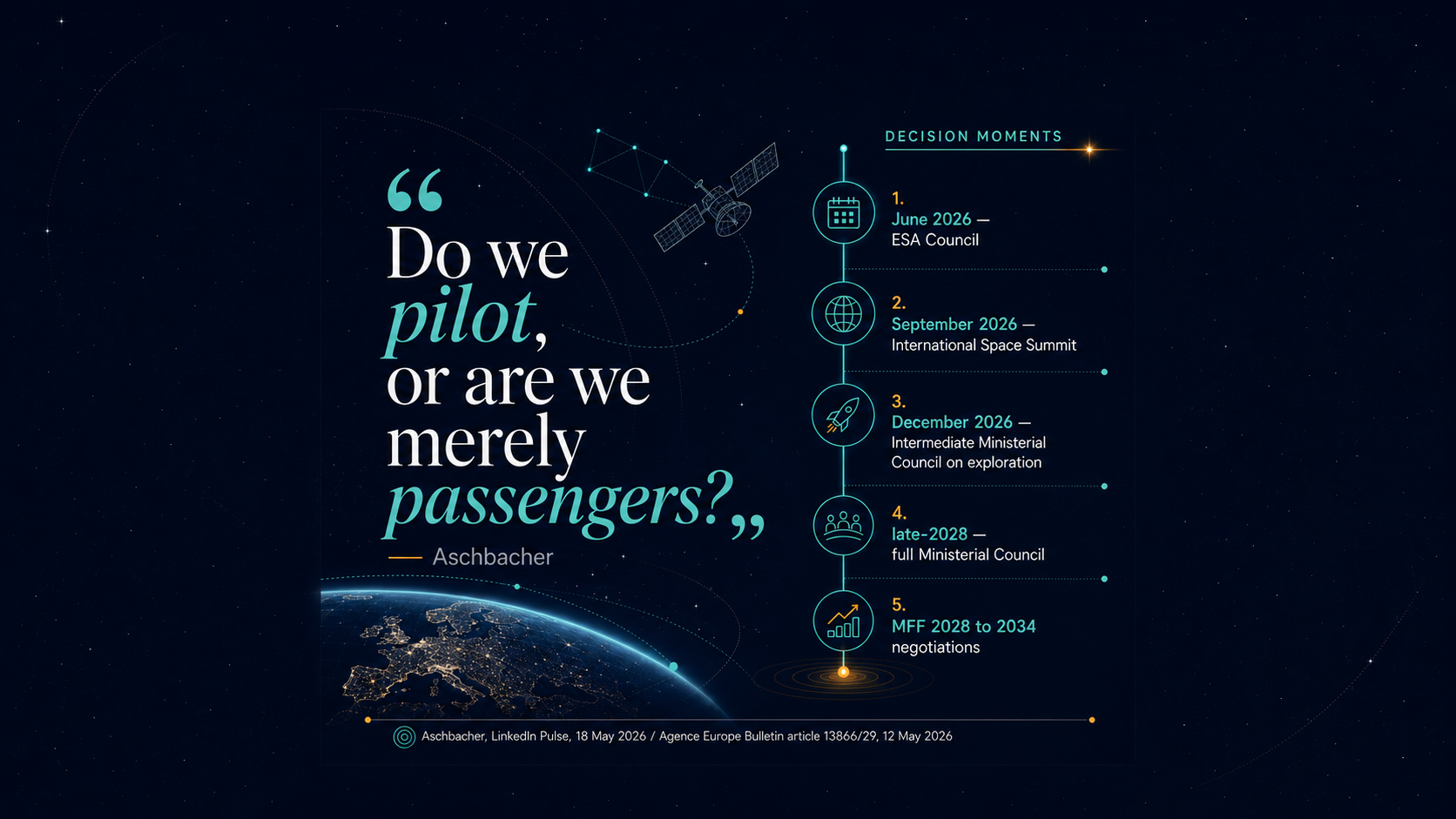
The closing call is the question that gives the op-ed its title, paired with a direct statement of confidence: "The choice before Europe is clear: do we pilot, or are we merely passengers? We have everything we need. What remains are the confidence and political will to act."
These are public statements published by the Director General in writing under his own byline. They are not paraphrases; they are sourced quotes.
The programme architecture Aschbacher actually names
The op-ed names three European programme references as the architectural anchors for autonomy:
Explore2040 is ESA's cohesive exploration strategy for human and robotic spaceflight capability. It is the document the Director General points to as the cohesive framing — the strategic envelope that the operative decisions will populate.
Copernicus is referenced as "the world's most comprehensive Earth observation system" and is the institutional precedent the op-ed leans on for what European-scale capability looks like when sustained.
Galileo is referenced as "a global reference for satellite navigation" — the second institutional precedent for what sustained European-scale operational capability looks like.
What the op-ed does not name is also load-bearing. It names no specific new human spaceflight hardware programme. No Ariane-derived crewed launcher specification. No European-led space station hardware decision. No specific funding envelope in EUR for autonomous human spaceflight. Independent trade-press coverage notes adjacent ESA initiatives — the LEO Cargo Return Service launched 2023, the Crew Launch Abort Demonstrator initiative announced November 2025, and the European-led space station studies call launched February 2026 — but these are not named in the op-ed itself.
The reasonable planning read: the op-ed is a positioning document for the late-2026 and 2028 decision moments. It is not a programme commitment.
The institutional dates the op-ed points to
Aschbacher names a sequence of decision moments in writing.
ESA Council in June 2026. The next ESA Council meeting at the Director General's level, where Member State delegations review programme posture before the Ministerial cycle. The June Council is the first venue at which the Explore2040 framing will be tested against Member State positions.
International Space Summit in September 2026. The venue where the European autonomy thesis will be carried into a wider international audience. Whether the September Summit produces a programme-level commitment or a strategy-level statement is the open planning question.
ESA Intermediate Ministerial Council on exploration in December 2026. The op-ed scopes this Council explicitly to exploration, not to a general-purpose Ministerial agenda. Positioned as the adjustment moment between the November 2025 Ministerial (CM25) and the next full Ministerial cycle, the December 2026 Intermediate Ministerial on exploration is the next Ministerial-level venue at which the autonomy thesis could meet formal confirmation or deferral on exploration specifically.
ESA full Ministerial Council, late 2028. The next full Ministerial cycle. Within Aschbacher's op-ed framing, this is the venue at which any autonomy commitment shaped at June, September or December would be expected to translate into programme envelopes.
EU Multiannual Financial Framework 2028 to 2034. The budget envelope inside which any new European human spaceflight programme would be funded. The MFF negotiations are the structural constraint that gives the op-ed its timing — the post-2027 EU budget architecture is not yet closed, and the autonomy case is being made publicly now into that open negotiation.
Space Insights cross-file editorial read: three surfaces of one Space Insights autonomy read
The 21 to 23 May GLOBSEC Forum, where Aschbacher contributed to the "Space Frontlines: Shaping European Security" panel, is the second institutional surface of the same thesis. ESA's own communication of the GLOBSEC participation records that the panel discussions underlined "strengthening resilience, accelerating delivery and ensuring interoperability across European and national systems" as key priorities emerging from the exchange. Resilience, delivery and interoperability are operational specifications of autonomy.
The industrial and capital-markets layer is visible in the early-May OHB cluster covered separately by Space Insights (W21 coverage; primary sources per Reuters, Bloomberg and the Dassault-OHB joint announcement). That file remains a cross-reference rather than a load-bearing claim inside this article. The Aschbacher op-ed sits at the political-leadership level of the same Space Insights cross-file synthesis. This linkage is a Space Insights editorial reading, not a connection made by ESA or Aschbacher.
The EU Space Act file is the regulatory-state surface. Document ST-8861-2026-INIT recorded that the application date is not expected before 2030 and that the national-security clause remains the foremost open issue (W20 Space Insights coverage; primary source per the Council of the EU document register) — both of which raise the regulatory autonomy question that Aschbacher's op-ed answers from the operational side. This linkage is a Space Insights editorial reading; Aschbacher's op-ed does not name the EU Space Act file.
Three surfaces, one Space Insights autonomy read. This is a Space Insights editorial framing of the stack across the May 2026 European autonomy file, not a single primary-source statement; the source articles for the prior instances are Space Insights' own W20 and W21 coverage, and the primary documents are linked through those packages.
What the op-ed does not do, and why that matters
The op-ed does not commit ESA to a specific programme. It does not name a specific EUR amount. It does not propose a specific timeline for first European-crewed flight. It does not announce a procurement.
That absence is itself a planning signal. The decision-grade content is reserved for the June ESA Council, the September International Space Summit, the December Intermediate Ministerial Council on exploration, the late-2028 full Ministerial and the MFF negotiation. The op-ed is the predicate document — the framing that allows those venues to operate against an articulated Director-General position rather than against an open question.
For primes and SMEs in the European supply chain, the practical read is that the late-2026 calendar and the 2028 Ministerial are the windows where the autonomy thesis converts into either programme-level commitments or strategy-level statements. The op-ed does not settle which.
Space Insights scenario read: three possible trajectories into the 2028 Ministerial
Three scenarios are visible at this point. They are editorial scenarios, not predictions.
Scenario one — Programme commitment. The ESA Council in June, the International Space Summit in September and the December Intermediate Ministerial Council on exploration produce a Council-level direction on European-led human spaceflight capability, with a budget envelope tabled for the 2028 to 2034 MFF and for the late-2028 full Ministerial. This is the most ambitious version of the trajectory the op-ed argues for. It would require Member State alignment that is not yet visible publicly.
Scenario two — Strategy commitment without programme. The June, September and December venues produce a strategy-level statement consistent with Explore2040, with programme-level commitments deferred to the MFF outcome in 2027 and to the late-2028 Ministerial. On the Council-scrutiny dynamics visible from the EU Space Act file (W20 Space Insights coverage), this would preserve the autonomy framing without forcing a budget allocation before the MFF negotiation converges.
Scenario three — Quiet continuation. The June, September and December venues record the framing without producing either a programme commitment or a structural strategy statement. The Explore2040 envelope continues to be populated incrementally through existing ESA programme cycles (LEO Cargo Return Service, Crew Launch Abort Demonstrator, European-led space station studies). This is the editorial baseline if Member State alignment does not converge by December.
All three scenarios are consistent with the op-ed text. The op-ed positions the question; the institutional process will answer it. This is a Space Insights scenario read, not an ESA statement; the scenarios are editorial, not predictions.
What is uncertain
The op-ed itself is verified primary content. What is not yet visible is how Member States will receive it. ESA Council dynamics depend on Member State positions that are not yet public for the June meeting. The MFF negotiation is the structural constraint that no Member State has yet committed to in space-specific terms.
What is also uncertain is the international response. The op-ed is a measured European statement; the United States administration's response (if any) will shape the September International Space Summit framing.
What this means for European space-sector planners
For European primes, SMEs, and Programme Managers writing post-2027 procurement and partnership assumptions:
The op-ed makes explicit a shift in vocabulary from "Europe contributes to international programmes" toward "Europe must be able to lead its own". That is a vocabulary shift before it is a budget shift.
Adjacent ESA programmes already in motion — LEO Cargo Return Service (launched 2023), Crew Launch Abort Demonstrator initiative (announced November 2025), European-led space station studies (call launched February 2026) — are the operational surfaces the op-ed leans on without naming. Their procurement timelines remain the practical anchor for near-term planning.
The June ESA Council, the September International Space Summit, the December Intermediate Ministerial Council on exploration, the late-2028 full Ministerial and the MFF 2028 to 2034 negotiations are the watch dates. The op-ed is not the decision; it is the positioning before the decision.
Forward look
The reasonable read of the 18 May op-ed is unchanged from its closing line: Europe is being asked to choose between piloting and being a passenger, and the institutional venues for that choice are concentrated in the late-2026 calendar and the 2028 Ministerial. The institutional read for European space-sector planners is to track the Council vocabulary, not the op-ed vocabulary — what gets recorded in the meeting outcomes, presidency communications or Council conclusions in June, September and December will matter more for procurement and partnership planning than what was published on 18 May.
The Aschbacher op-ed and the GLOBSEC 2026 panel can be read as two surfaces of the same autonomy thesis inside one week. The next surface to watch is the institutional outcomes, beginning with the June ESA Council.
Sources
- 1.Are we pilots or are we passengers? — Josef Aschbacher, LinkedIn Pulse
- 2.Are we pilots or passengers? — by Dr. Josef Aschbacher — Agence Europe Bulletin, article 13866/29
- 3.Autonomous Human Spaceflight is Not a Luxury, Says ESA Chief — European Spaceflight
- 4.ESA at GLOBSEC 2026 — European Space Agency
- 5.Josef Aschbacher Is Charting An Independent Course For ESA — NASA Watch
Get briefings like this every Friday.
Subscribe