KIRK joint venture, announced 19 May 2026 — Helsing and OHB at joint leadership, Kongsberg Defence & Aerospace and HENSOLDT as core consortium partners. The W22 prime-architecture surface of the European autonomy file. Space Insights.
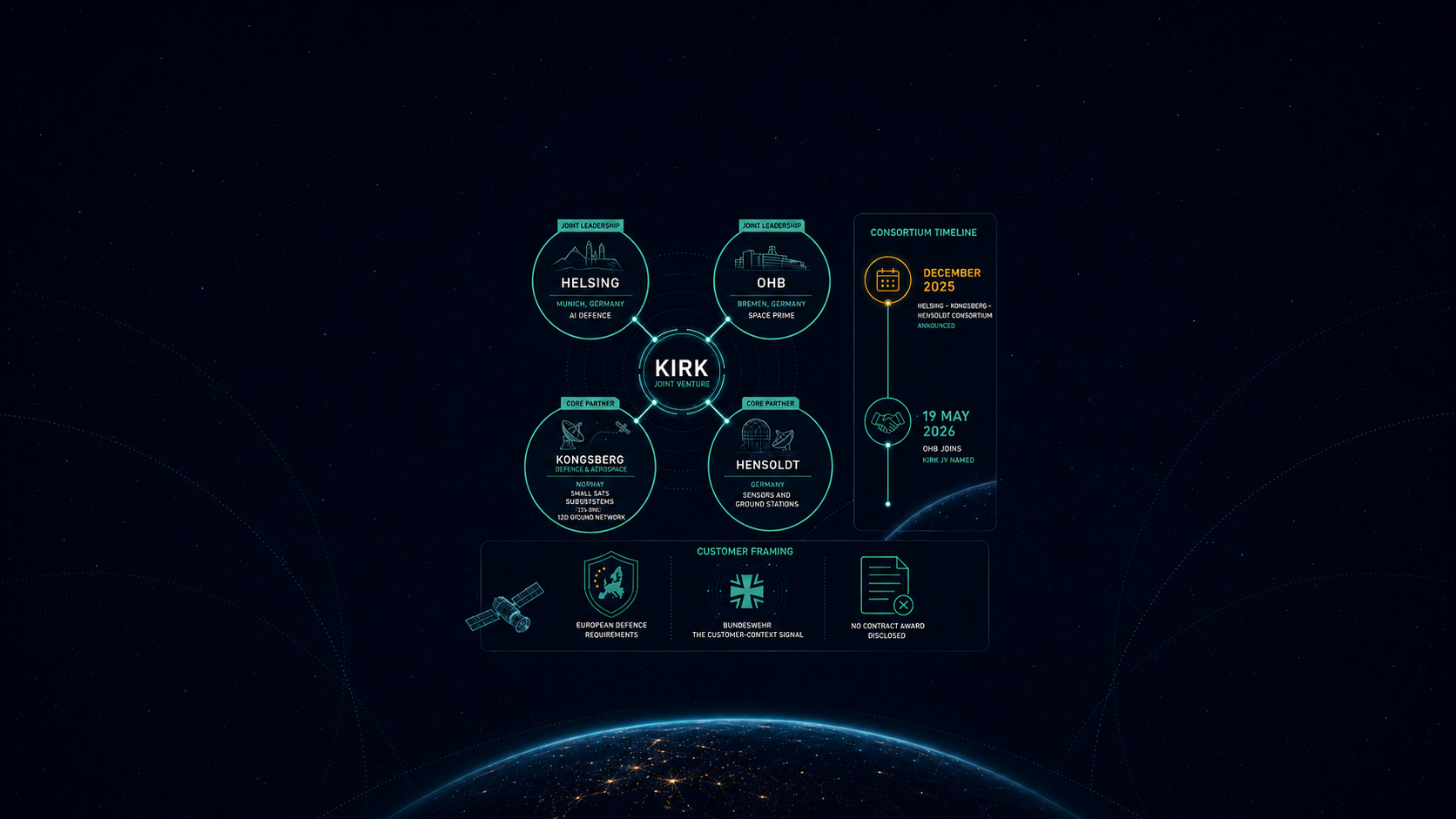
On 19 May 2026, dated Bremen and Munich, Helsing and OHB announced the formation of KIRK — Künstliche Intelligenz und Raumfahrt-Kompetenz, "Artificial Intelligence and Space Competence" — a joint venture to develop a space-based tactical surveillance, reconnaissance and targeting system. OHB joins an existing three-partner consortium, first announced in December 2025 by Helsing with Kongsberg Defence & Aerospace and HENSOLDT, with Helsing and OHB now in joint leadership and Kongsberg and HENSOLDT continuing as core consortium partners.
For European space-sector planners, in Space Insights' W22 read, KIRK is the prime-architecture surface of the same European autonomy file that surfaced this week at the political-leadership level (Aschbacher op-ed, 18 May) and at the operational-delivery level (ICEYE MikroSAR handover to Poland's ARGUS, 15 May). KIRK is positioning; no delivery timeline was published.
The four-partner architecture
The KIRK announcement names four roles inside the consortium.
Helsing (Munich, private AI-defence company founded 2021) and OHB SE (Bremen, Frankfurt-listed German space prime, CEO Marco Fuchs) sit at the joint leadership of the venture. Helsing co-CEO and co-founder Gundbert Scherf is quoted on urgency: "we have no time to lose" in deploying integrated defence systems in space. Marco Fuchs framed AI-driven space systems as "a key component" of efforts to strengthen the Bundeswehr. Helsing's contribution covers combat-proven AI for space, including real-time onboard and offboard data processing, multi-sensor fusion and automated target recognition. OHB is responsible for turnkey end-to-end space systems for Earth observation, communications, navigation and reconnaissance, plus advanced payload development.
Kongsberg Defence & Aerospace (Norwegian, subsidiary of Kongsberg Gruppen ASA, Oslo-listed) contributes end-to-end systems including small satellites, secure communications, C4ISR integration and access to the global KSAT ground-station network. KSAT (Kongsberg Satellite Services) is the Kongsberg Defence & Aerospace and Space Norway joint venture that operates one of the largest commercial ground-station networks worldwide.
HENSOLDT (German defence electronics, Frankfurt-listed Prime Standard since September 2020; shareholding structure per HENSOLDT investor relations: Federal Republic of Germany 25.1%, Leonardo S.p.A. 22.8%, free float approximately 52.1%) contributes space-qualified sensors for all-weather persistent surveillance and high-precision Earth observation, plus mobile ground stations and existing system capabilities.
The Helsing primary release frames the system as being developed for "European defence requirements", with OHB CEO Marco Fuchs specifically positioning AI-driven space systems as a key component of strengthening the Bundeswehr (German federal armed forces). The Bundeswehr is the most visible customer-context signal in the announcement and surrounding reporting; the release does not announce a Bundeswehr contract. The broader European framing leaves room for other Member State customers. NATO context is implied but not explicitly stated in the announcement text.
The software-defined architecture
The Helsing primary release notes that the consortium is working to reduce the latency between data collection and target engagement — the "time to information". The consortium pursues a software-centric approach, including the use of artificial intelligence both to manage the overall system and to improve real-time capability through AI optimisations of onboard functions. The satellites themselves are intended to be implemented as "software-defined", enabling them to be reconfigured in response to new and emerging threats.
This is the architectural specification at the level the announcement records. It is not an operational specification of the resulting system, and the announcement does not detail revisit time, resolution profile, coverage geography or tasking architecture.
How KIRK extends the December 2025 consortium
The Helsing-Kongsberg-HENSOLDT three-way alliance was first announced in December 2025 to build European space-based tactical targeting capability; earlier reporting also referenced Isar Aerospace as a preferred launch partner. KIRK is the May 2026 evolution: OHB joins as the fourth partner; Helsing and OHB take joint leadership; Kongsberg and HENSOLDT continue as core consortium partners.
The architectural shift is structural. The December 2025 consortium had three partners and an AI-defence-led posture (Helsing as the visible lead). The May 2026 expansion brings the German space prime to joint leadership alongside AI-defence — a pairing that puts AI capability and space-systems integration at the same level. For European Programme Managers tracking prime-architecture consolidation, the shift from three to four partners with the German space prime entering joint leadership is the structural change worth recording.
Space Insights cross-file editorial read
KIRK is the third W22 datapoint in an OHB-touched cluster Space Insights has tracked across W21 and into W22. The W21 cluster comprised four publicly recorded items: OHB SE CEO Marco Fuchs's 7 May Reuters-reported statement that OHB would consider legal action if EU antitrust regulators approve the Airbus-Leonardo-Thales satellite-manufacturing combination known internally as Project Bromo; the 11 May Dassault Aviation-OHB SE VORTEX-S spaceplane proposal to ESA with OHB as service-module integrator; the 12 to 13 May OHB Space UK Preliminary Authorisation to Proceed for assembly, integration and test of ESA's EnVision Venus spacecraft at a contract value of approximately €24 million; and Bloomberg's 15 May report that OHB SE had added Berenberg and Commerzbank to a planned share offering that could raise more than €1 billion, joining Deutsche Bank, Goldman Sachs and JPMorgan on the mandate. The W21 Space Insights reading was that OHB SE was operating on three time horizons in parallel: a near-term capital-markets window with the timing of the planned share offering still unconfirmed, a medium-term horizon tied to the European Commission competition review of the Airbus-Leonardo-Thales satellite combination, and a long-term programme-delivery clock (EnVision 2031, VORTEX-S Phase 2 procurement process). KIRK adds a fourth horizon: long-term defence-customer programme delivery anchored on the Bundeswehr customer-context signal recorded in the 19 May announcement. This is a Space Insights editorial reading, not an OHB SE statement, and the source articles for the prior W21 instances are Space Insights' own W21 coverage (per Reuters, ESA tender record via European Spaceflight, OHB SE and ESA UK announcements, and Bloomberg).
What Kongsberg's contribution means for the Nordic ecosystem
For the Nordic space ecosystem, the Kongsberg Defence & Aerospace role in KIRK is significant on three structural reads.
KSAT ground-station network integration into a Bundeswehr-context tactical reconnaissance system places Norwegian ground-segment infrastructure inside a German defence-customer programme architecture. The cross-border architectural pairing is the structural read; specific operational integration is not detailed and is outside the editorial scope of this analysis.
Small-satellite and secure-communications contribution confirms Kongsberg Defence & Aerospace's positioning as a Nordic system integrator at European defence-prime tier. For the Nordic file, the key point is narrower and concrete: Norwegian Kongsberg / KSAT ground-segment and C4ISR capability is being positioned inside a German-led defence-space architecture.
C4ISR integration is the system-level logic that connects the four contribution layers — Helsing's AI, OHB's space prime architecture, Kongsberg's small satellites and secure comms, HENSOLDT's sensor and ground-station portfolio — with Kongsberg explicitly named for C4ISR integration in the release. This is one of the more visible Nordic ecosystem positionings of the May 2026 window.
How KIRK connects to the W22 European autonomy thread
Space Insights cross-Article editorial read
Reading the W22 signal mix as one editorial week, three surfaces of the European autonomy thesis are simultaneously visible across Space Insights' own W22 coverage.
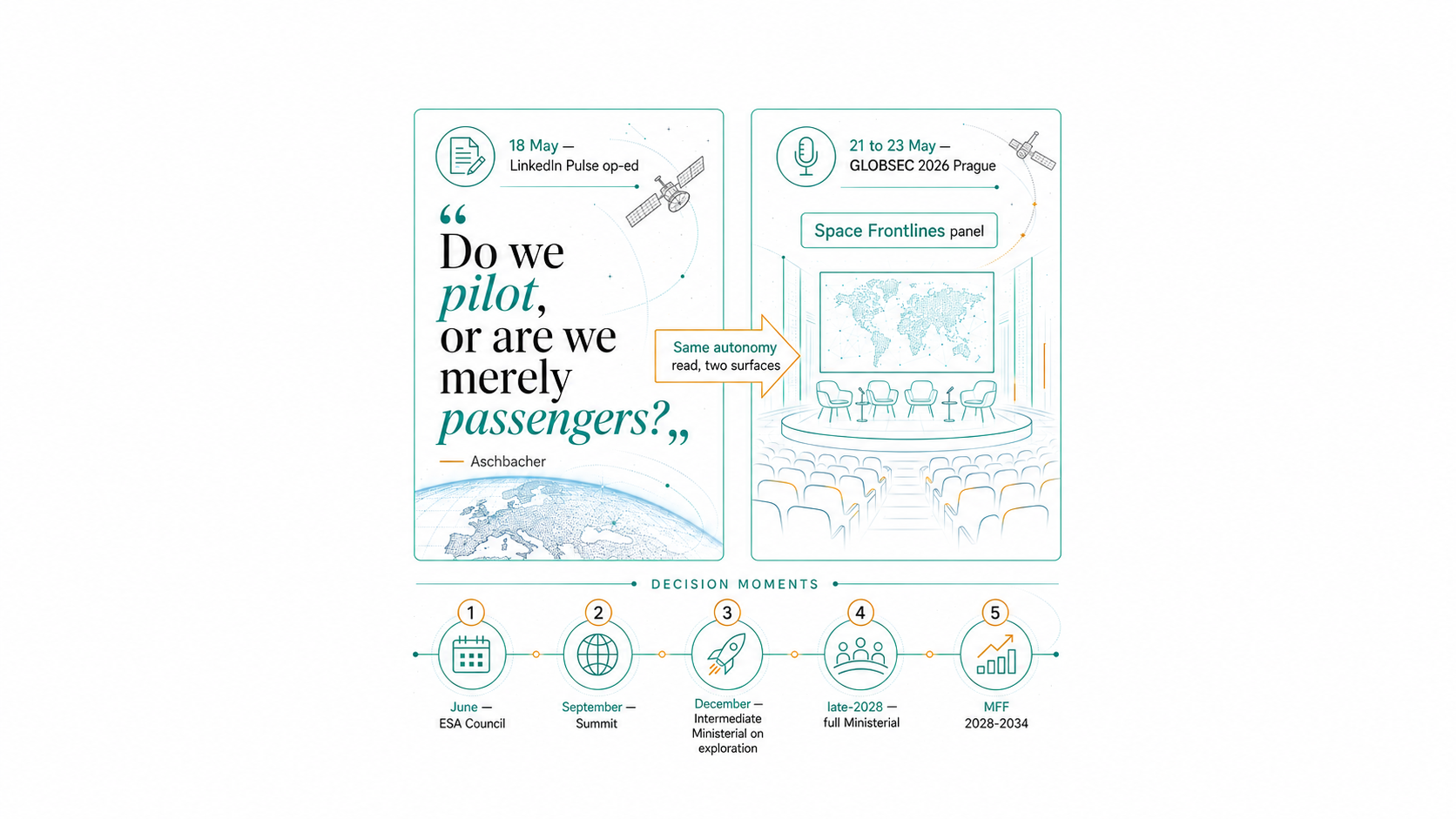
The Aschbacher op-ed (18 May, Space Insights W22 signal 3) is the political-leadership surface: "do we pilot, or are we merely passengers?" — Explore2040 as the framing, with the June ESA Council, the September International Space Summit, the December Intermediate Ministerial Council on exploration and the late-2028 full Ministerial as the named institutional dates.
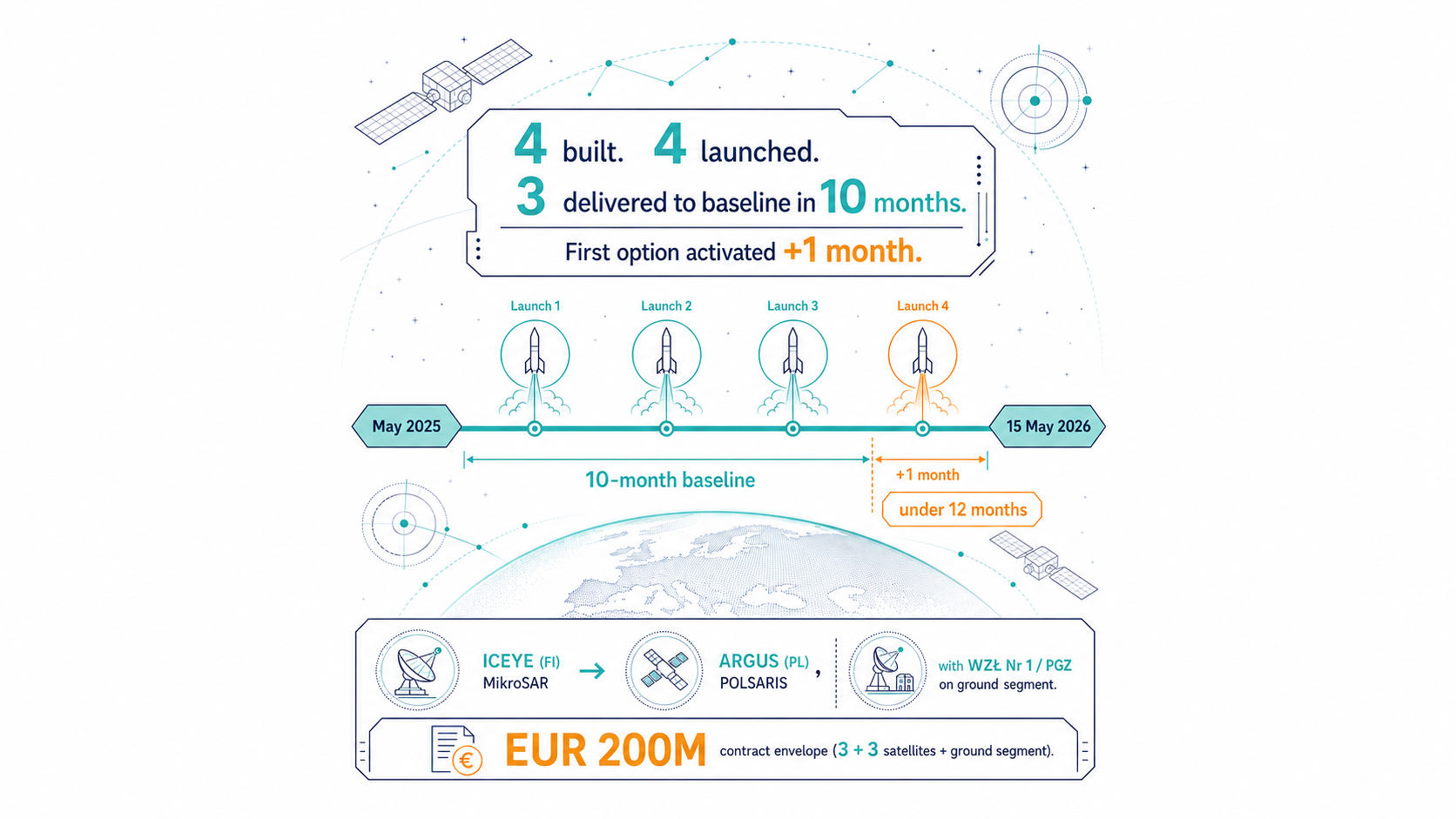
The ICEYE MikroSAR handover to Poland's ARGUS (15 May, Space Insights W22 signal 18) is the operational-delivery surface: a four-satellite SAR system handed to a sovereign customer in under 12 months from contract signature, per the ICEYE press release.
In Space Insights' W22 read, KIRK (19 May, this signal) is the prime-architecture surface of the same autonomy file: a four-partner European consortium consolidates at the AI-defence + space-prime + Nordic-integrator + sensor-electronics layer for a Bundeswehr-context tactical reconnaissance system, per the Helsing primary release.
The three surfaces are not equivalent. Political leadership and prime-architecture announcements are positioning; operational delivery is execution. KIRK is positioning. The May 2026 consortium-expansion announcement does not name a delivery date; it names an architectural commitment. This linkage across the three W22 surfaces is a Space Insights editorial framing of the week's institutional pattern, not a single primary source statement.
What is not in the KIRK announcement
The 19 May press release records the consortium formation, the joint leadership of Helsing and OHB, the core-consortium positions of Kongsberg and HENSOLDT, the per-partner contribution architecture and the European-defence-requirements framing with Bundeswehr-strengthening as the named customer-context signal. It does not record:
- A specific delivery timeline for the tactical reconnaissance system.
- A specific budget envelope or EUR amount for the JV or for the system.
- The ownership split between Helsing and OHB at joint leadership.
- Any contracted procurement commitment from the Bundeswehr or from any other European defence customer.
These omissions are appropriate for an architecture-level consortium announcement; they also mean KIRK should be read as positioning, not as a contract win.
What this means for European space-sector planners
For European primes, SMEs and Programme Managers writing post-2027 defence-procurement and partnership assumptions, three reads follow.
OHB SE's defence-customer trajectory. With KIRK, OHB SE is now on record as joint leader of a tactical reconnaissance JV framed around European defence requirements and Bundeswehr-strengthening language. Read with the W21 cluster (Bromo legal posture, planned share-offering window, EnVision UK, VORTEX-S), this is OHB's fourth visible strategic positioning in three weeks. The pattern is consistent with the W21 reading: OHB is operating on multiple time horizons in parallel.
Helsing's prime-architecture positioning. Helsing's co-leadership of KIRK is the third Helsing instance in a European defence-prime architecture visible to Space Insights (after the December 2025 three-way consortium and subsequent UK and German defence procurement announcements). Co-leadership of KIRK alongside OHB SE is consistent with Helsing being read in this announcement at European space-prime peer level rather than at AI-vendor-to-primes level, although the broader European defence-supply taxonomy is wider than the KIRK consortium alone.
The Bundeswehr space-procurement architecture. With KIRK framed around Bundeswehr-strengthening language, German Federal Ministry of Defence procurement architecture for tactical space reconnaissance now has a publicly named four-partner consortium positioned against it. The next institutional venue is whichever Bundeswehr or German Federal Ministry of Defence procurement window for tactical-space reconnaissance capability publicly emerges; the 19 May announcement does not name a specific procurement cycle or programme line.
What is uncertain
The KIRK system delivery timeline is not published. Procurement-cycle context (whether a Bundeswehr contract follows on a specific timeline) is not in the public record. The ownership split between Helsing and OHB at joint leadership is not disclosed in the announcement.
Forward look
Three watch items for the second half of 2026:
- OHB SE half-year and Q2 2026 results window — whether any KIRK-related provisions, partnerships or commitments are referenced in OHB SE's published interim disclosures, in line with the company's normal reporting calendar.
- Bundeswehr space-procurement programming — whether the German Federal Ministry of Defence makes any tactical-reconnaissance procurement programming public that the KIRK consortium architecture could be read against, and on what timeline.
- KIRK system-design announcements — whether a delivery date or budget envelope becomes public through subsequent consortium or partner communications; major European defence and space trade calendar windows (Le Bourget Air Show June 2027 the next high-visibility one) are plausible venues but not committed ones.
KIRK is an architecture-level consortium expansion. Whether it converts to a contracted programme is the next institutional question. The June ESA Council and the parallel German federal defence-budget cycle are proximate political-context windows, although neither is named in the 19 May announcement.
Sources
- 1.Helsing and OHB establish joint venture 'KIRK' for tactical space-based reconnaissance systems — Helsing (press release)
- 2.Helsing and OHB form KIRK space targeting joint venture — Aerotime
- 3.Helsing and OHB form KIRK joint venture for European tactical space-based reconnaissance system — Defence-Industry.eu
- 4.Helsing and OHB Establish Joint Venture 'KIRK' for Tactical Space-Based Reconnaissance Systems — SpaceWatch.Global
Get briefings like this every Friday.
Subscribe