GLOBSEC 2026 in Prague, 21 to 23 May 2026 — the 'Space Frontlines: Shaping European Security' panel as the security-policy surface of the W22 European autonomy file. Space Insights.
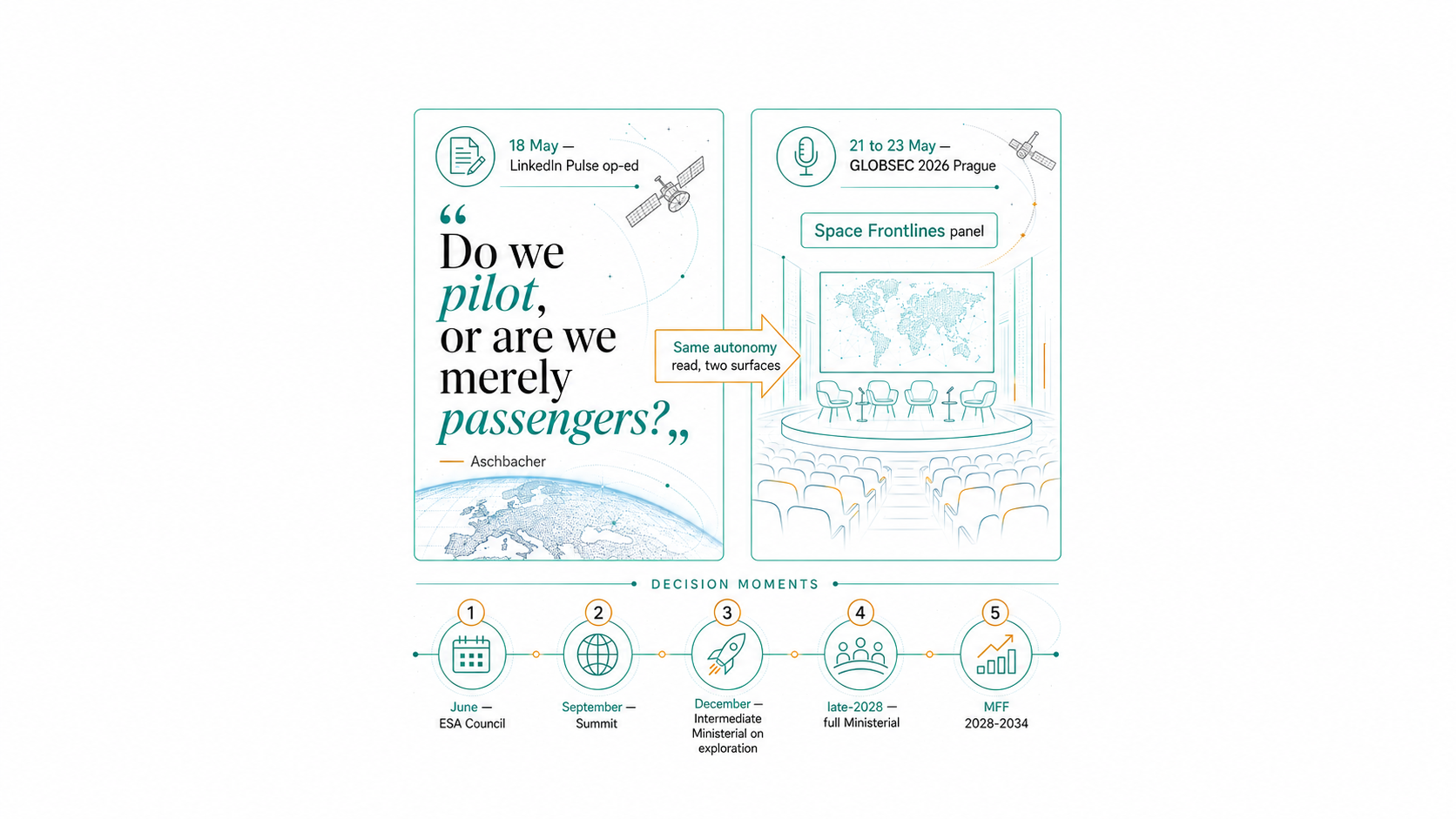
The 21st GLOBSEC Forum in Prague, 21 to 23 May 2026, included a panel titled "Space Frontlines: Shaping European Security", where the European Space Agency was represented by Director General Josef Aschbacher. Space Insights reads the panel as a security-policy surface of the autonomy thesis Aschbacher set out three days earlier in "Are we pilots or are we passengers?" on LinkedIn Pulse (with a parallel Agence Europe Bulletin version, article 13866/29). Same Director General, same week, different vocabulary — and in Space Insights' reading, the vocabulary tells the planning story.
For European space-sector planners, GLOBSEC 2026 is the political-context venue, not the decision venue. The decision venues remain the June 2026 ESA Council, the September 2026 International Space Summit, the December 2026 ESA Intermediate Ministerial Council on exploration, the late-2028 ESA full Ministerial Council and the EU Multiannual Financial Framework 2028 to 2034 negotiations. What GLOBSEC adds is the security-policy frame for the thesis those venues will address.
What ESA's own communication records
ESA's institutional communication of the GLOBSEC participation, published under "ESA at GLOBSEC 2026", records two operative things.
The venue. The 21st edition of the GLOBSEC Forum in Prague, 21 to 23 May 2026. The "Space Frontlines: Shaping European Security" panel was the specific session ESA participated in. No other ESA officials are named in the communication.
The key priorities emerging from the panel. ESA records that the panel discussions underlined three priorities "emerging as key" from the exchange: "strengthening resilience, accelerating delivery and ensuring interoperability across European and national systems". ESA's participation demonstrated "how space capabilities support informed decision-making, strengthen resilience and reinforce Europe's future security".
The bilateral interventions. The ESA communication also records that on the margins of the Forum the Director General engaged with Czech President Petr Pavel on the Czech Republic's growing ambitions in space and on its contribution to ESA programmes, and met with First Deputy Prime Minister Karel Havlíček. These bilateral encounters are part of the institutional fact pattern of ESA's GLOBSEC participation, not subordinate to the panel proceedings.
The ESA communication does not quote Aschbacher directly. It records the key priorities surfaced through the panel discussions, the ESA framing of why space participation at the forum matters, and the bilateral exchanges with the Czech head of state and First Deputy Prime Minister. That absence of direct quote is consistent with security-policy-venue protocol; the analytical content is in the priorities recorded.
How Space Insights reads resilience, delivery and interoperability
In Space Insights' reading, resilience, delivery and interoperability are the operational vocabulary through which the autonomy thesis becomes actionable. The editorial read for which existing programmes are the resilience anchors (IRIS² secure connectivity, Galileo, GOVSATCOM, the EU Space Surveillance and Tracking framework) is Space Insights' synthesis, not directly mapped in the ESA communication; what the ESA text records is that resilience is among the strategic themes that surfaced as key priorities.
Space Insights maps "accelerating delivery" to the ICEYE MikroSAR / POLSARIS handover to Poland's ARGUS agency on 15 May 2026 — under 12 months from contract signature — covered separately in Signal 18 (primary source ICEYE press release of 15 May 2026), and "ensuring interoperability across European and national systems" to the KIRK joint venture (Helsing, OHB, Kongsberg Defence and Aerospace, HENSOLDT — announced 19 May 2026) covered separately in Signal 10 (primary source Helsing release of 19 May 2026). These are cross-file examples Space Insights places against the GLOBSEC vocabulary, not ESA's own GLOBSEC references.
In Space Insights' reading, the three themes are the operational vocabulary the GLOBSEC venue surfaces, and the vocabulary the institutional dates of June, September and December can reasonably be tracked against.
How the GLOBSEC surface differs from the op-ed surface
The Aschbacher op-ed and the GLOBSEC panel can be read together as two surfaces of the same autonomy thesis through different vocabularies, and the difference is load-bearing for planners.
The op-ed vocabulary is operational and rhetorical: "do we pilot, or are we merely passengers?", "autonomous human spaceflight is not a luxury", "exposed to decisions beyond its control". The op-ed names US-side programme moves (Artemis architecture changes, a Gateway pause, a Mars Sample Return cancellation — Aschbacher's framings) and names European programme references (Explore2040, Copernicus, Galileo). The audience is the European space-policy and Member State community.
The GLOBSEC vocabulary is security-architectural: "strengthening resilience, accelerating delivery and ensuring interoperability across European and national systems". The audience is the European security-policy community (Defence Ministries, MFA Strategic Policy Departments, NATO national delegations). The framing translates the op-ed thesis into the language that defence-and-foreign-policy planners can act on.
The two vocabularies serve different institutional functions. The op-ed positions the question for the space-policy community. The GLOBSEC panel positions the same question for the security-policy community. Together, they help the autonomy framing travel across both the space-policy and security-policy audiences ahead of the June and September venues.
Space Insights cross-file editorial read: the W22 multi-surface synthesis
Reading W22 as one editorial week, multiple surfaces of the European autonomy thesis are simultaneously visible across Space Insights' own W22 coverage:
| Surface | Signal | Date | Vocabulary | Institutional layer |
|---|---|---|---|---|
| Political leadership | Aschbacher op-ed | 18 May | Pilots / passengers, autonomy | ESA DG, space-policy community |
| Operational delivery | ICEYE MikroSAR / POLSARIS to ARGUS | 15 May | Under 12 months, sovereign delivery | Polish MOD, ICEYE, Finnish-Polish corridor |
| Prime architecture | KIRK JV (Helsing, OHB, Kongsberg, HENSOLDT) | 19 May | Tactical space reconnaissance, AI + space + Nordic + sensors | Four-partner consortium, Bundeswehr customer |
| Security policy | GLOBSEC 2026 panel | 21 to 23 May | Strengthening resilience, accelerating delivery, ensuring interoperability | ESA at security-policy venue, Prague |
The four surfaces are not equivalent. Political leadership, prime architecture and security policy are positioning. Operational delivery is execution. The four-surface coherence of W22 — with three positioning surfaces and one execution surface in one week — is a Space Insights editorial framing of the week's institutional pattern, not a single primary source statement. The source articles for each surface are Space Insights' own W22 coverage of the Aschbacher op-ed (Signal 3), the ICEYE MikroSAR handover (Signal 18), the KIRK JV (Signal 10) and the GLOBSEC 2026 panel (Signal 4, this article); each rests on its own primary source path.
What the GLOBSEC framing does not do
The ESA communication does not specify a programme-level commitment. It does not commit ESA to any new architecture. It does not record a Member State position on autonomous human spaceflight or on European-led space-defence systems. It records that the Director General participated in the panel, that the panel discussions underlined strengthening resilience, accelerating delivery and ensuring interoperability as emerging key priorities, that bilateral exchanges with Czech President Petr Pavel and First Deputy Prime Minister Karel Havlíček were held on the margins of the Forum, and that ESA's framing of space's role in security was on the record at the venue.
For planners, that means GLOBSEC 2026 is signal-strength, not commitment-strength. It tells you the vocabulary that will be deployed in June and September. It does not tell you what those venues will decide.
Space Insights cross-pipeline context: how this connects to the W20 EU Space Act file
This is a second-order Space Insights linkage: the ESA GLOBSEC text does not reference the EU Space Act.
The 29 May 2026 Competitiveness Council, where Council document ST-8861-2026-INIT is expected to be taken note of, is the next regulatory-state surface within the same Space Insights autonomy read. The Cyprus Presidency progress report records that the EU Space Act application date is not expected before 2030 and that the national-security clause remains the foremost remaining open issue (per W20 Space Insights coverage; primary sources per Council of the EU and Cyprus Presidency documentation, document ST-8861-2026-INIT).
The GLOBSEC framing of "ensuring interoperability across European and national systems" sits, in Space Insights' editorial read, directly inside that open EU Space Act question. The national-security perimeter of the EU Space Act is the regulatory expression of the autonomy thesis the GLOBSEC panel framed at policy-venue level. The vocabulary used in the Council outcome, meeting note or Presidency communication after 29 May will be the signal to watch on whether the Space Act file is carried forward as a priority continuation or paused for structural rework — which in turn frames whether the next Presidency takes the autonomy thesis forward at regulatory level or holds it. This regulatory linkage is a Space Insights editorial reading, not a connection made by ESA or recorded in the GLOBSEC communication.
The Aschbacher op-ed, the GLOBSEC panel and the 29 May Competitiveness Council can be read as three surfaces of the same week's institutional architecture. The June ESA Council follows them.
What is uncertain
The ESA communication does not specify whether Aschbacher's panel intervention recorded any new programme positioning beyond the themes captured in the institutional summary. The GLOBSEC Forum's own documentation may add further detail in the second half of 2026.
Member State delegations' alignment behind the autonomy thesis is not yet visible publicly. The June ESA Council vocabulary will be the first surface where Member State posture can be read.
Forward look
Three watch items for the second half of 2026:
- 29 May 2026 Competitiveness Council — the EU Space Act vocabulary for the next Presidency, and whether the national-security clause is recorded as priority continuation or structural rework.
- June 2026 ESA Council — whether the Explore2040 framing converts to a Council-level direction on autonomy.
- September 2026 International Space Summit and December 2026 ESA Intermediate Ministerial Council on exploration — whether the autonomy thesis lands as a programme commitment, a strategy commitment, or a continuation framing.
The GLOBSEC 2026 panel reads, in Space Insights' editorial framing, as a second surface of the autonomy thesis published this week. The third surface (29 May), the fourth (June Council), the fifth (September Summit) and the sixth (December Intermediate Ministerial on exploration) are the institutional venues that convert vocabulary into commitments. The reasonable editorial read is to track Council and Summit vocabulary, not GLOBSEC vocabulary — the panel positions the vocabulary; Councils and Ministerials determine whether that vocabulary becomes commitment.
Get briefings like this every Friday.
Subscribe