The 29 May 2026 Competitiveness Council placed the EU Space Act, the European Competitiveness Fund space part and the proposed EU Space Services Agency in a single session. Space Insights.
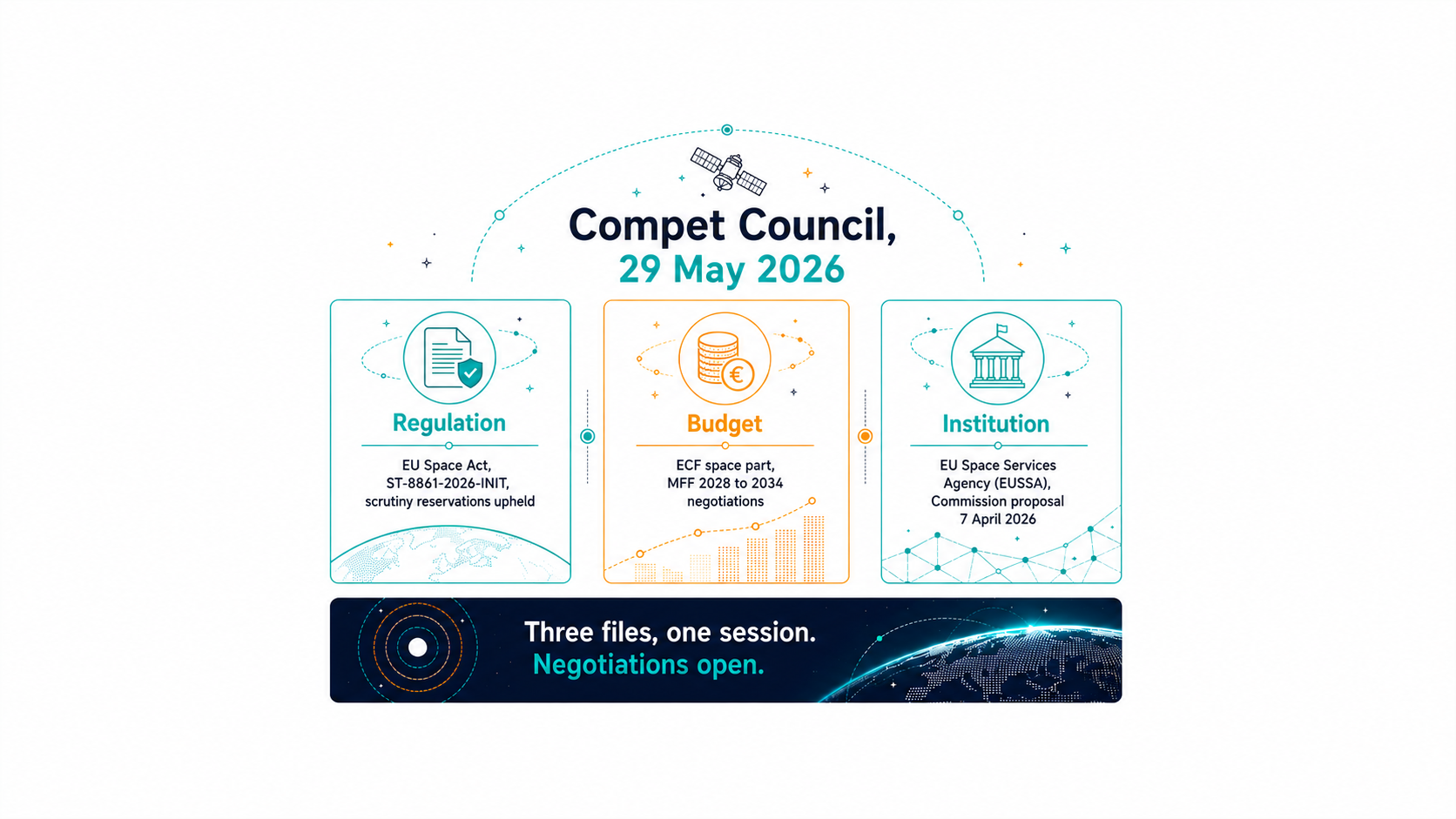
At the Competitiveness Council on 29 May 2026, under the Cyprus Presidency, ministers were briefed on three EU space architecture files in the same session: the EU Space Act (regulation), the space part of the European Competitiveness Fund or ECF (budget file under negotiation), and the proposed EU Space Services Agency (EUSSA) regulation (institution). None of the three files is closed. In Space Insights' editorial reading, the structural shape of the European space architecture is becoming visible as a connected architecture rather than as three isolated files; the Cyprus Presidency briefing slot is what made the convergence legible.
For European primes and SMEs writing post-2027 procurement and partnership assumptions, the operative content is not the rhetorical force of the Council outcome material. It is the specific document references, the specific dates and the specific procedural status of each of the three files.
The three files, file by file
The EU Space Act is the regulatory file. The Cyprus Presidency progress report on the draft Act, Council document ST-8861-2026-INIT, was released 8 May 2026 and tabled at Compet Council on 29 May. Delegations recorded that the Presidency compromise text moves in the right direction by reducing complexity. All Member States, however, upheld a scrutiny reservation throughout the Cyprus Presidency, meaning that the formal national positions remain subject to further internal review. The key open issues per the progress report are scope and dual-use exemptions, governance architecture and treatment of third-country operators. ITRE rapporteur on the file remains Donazzan, on a Commission proposal first tabled June 2025.
The European Competitiveness Fund space part is the budget file. The ECF space part is expected to become one of the main post-2027 EU budget vehicles for space systems and EU space-policy implementation, sitting inside the 2028 to 2034 Multiannual Financial Framework. At the 29 May Council, the Cyprus Presidency briefed ministers on the ongoing negotiations on the space part of the ECF, with several delegations emphasising the need for coordinated governance between the ECF and Horizon Europe to ensure a seamless investment journey for the space sector. The ECF and MFF negotiations are relevant to the future funding architecture for EU space systems, potentially including Galileo, EGNOS, Copernicus, GOVSATCOM and IRIS², depending on the final budget architecture.
The proposed EU Space Services Agency (EUSSA) regulation is the institutional file. The European Commission proposal of 7 April 2026 would reframe the European Union Agency for the Space Programme (EUSPA) as a standalone agency with its own legislative basis, with a mandate connected to the implementation of EU space systems and policy actions, including current flagship domains such as navigation, Earth observation and secure connectivity, where assigned under final legislation. At Compet Council on 29 May, the Council reviewed the status of the file. The legislative procedure is ordinary, the proposal is early in the ordinary legislative procedure, and the file is now sitting alongside the EU Space Act and the ECF space part in the same Council architecture.
Ministers then held a policy debate on space for economic security and dual-use applications — the second-half item of the 29 May session. The debate did not produce binding conclusions, but it sets a register inside which the three legislative files will continue to be discussed.
Why three files in one session matters for sector planners
The convergence of regulation, budget and institution in a single Council session is the structural shape of the post-2027 European space architecture as it is now becoming visible. Each of the three files alone is a long-running negotiation in its own right. Together, they describe the architecture inside which European space programmes will operate from 2028 onward.
What the three-file convergence signals for procurement planning
For a Tier 2 supplier or a Programme Manager writing 2028-onwards procurement assumptions, the practical read is that the regulation, the budget envelope and the agency are converging into a single architecture. The vocabulary the Council uses on each — "scrutiny reservations upheld" on the EU Space Act, "ongoing negotiations" on the ECF space part, "status reviewed" on the EUSSA proposal — describes a process that is moving without being concluded. The procurement window inside which suppliers can position is wider than a single file would suggest, because movement on any one of the three is likely to affect how the others land.
What the three-file convergence does not tell us yet
What the Compet Council session does not yet tell us is the resolution direction on any of the three files. The EU Space Act scope, dual-use exemptions and third-country treatment remain open. The ECF space part envelope remains subject to the MFF negotiation. The EUSSA proposal remains early in the ordinary legislative procedure. None of the three has a confirmed adoption date inside the current calendar.
In Space Insights' editorial reading, this is the converse of a decision moment: it is an architecture moment, in which the structural shape of the post-2027 European space file is becoming visible without the substantive decisions being closed. The structural shape itself is the new information; the substantive decisions remain pending.
How the European space industry is reading the architecture
European industry voices have begun to surface their reads of the same architecture. SpaceNews reported on 26 May 2026 that representatives of the European space industry have warned that the proposed EU Space Act might hinder their global competitiveness — a structural concern about how the regulatory file's scope and obligations will land alongside ECF funding and the new agency's institutional reach. In parallel, Deputy Minister Nicodemos Damianou's opening address at EU Space Days 2026 (26 to 27 May) framed the Cypriot Presidency priorities as the need for modern, harmonised space rules to boost competitiveness, strategic autonomy and innovation, per Cyprus Mail coverage. Together, they illustrate two public registers around the file: Presidency-level modernisation language and industry-level competitiveness concerns.
In Space Insights' editorial reading, these are public positions in the Council process, not Council conclusions about it. Under the active scrutiny reservations on the EU Space Act and the open MFF negotiation, neither industry framing nor Presidency framing is decisive on the substance.
What is uncertain
Three uncertainties are editorially material for sector planners.
First, the Council adoption direction on the EU Space Act. Scrutiny reservations from all Member States mean the file remains genuinely open on the substance — scope, dual-use exemptions, governance and third-country treatment are not yet settled. The Cyprus Presidency progress report describes a moving negotiation, not a converged position.
Second, the ECF space part envelope. The MFF 2028 to 2034 negotiations are among the structural constraints, and no final space-specific envelope is visible in the public Council outcome material — the public Council material does not yet make a final ECF space part envelope visible at a number. Coordinated governance between the ECF and Horizon Europe is one of the architectural elements on which several delegations are aligned.
Third, the EUSSA proposal's procedural stage. The proposal of 7 April 2026 is early in the ordinary legislative procedure; a public European Parliament position was not identified in this Space Insights scan, and the agency's institutional perimeter (which programmes it operates, which budgets it administers, which governance reports to it) remains subject to Council and Parliament work.
Forward look
The next institutional moments at which the three files can be read together against Member State posture are the next Council meetings or Presidency communications with space-policy items, the European Parliament committee work on the EUSSA proposal and the EU Space Act through summer and autumn, and the rolling MFF 2028 to 2034 Council negotiations. The Cyprus Presidency has set the architecture-level frame; the resolution on each file moves through the following Council schedules.
For European space-sector planners, the practical anchor is the Council outcome document or Presidency communication after the next Compet Council with a space agenda item. The vocabulary used in that document — whether on EU Space Act scope, EUSSA institutional perimeter or ECF space part envelope — will be one of the next decision-strength signals to watch. Until then, the architecture is visible; the substance is pending.
In Space Insights' editorial reading, the three-file convergence at the 29 May Council session is what makes the European space architecture legible as a connected architecture, and that legibility itself is what the Cyprus Presidency briefing produced.
Sources
- 1.Competitiveness Council (Research and Space), 28-29 May 2026 — Council of the European Union
- 2.Council document ST-8861-2026-INIT — EU Space Act progress report — Council of the European Union
- 3.Main results of the EU Competitiveness Council on Research and Space — IEU Monitoring
- 4.Europe needs modern space rules to boost competitiveness — Damianou opening address at EU Space Days 2026 — Cyprus Mail
- 5.European space industry warns EU Space Act could slow competitiveness — SpaceNews
Get briefings like this every Friday.
Subscribe