Dassault Aviation and OHB SE announced VORTEX-S on 11 May 2026: Dassault as prime architect and global integrator, OHB as service-module architect and integrator. Positioned for ESA's ALADDIN Phase 2 procurement. Space Insights.
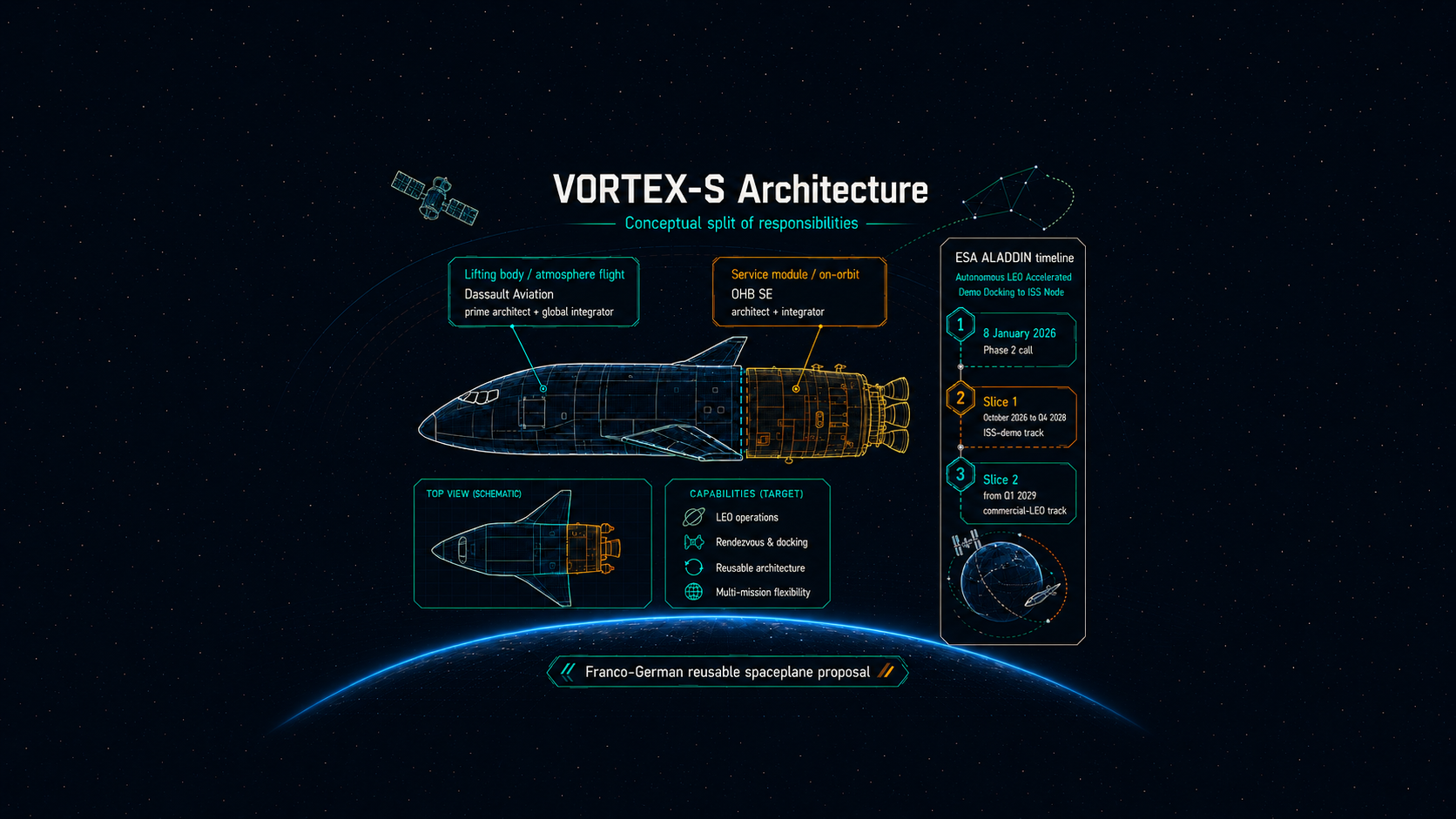
On 11 May 2026, Dassault Aviation and OHB SE announced a joint proposal to the European Space Agency for the VORTEX-S multipurpose spaceplane. The architecture allocates Dassault Aviation as prime architect and global integrator of the spaceplane, and OHB SE as architect and integrator of the service module. European Spaceflight reports that the announcement positions for ESA's LEO Cargo Return Service initiative, which the same coverage describes as reframed under the ALADDIN identifier (Autonomous LEO Accelerated Demo Docking to ISS Node) in the agency's 8 January 2026 Phase 2 call. Per the same European Spaceflight coverage, the Phase 2 structure runs in two slices: the first slice from October 2026 through Q4 2028 on the ISS-demonstration track, and the second slice from Q1 2029 on the commercial-LEO-destinations track.
What VORTEX-S is, in plain terms
VORTEX-S is a reusable spaceplane concept positioned for two distinct use cases inside the same airframe, per the Dassault Aviation / OHB joint press release:
- Round-transport to space stations — cargo to and from the International Space Station, and to future European or commercial-LEO stations
- Autonomous orbital free-flyer missions — independent on-orbit operations without mandatory docking
The Dassault-OHB announcement does not disclose specific payload, downmass, or secondary-deployment specifications beyond the two high-level use cases. The reusability framing places VORTEX-S in the conceptual neighbourhood of other lifting-body re-entry vehicles in development internationally, but the European-architecture context is distinct: VORTEX-S is being proposed as part of ESA's autonomous-LEO-transport programme, not as a commercial-cargo augmentation to NASA-supplied infrastructure.
ALADDIN: the programme behind the bid
European Spaceflight reports that ALADDIN restructures what ESA previously communicated as the LEO Cargo Return Service initiative. Per the same coverage, on 8 January 2026 ESA published the Phase 2 call under the new ALADDIN identifier, with the rescoping aligned to the ISS deorbit timetable and the last-opportunity ISS demonstration window in the second quarter of 2029. Phase 2 invites consortium proposals against the autonomous-docking-to-ISS-node demonstration specification.
Per European Spaceflight, the Phase 2 procurement runs in two slices: the first slice from October 2026 through Q4 2028 on the ISS-demonstration track, and the second slice from Q1 2029 on the commercial-LEO-destinations track. The same coverage notes that Dassault may be looking to consolidate its VORTEX-S and VORTEX-C variants into a single vehicle for the purposes of bidding on Phase 2.
Phase 1 of LEO Cargo Return Service contracts were awarded by ESA in May 2024 to Thales Alenia Space and The Exploration Company. ALADDIN Phase 2 is the next selection stage. On 10 March 2026, ESA announced an incentive of up to €50 million per contract for proposals using Ariane 6 or other European launchers, on top of per-contract values of up to €420 million (with €200 million initially allocated and the remaining €220 million contingent on additional funding secured at the ESA Ministerial Council meeting in late 2028), per European Spaceflight coverage.
The Phase 2 framing is significant for two reasons. First, ALADDIN is competitive: ESA expects multiple proposals and will down-select. Second, the autonomous-docking specification places a premium on consortium experience with rendezvous, proximity operations and on-orbit control — areas where OHB's satellite-systems heritage is directly relevant.
The roles, and why the pairing is the message
Dassault Aviation's role as prime architect and global integrator draws on the company's aerospace-platform heritage. Aircraft-grade airframe design, aerodynamics qualification, control-surface authority, and reusable-vehicle operational integration are the relevant competence pillars. Dassault's wider aircraft and advanced-aeronautics heritage is relevant to the atmospheric-flight and re-entry side of the concept.
OHB SE's role as service-module architect and integrator draws on the company's satellite-systems heritage. Propulsion, power generation and distribution, thermal management, on-orbit attitude and orbit control, and the avionics required to operate a free-flyer payload are the relevant competence pillars. OHB's satellite-systems and mission-integration portfolio provides the institutional reference for service-module integration at this scale.
The complementary perimeter is structural, not branding. Dassault does not build satellite service modules; OHB does not build aircraft. Two family-owned high-tech companies with adjacent but non-overlapping competence pillars are combining for a single architecture proposal.
Marco Fuchs, CEO of OHB, framed the pairing as: "The partnership with Dassault Aviation is a perfect match: as family-owned high-tech companies, we share the same vision and bring complementary strengths to the development of a reusable spaceplane – Dassault Aviation as aircraft manufacturer, and OHB as space company" (per the Dassault Aviation / OHB joint press release, 11 May 2026). The statement is in institutional capacity only.
The post-Bromo industrial context
The Dassault-OHB announcement also lands in a wider European industrial-policy context shaped by the proposed Airbus-Leonardo-Thales satellite-manufacturing combination known as Project Bromo (per Reuters, OHB SE has publicly indicated it would consider legal action if the European Commission cleared the merger). Per W20 and W21 Space Insights coverage, Bromo remains under DG COMP competition review at the time of writing, and OHB SE has positioned itself publicly as an independent European satellite manufacturer outside the Bromo perimeter.
VORTEX-S is the first ALADDIN Phase 2-positioned consortium identified in this Space Insights scan, and it shows that an ALADDIN-relevant architecture can be publicly framed around a Dassault-OHB core team, outside the Airbus-Leonardo-Thales combination. The Dassault-OHB consortium can be expanded with additional European partners — the announcement explicitly notes that discussions are underway with other major European space companies — but the publicly disclosed architectural backbone is independent of the Bromo perimeter.
From an industrial-policy perspective, this could be read either as architectural diversity in the European-prime supply base or as a question of consortium scale. ESA's actual evaluation will depend on the published procurement criteria and the submitted proposals; the industrial-policy signal nevertheless exists, and it is part of the structural read.
What this tells us about Europe's reusable-LEO ambitions
Three readings emerge.
A. Programme-architecture reading. Europe has restructured its LEO autonomous-transport programme architecture (LEO Cargo Return Service to ALADDIN per European Spaceflight), opened a competitive Phase 2 call, and is now receiving consortium proposals. The Dassault-OHB pairing is one of the first publicly visible consortium architectures positioned around the Phase 2 opportunity. More public consortium announcements may follow as the Phase 2 procurement progresses.
B. Industrial-policy reading. Independent of any specific award outcome, VORTEX-S shows that an ALADDIN-relevant architecture can be publicly framed around a Dassault-OHB core team, outside the Airbus-Leonardo-Thales combination. That is a programme-design data point for ESA and a positioning data point for OHB.
C. Long-term-transport reading. Whether or not VORTEX-S is awarded, the European appetite for reusable in-space transport infrastructure is now embedded in a formal programme (ALADDIN), with at least one serious publicly announced architecture proposal — built around the Dassault-OHB core team — on the public record. The technical maturity of VORTEX-S cannot be evaluated from the public announcement alone, but the 2030s LEO-transport conversation has acquired a specific European-architecture reference point.
Space Insights cross-file editorial read
This reading sits within a broader European pattern Space Insights has tracked across the spring of 2026: the NASA Gateway pause (W17) and ESA LISA risk mitigation (W20) are the two prior public instances where ESA programmes have been adjusted to be more robust to US programme uncertainty. VORTEX-S is the third instance Space Insights identifies in this pattern, with a difference: the first two were ESA-led adaptations within existing missions, while VORTEX-S is an industry-led architecture proposal published into ESA's restructured LEO-transport programme. This is an editorial reading, not an ESA statement, and the source articles for the two prior instances are Space Insights' own W17 and W20 coverage.
What is uncertain
ALADDIN Phase 2 award decisions have not been published at the time of writing. The number of proposals submitted has not been publicly disclosed. The full Dassault-OHB consortium is described as "expanding" — additional partners are not yet named. The technical specification of VORTEX-S beyond the two high-level use cases has not been publicly released. None of these uncertainties affect the announcement's signal value; they affect what can be evaluated when the award decisions are published.
Forward look
Four watch items:
- ALADDIN Phase 2 first slice (October 2026 to Q4 2028) ISS-demonstration track — ESA's procurement window for the first slice (per European Spaceflight)
- ALADDIN Phase 2 second slice (from Q1 2029) commercial-LEO-destinations track — the longer-horizon procurement signal
- Additional consortium-partner announcements — Dassault-OHB's stated expansion timeline
- Parallel Phase 2 proposals — other consortia entering the public record; the next public signal will be whether ESA confirms proposals, down-selection or contract awards under the Phase 2 process
The reasonable read of 11 May is that VORTEX-S is a serious publicly announced European architecture proposal, given the Dassault-OHB core team, but its technical maturity cannot be evaluated from the public announcement alone. The reasonable editorial read is to track ALADDIN as a programme, not VORTEX-S as a product, until the procurement process produces public outcomes.
Sources
- 1.Dassault Aviation and OHB team up to propose to ESA the VORTEX-S multipurpose space plane — Dassault Aviation
- 2.OHB Joins Dassault Aviation's VORTEX Spaceplane Initiative — European Spaceflight
- 3.Dassault Aviation and OHB team up to propose to ESA the VORTEX-S multipurpose space plane (GlobeNewswire) — Dassault Aviation via GlobeNewswire
- 4.Dassault and OHB team up on VORTEX-S spaceplane bid to ESA — Aerotime
- 5.ESA Adjusts Scope of Phase 2 of its LEO Cargo Return Services Initiative — European Spaceflight
- 6.ESA to Incentivise the Use of European Launchers for LEO Cargo Return Initiative — European Spaceflight
Get briefings like this every Friday.
Subscribe