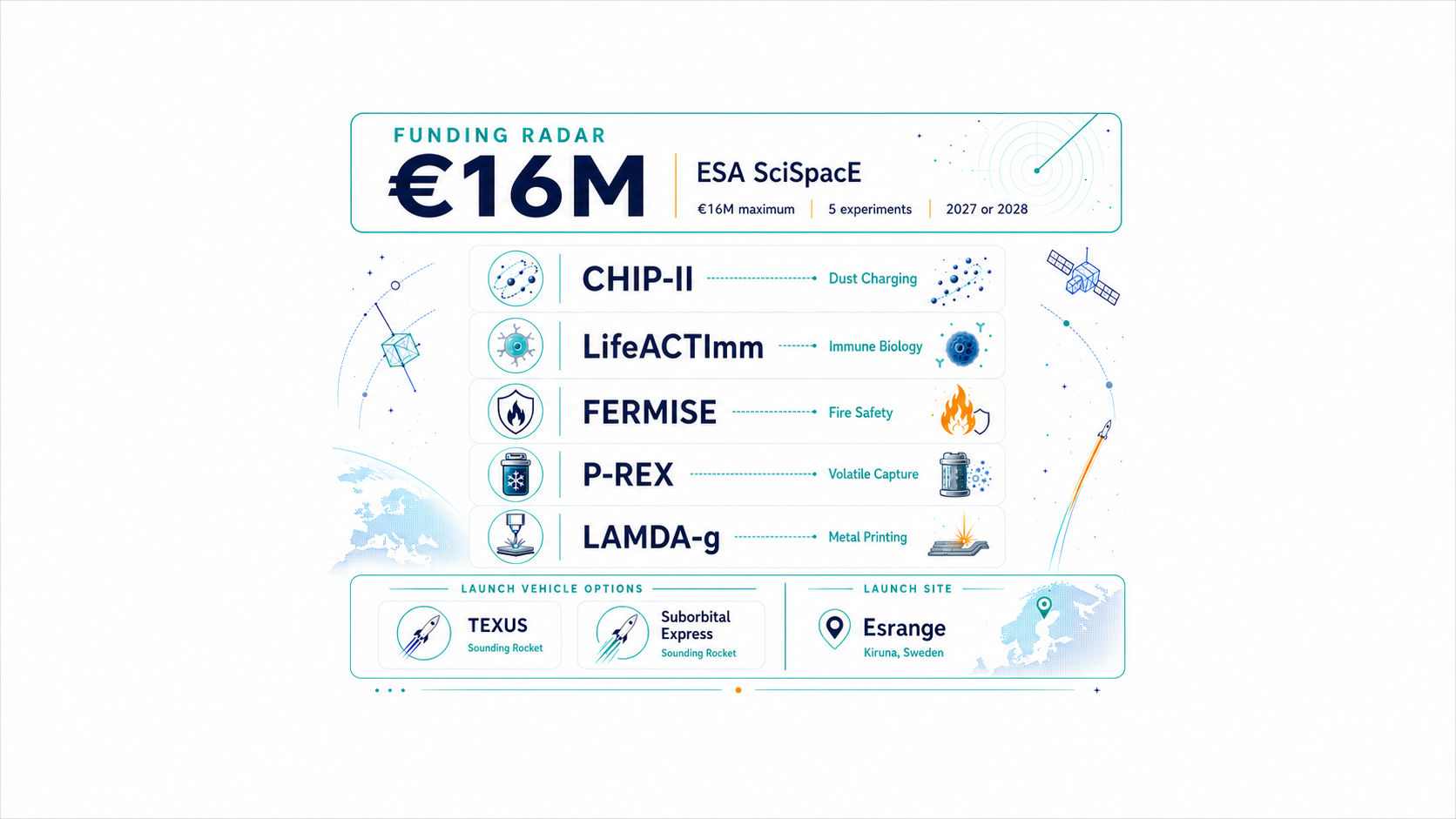
ESA's 13 May 2026 implementation call: design, development, manufacture, launch and recovery of five ESA-specified sounding-rocket experiments — CHIP-II, LifeACTImm, FERMISE, P-REX, LAMDA-g — in 2027 or 2028. Budget €16 million maximum. Space Insights.
According to European Spaceflight's coverage of ESA's tender record, ESA opened an implementation call on 13 May 2026 under its SciSpacE sounding-rocket platform (Exploration Science, Directorate of Human and Robotic Exploration) for the design, development, manufacture, launch and recovery of five pre-identified scientific experiments on sounding rockets in 2027 or 2028. Maximum budget €16 million, per the same coverage. The five experiments are ESA-specified: CHIP-II (dust-particle charging in early planet formation), LifeACTImm (immune cells in microgravity), FERMISE (fire and fire-risk mitigation), P-REX (capture and purification of volatile contaminants extracted from lunar regolith), and LAMDA-g (laser-based metal additive manufacturing in the absence of gravity). The procurement covers vehicle selection, payload integration, launch operations and post-flight recovery. It does not invite new science definition: the experiments were selected through ESA's separate Exploration Science / SciSpacE Announcement of Opportunity that closed in May 2025.
Call summary
| Programme | Call title | Open | Budget | Eligibility |
|---|---|---|---|---|
| ESA SciSpacE sounding-rocket implementation call (Exploration Science, Directorate of Human and Robotic Exploration) | Design, development, manufacture, launch and recovery of five pre-identified sounding-rocket experiments | 13 May 2026; deadline: check the live ESA-star tender entry before submission | €16 million maximum (implementation procurement, not science grant) | Eligibility and participation conditions: per the relevant ESA-star tender entry |
Spotlight: what is in scope
The contractor is responsible for delivering, end to end, five experiments specified by ESA. The deliverable is flown, recovered hardware with telemetry and post-flight data return, not a research deliverable. Per European Spaceflight's coverage:
- CHIP-II — a follow-on mission studying whether electrical charging helps dust particles stick together during the early stages of planet formation. The "II" suffix reflects the follow-on nature; CHIP-II prospective contractors are given the option to either refurbish existing modules or develop new ones.
- LifeACTImm — a follow-on mission examining how microgravity affects immune cells and testing potential ways to reduce its impact. Refurbishment or new-build option as above.
- FERMISE — a follow-on mission focused on fire experiments and on mitigating the risk of fire for future space exploration. Refurbishment or new-build option as above.
- P-REX — a new development studying how water vapour and other volatile contaminants extracted from lunar regolith could be captured and purified (lunar in-situ resource utilisation context).
- LAMDA-g — a new development testing laser-based metal additive manufacturing in the absence of gravity.
Three of the five (CHIP-II, LifeACTImm, FERMISE) are follow-on missions where prospective contractors may refurbish existing modules or develop new ones; P-REX and LAMDA-g require new developments.
On vehicles: ESA's SciSpacE sounding-rocket platform page lists TEXUS and MASER-class Esrange campaigns as typical European routes. European Spaceflight reports that the implementation call can be served by one or more suitable sounding-rocket missions, including TEXUS or SSC Space Suborbital Express-type routes, and that the call does not appear to mandate a specific vehicle. The contractor is tasked with procuring "one or more suitable sounding rocket missions" able to support ESA's payload, microgravity duration, telemetry and recovery requirements.
Esrange in Sweden is the typical European sounding-rocket site, with a long operational record across ESA campaigns; the implementation call should be checked for final mission and site conditions.
Why this matters now
For European microgravity-research delivery institutions, the call is one of the most focused ESA procurement opportunities in the May window. It is one piece of a wider May 2026 European funding stack — alongside other procurement and research-and-innovation events — that Space Insights tracked in W19 and W20 Funding Radar coverage.
Space Insights cross-pipeline context: the diversity of the May 2026 European funding stack is the structural feature; no single call is the only entry point. This implementation procurement sits in the procurement leg, alongside EUSPA's parallel May procurement deadline. The research-and-innovation leg (Horizon Europe Cluster 4 calls) and the event-driven dialogue leg (EU Space Days) are covered in W19 and W20. This is a Space Insights editorial framing of the stack, not a single primary source statement.
Caveats and discipline
Two editorial cautions apply.
Procurement, not grant. This is an implementation procurement, not an open science-grant call. The contractor is expected to deliver ESA-specified experiments to flight and recovery. Institutions seeking research-grant funding for new microgravity science should look to the parallel Horizon Europe science calls and to the next Exploration Science / SciSpacE Announcement of Opportunity, not to this implementation procurement.
Pre-identified experiments. The five experiments are ESA-specified. The contractor does not propose new science; the contractor delivers ESA's specified payload set to flight and recovery. The science selection step was the separate Exploration Science / SciSpacE Announcement of Opportunity that closed in May 2025 (per ESA's Exploration Science sounding-rocket platform page).
Related context: Esrange's parallel orbital-launch track
Esrange's sounding-rocket cadence is the legacy operational capability. In parallel, the same site is being upgraded for orbital launch capability: SSC Space signed a SEK 209 million agreement with the Swedish Defence Materiel Administration (FMV) on 16 March 2026, targeting operational capability by 2028, with Firefly Aerospace's Alpha rocket and Launch Complex 3C at Esrange (per SSC Space primary release, 16 March 2026; earlier SSC/Firefly cooperation context per the June 2025 SSC and Firefly primary release).
The W21 reading is that Esrange's sounding-rocket cadence and orbital-launch capacity are operating on different but converging tracks at the same site. The €16 million sounding-rocket procurement is a legacy-cadence event; the orbital-launch capacity is the structural shift.
Closing note
Consortia tracking ESA suborbital and sounding-rocket opportunities should treat the €16 million call as an implementation procurement, not a science proposal, and plan resourcing accordingly. Per European Spaceflight's coverage, the call's deadline should be verified directly in the ESA-star tender entry.
Sources
- 1.Sounding Rocket platform (SciSpacE / Exploration Science) — European Space Agency
- 2.ESA Opens €16 Million Call for Suborbital Launch Campaign — European Spaceflight
- 3.SSC Space signs agreement with FMV on satellite launch capability from Esrange — SSC Space
- 4.SSC and Firefly progress towards orbital launch — TSA signed between Sweden and USA — SSC Space
Get briefings like this every Friday.
Subscribe