ESA's Space Transportation directorate frames the second Spectrum launch from Andøya Spaceport (NET 18 to 24 May 2026) as a qualification flight under the Boost! programme — the institutional reading behind the next Nordic orbital-launch attempt. Space Insights.
The European Space Agency's Space Transportation directorate has published an update framing Isar Aerospace's second Spectrum launch from Andøya Spaceport as a qualification flight under ESA's Boost! programme. The launch currently sits in a NET (no earlier than) window of 18 to 24 May 2026, following Andøya Space's 13 May danger-area notice. Earlier launch attempts were delayed or scrubbed for range-safety and technical reasons — including a 25 March 2026 attempt aborted after an unauthorised vessel entered the maritime danger area, and a later 9 April 2026 attempt stood down because of a suspected pressure-vessel issue (per public mission updates). Isar Aerospace's 22 December 2025 press release confirmed that both vehicle stages had passed 30-second integrated static fire tests, validating readiness for final integration. For the European Launcher Challenge cohort and the wider Nordic sovereign-space arc, the qualification framing is the institutional signal of the week.
What changed from Spectrum-1 to Spectrum-2
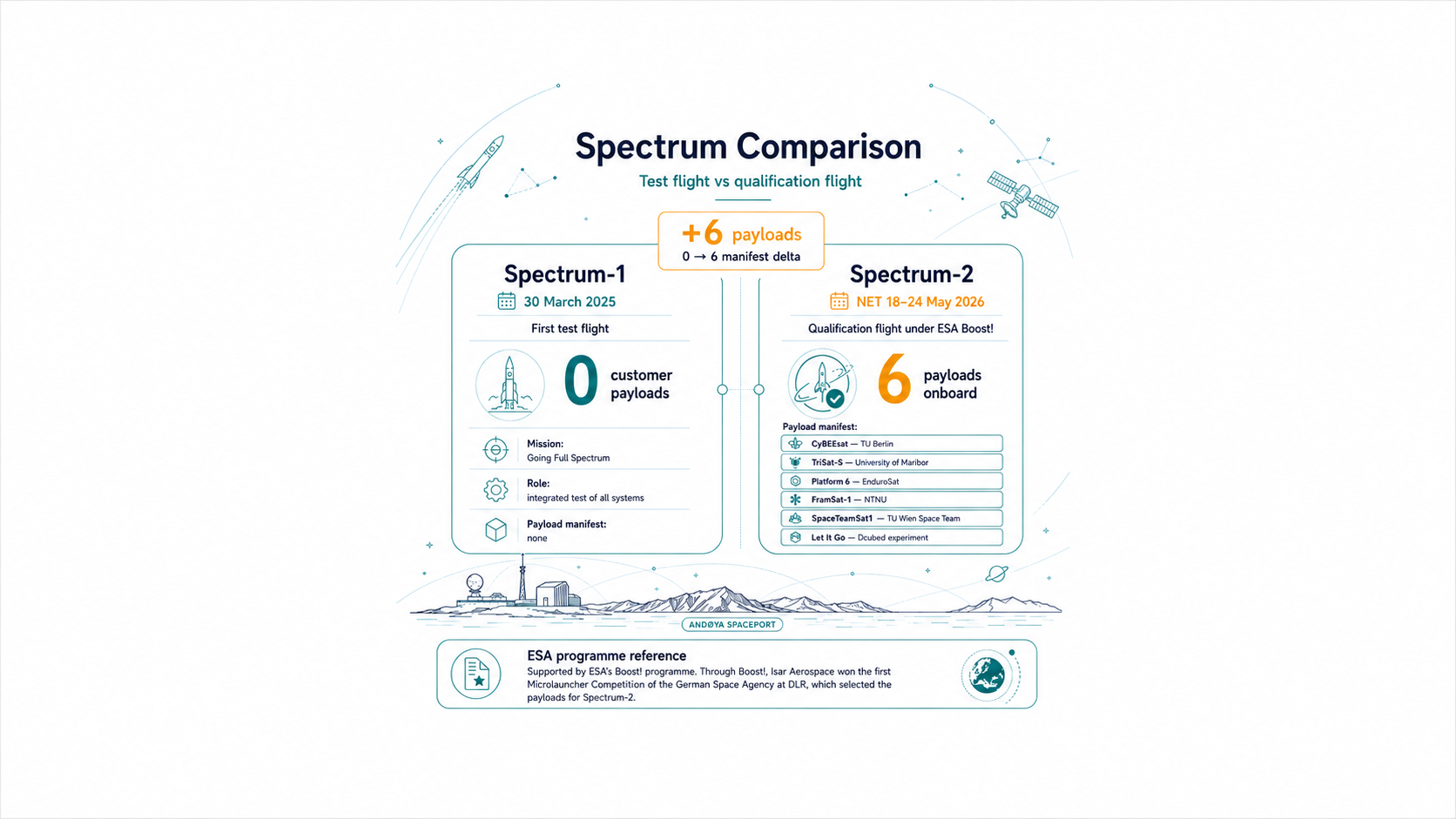
Spectrum-1, launched from Andøya on 30 March 2025, was characterised by ESA and Isar Aerospace as Isar's first test flight. The mission ended approximately 30 seconds after lift-off, with the vehicle receiving a termination command following an unintended vent-valve opening and loss of attitude control at the start of the roll manoeuvre, per Isar Aerospace's post-flight analysis primary release. The framing at the time was first test flight, with success defined as data return and the operational proof that the vehicle could clear the pad — the first orbital launch attempt from continental Europe.
Spectrum-2 changes the framing. Per ESA's Space Transportation directorate page on the Boost! programme, the mission is described as a qualification flight. The qualification framing matters because ESA and Isar are no longer presenting the mission only as an early test flight; it is now linked publicly to Boost! support and the broader European Launcher Challenge context. In Space Insights' editorial reading, that public framing is procurement-relevant because it creates a public data point for future institutional-launch discussions. ESA's primary document does not state an automatic procurement consequence. ESA's primary framing of the Boost! programme as "supporting this second Spectrum flight and scaling-up of production facilities" sits alongside the company's own description of the flight as Isar's second test flight.
Three concrete changes between flight 1 and flight 2:
- Status framing — first test flight → qualification flight under ESA Boost!
- Payload manifest — per ESA primary, "five commercial and educational cubesats and an experiment that aims to prove new technologies in orbit"; Spectrum-1 carried no commercial customer payload
- Operational documentation — single-event framing → parallel public documentation across Andøya (danger-area notice 13 May 2026), Isar Aerospace (22 December 2025 final-tests-cleared release) and ESA (Boost! programme qualification framing)
Why ESA Boost! matters
Boost! is ESA's commercial-space-transportation support instrument, designed to derisk early operational flights of new European launch vehicles. Per ESA's primary page, Isar Aerospace has received "several rounds of co-funding as part of ESA's Boost! programme", and the programme is "also supporting this second Spectrum flight and scaling-up of production facilities". The institutional importance comes from ESA's public support through Boost!, not from any publicly disclosed payment or data-access mechanism specific to this mission.
With Spectrum-2 publicly framed as a Boost! qualification flight, ELC-associated decisions and next-stage tendering should be watched through 2026 and beyond, depending on ESA's post-CM25 implementation timetable. If the mission does not meet its objectives, the next public signal will be whether ESA and Isar describe the outcome as an iterative Boost!-supported learning step, a corrective campaign, or a delay to the qualification path.
The Nordic sovereign-space and launch arc
Spectrum-2 sits inside a broader Nordic pattern that has consolidated over the previous 90 days:
- SSC Space + FMV (16 March 2026) — SEK 209 million agreement to develop satellite launch capability from Esrange Space Center, scheduled to be operational by 2028, with Firefly Aerospace as the launch-vehicle partner (SSC Space primary release)
- Norway and Iceland accession to GOVSATCOM and IRIS² (26 March 2026) — first non-EU countries to join the Union's secure connectivity participation framework, signed by Commissioner Andrius Kubilius with Norwegian Minister of Trade and Industry Cecilie Myrseth and Iceland's Ambassador to the EU Stefán Haukur Jóhannesson (W19 Space Insights coverage; per Council of the EU and EUSPA primary documentation)
- Sweden's first military reconnaissance satellite (3 May 2026) — Planet Labs-built, launched aboard a Falcon 9 from Vandenberg Space Force Base under a commercial-military partnership, with handover planned to the Swedish Space Operations Center in Uppsala after a first year of manufacturer-assisted operations (W20 Space Insights coverage; primary sources per Aviation Week and Planet Labs first-light release)
- W21 Andøya Spectrum-2 qualification window — the closest-in operational milestone
Read together, these are four parallel Nordic sovereign-space tracks running on different national programmes but converging on the same operational map. The Andøya Spaceport / Isar Aerospace / ESA Boost! triangle is the orbital-launch leg of that map; the Swedish reconnaissance satellite belongs to the sovereign-space and ISR leg.
What the qualification outcome means for the European Launcher Challenge
The European Launcher Challenge cohort — Isar Aerospace, MaiaSpace, Orbex, PLD Space, Rocket Factory Augsburg, preselected in July 2025 with a per-Challenger target of EUR 169 million per ESA primary release N° 42-2025 — sits in the middle of the procurement window that Spectrum-2's qualification reading informs. ESA's ELC press release identifies orbital launch by 2027 as a key milestone; ELC-associated decisions and next-stage tendering should be watched through 2026 and beyond, depending on ESA's post-CM25 implementation timetable.
Space Insights scenario read: three possible public interpretations
This is not ESA's published scoring framework; it is an editorial planning lens.
Qualification successful. Spectrum-2 reaches its declared objectives. A successful orbital outcome would strengthen Isar's evidence base in the ELC context, where ESA has identified orbital launch by 2027 as a key milestone.
Partial outcome. Spectrum-2 returns substantive data but the mission does not fully achieve its declared objectives. The cadence to a next attempt becomes the watch item; ESA's downstream institutional reading depends on how the agency and Isar describe the result.
Vehicle anomaly. Spectrum-2 does not return the planned data set. The institutional read depends on whether the outcome is described as an iterative Boost!-supported learning step or as a setback requiring a separate corrective campaign. The 25 March abort and 9 April stand-down are already part of the public timeline; how a vehicle-loss event would be absorbed within the same Boost! instrument is an open question, not the launch itself.
None of these outcomes is predictable in advance. The qualification framing is what has shifted regardless of the launch-day outcome: the public institutional reading of the mission has moved from first test flight to a qualification flight under a named ESA instrument.
Forward look
Three watch items:
- NET 18 to 24 May launch window — the operational date
- ESA Boost! milestone reporting — any post-flight institutional communication on the qualification scoring and the procurement-readiness reading
- ELC-associated decisions and next-stage tendering — to be watched through 2026 and beyond, depending on ESA's post-CM25 implementation timetable
The reasonable read of the week is that Andøya Spaceport, Isar Aerospace and ESA's Boost! programme are now visible in parallel public documentation. The reasonable editorial read is to track the qualification specification — what counts as "qualified" in ESA's institutional reading — rather than only the binary launch-success outcome.
Sources
- 1.Spectrum's qualifying second launch (Boost! programme) — European Space Agency
- 2.Ready for the second flight and qualification mission from Andøya — Andøya Space
- 3.Less than nine months after first test flight, Isar Aerospace clears final tests for second Spectrum launch — Isar Aerospace
- 4.SSC Space signs agreement with FMV on satellite launch capability from Esrange — SSC Space
- 5.Isar Aerospace lifts off successfully during first test flight of orbital launch vehicle — Isar Aerospace
- 6.European Launcher Challenge: preselected challengers unveiled (N° 42-2025) — European Space Agency
Get briefings like this every Friday.
Subscribe