ESA's Vega-C launches Smile, the ESA and Chinese Academy of Sciences magnetosphere explorer, on 19 May 2026 from French Guiana — the science pillar inside the EU Space Days 2026 window. Space Insights.
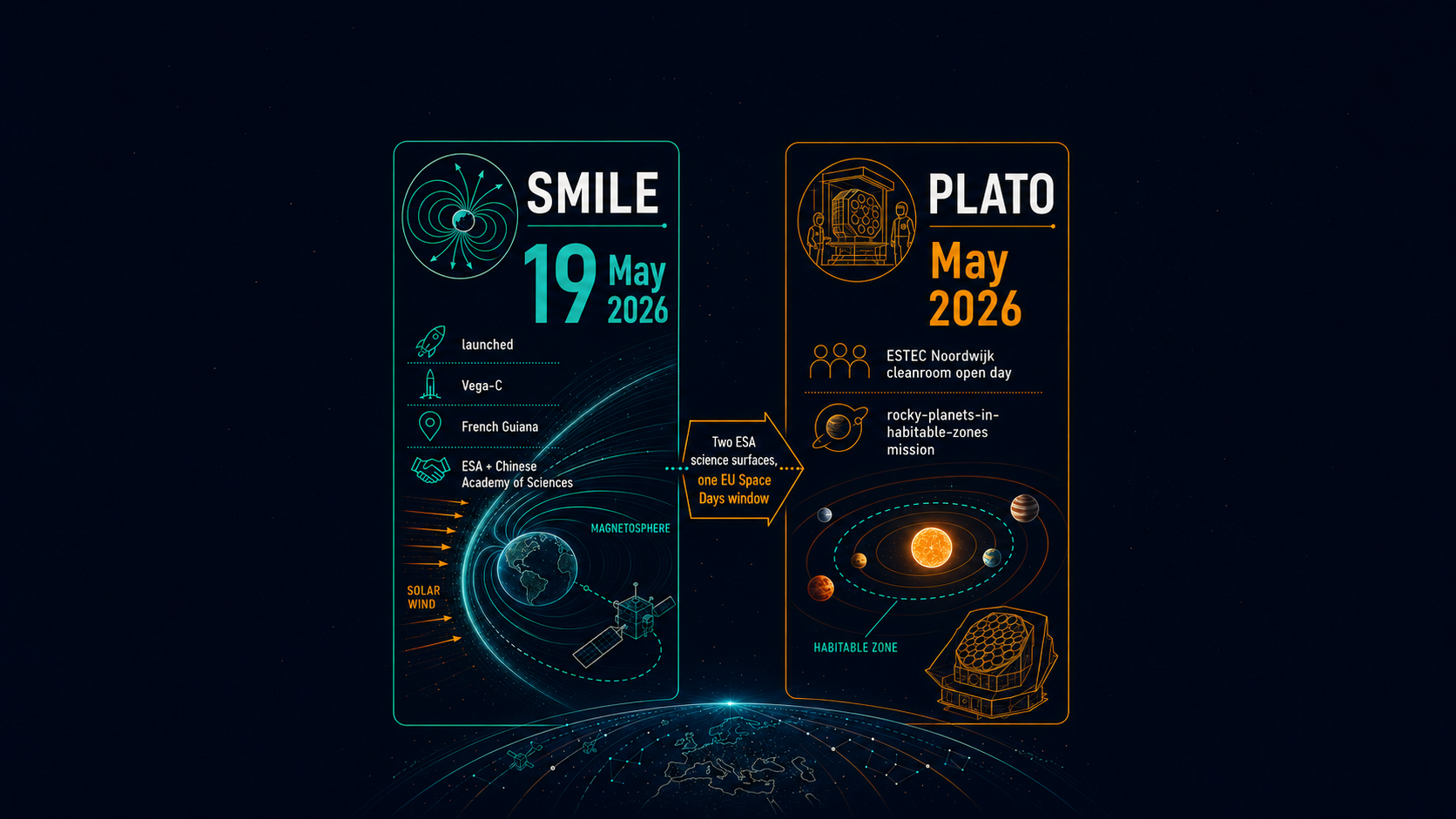
On 19 May 2026, Europe's Vega-C launcher successfully launched Smile (Solar Wind Magnetosphere Ionosphere Link Explorer), the ESA and Chinese Academy of Sciences joint mission, from Europe's Spaceport in French Guiana. Following separation, ESA received the first signal from the spacecraft and confirmed solar-panel deployment. Smile remained part of ESA's science-communications surface through the 24 to 31 May 2026 reporting window. The launch and the subsequent communications coincided with EU Space Days 2026 (26 to 27 May) and the Competitiveness Council on 29 May, both of which were dominated by the EU Space Act, the European Competitiveness Fund and the EU Space Services Agency (EUSSA) files. The science-pillar surface — Smile in post-launch operations, Plato readiness on the bench at ESTEC Noordwijk — ran in parallel to the secure-connectivity and industrial-policy file inside the same week.
For European space-sector planners, the operative content is not the rhetorical contrast between policy and science. It is the specific scientific scope of Smile, the cadence at which European science missions are continuing to deliver into the 2026 EU institutional window, and the structural read for what the science pillar contributes alongside the regulatory and budgetary debates that dominated the week's communications.
What Smile is, and what it will do
Smile (Solar Wind Magnetosphere Ionosphere Link Explorer) is a joint mission between ESA and the Chinese Academy of Sciences. The mission is designed to deliver the first X-ray observations of Earth's magnetosphere — the protective magnetic envelope that shields the planet from the solar wind — together with simultaneous ultraviolet imaging of the auroral regions and in-situ measurements of solar-wind plasma and magnetic fields, once commissioning and instrument operations progress. The science target is to characterise the dynamic interaction between the solar wind and Earth's magnetosphere on a global scale, an interaction whose understanding underpins both fundamental space-physics science and operational space-weather forecasting.
Smile launched from French Guiana on 19 May 2026 atop ESA's Vega-C launcher. The mission is now in its commissioning phase, during which the instruments are checked, calibrated and progressively brought to operational status. ESA framed Smile as the mission that will deliver the first X-ray observations of Earth's magnetic shield once commissioning and instrument operations progress; the 24 to 31 May window carried ongoing public communications on the mission's scientific significance.
The parallel readiness signal: Plato at ESTEC Noordwijk
In the same window, ESA hosted a press-and-stakeholder cleanroom open day at the European Space Research and Technology Centre (ESTEC) in Noordwijk for Plato (PLAnetary Transits and Oscillations of stars), the mission tasked with finding rocky planets in habitable zones around Sun-like stars. The open day preceded the 24 to 31 May reporting window itself but seeded continued coverage of Plato readiness through the EU Space Days week. Plato's science scope is exoplanet detection and the characterisation of host stars by asteroseismology; Plato is on track for launch in early 2027, with ESA's mission page listing January 2027 as the planned launch date on an Ariane 6 from French Guiana, destination Sun-Earth L2 halo orbit.
The two missions are scientifically distinct — magnetospheric physics and space weather on the Smile side, exoplanet detection on the Plato side — but they are surfacing in the same European institutional window: one on orbit with commissioning underway, one on the bench with launch preparations advancing. Read together, they describe the science-pillar cadence of the European space programme as it is operating through 2026.
Why this matters alongside the EU Space Days and Compet Council week
The 24 to 31 May 2026 window was dominated, at the institutional level, by the Cyprus Presidency space agenda. EU Space Days 2026 on 26 to 27 May served as the framing venue for the Presidency's space policy priorities. The Competitiveness Council on 29 May placed three architecture files in the same institutional frame: the EU Space Act (Council document ST-8861-2026-INIT, scrutiny reservations upheld by all Member States), the European Competitiveness Fund space part inside the MFF 2028 to 2034 negotiations, and the proposed EU Space Services Agency (EUSSA) regulation (Commission proposal 7 April 2026). The political and regulatory weather of the week was secure connectivity, industrial policy and the post-2027 budget architecture.
In Space Insights' editorial reading, Smile and Plato are two science-mission surfaces inside the same late-May institutional window: one launched and entering post-launch operations, the other visible in cleanroom readiness ahead of its planned 2027 launch. The science pillar is one of the structural features that distinguishes the European space architecture from a purely industrial-policy or purely secure-connectivity architecture. ESA-coordinated science missions like Smile (international cooperation with the Chinese Academy of Sciences) and Plato (European-led exoplanet mission) carry the European space programme's research and exploration mandate alongside the EU's institutional and industrial-policy work. The two surfaces are complementary; both are part of how the European space architecture operates in 2026.
This is a Space Insights editorial framing of the week's reads, not a statement by ESA or the Cyprus Presidency.
What is uncertain
Two uncertainties are worth recording.
First, the Smile commissioning timeline. As with all space-science missions, commissioning duration, instrument calibration outcomes and the initial science return depend on how the instruments perform in the operational environment. ESA's commissioning communications over the next quarter are expected to indicate progress against the planned commissioning schedule.
Second, the Plato launch window. ESA's mission page lists January 2027 as the planned launch date on an Ariane 6 from French Guiana, destination Sun-Earth L2 halo orbit; the precise launch slot will be confirmed inside the Ariane 6 manifest closer to the date. The ESTEC open day was a readiness signal rather than a launch date.
Forward look
For European space-sector planners, the science-pillar cadence to watch through 2026 is straightforward. Smile commissioning milestones over the coming period will show when the mission is ready to begin delivering its planned X-ray and ultraviolet observations of Earth's magnetosphere — the science return that justified the mission. Plato launch preparations at ESTEC and across the industrial integration chain run toward the ESA-listed January 2027 Ariane 6 window. ESA's Science & Exploration programme communications are the primary surface for both.
In Space Insights' editorial reading, the science pillar is the part of the European space architecture that is not visible in the Council and Presidency outcome documents, but that continues to operate inside the same institutional window. If adopted, the EU Space Act, the ECF space part and the EUSSA proposal are expected to shape parts of the post-2027 institutional and budget architecture; Smile and Plato show what ESA science delivery is doing now. Both are worth watching; this Friday's note is the reminder that the second pillar exists.
Sources
- 1.Smile — Solar Wind Magnetosphere Ionosphere Link Explorer — European Space Agency
- 2.Plato — PLAnetary Transits and Oscillations of stars — European Space Agency
- 3.Vega-C launcher — Europe's medium-lift launcher — European Space Agency
- 4.EU Space Days 2026 — Cyprus Presidency programme — European Commission, DG DEFIS
Get briefings like this every Friday.
Subscribe