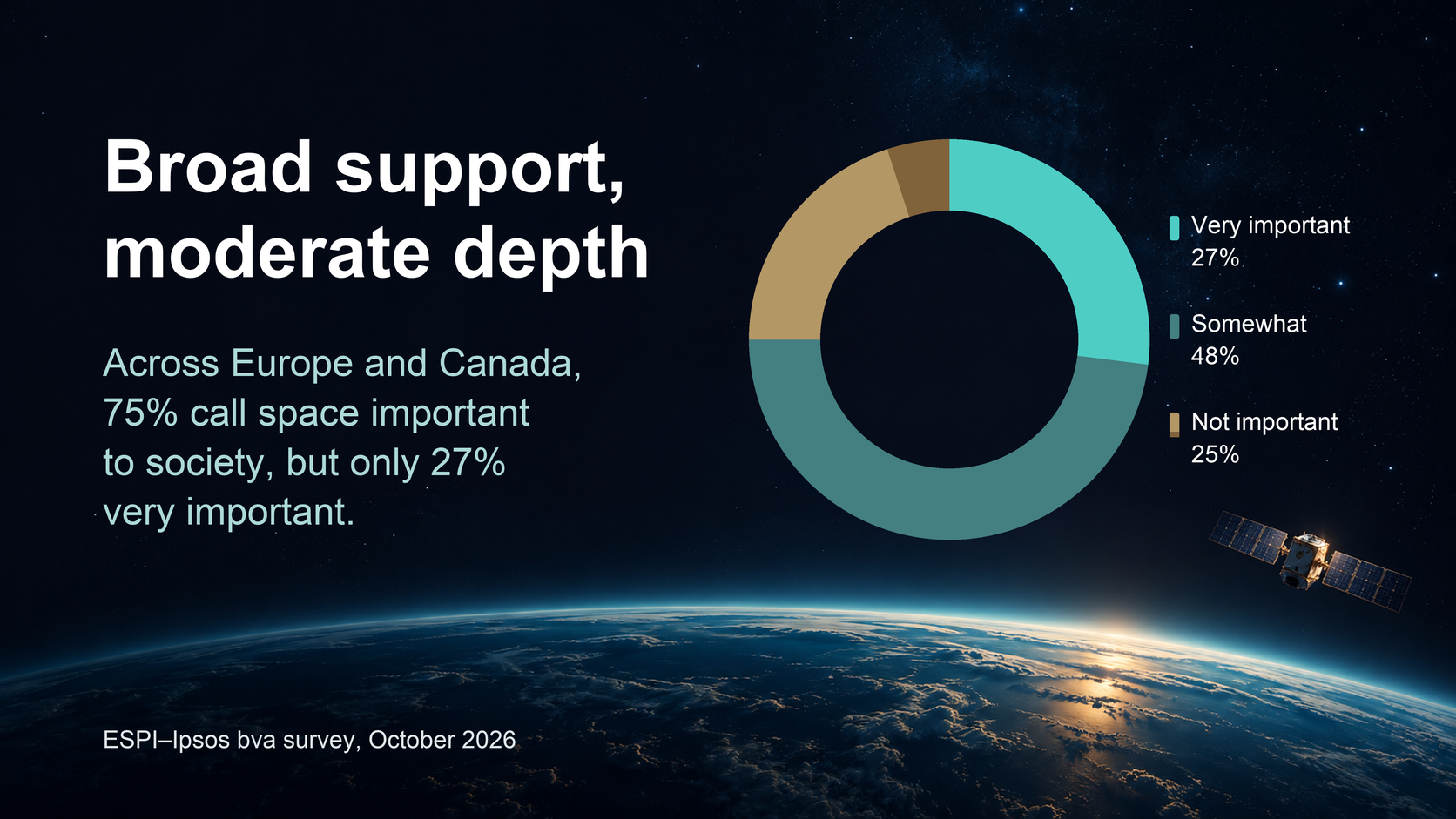
Space Insights editorial illustration based on the ESPI–Ipsos bva survey, October 2026. Figures refer to respondents across Europe and Canada.
The European Space Policy Institute published initial findings on 20 October from a survey of 15,500 people in 24 countries across Europe and Canada, carried out by Ipsos bva with support from ESA. Its headline, that 75% consider space activities important to society, combines 27% who answered "very important" with 48% who answered "somewhat important". One respondent in four said space activities are not important. ESPI release, slide 6.
Support for space as a category is broad, but mostly moderate. A separate question about specific services, asked on a different scale, produces larger top shares.
Specific services draw larger top shares
Respondents were asked to what extent space activities have a positive impact on people's everyday lives in particular areas. Slide 9.
| Area | "A great deal" | Total "yes" |
|---|---|---|
| Weather forecasting | 48% | 84% |
| Internet and telecommunications | 47% | 81% |
| Environmental and climate monitoring | 41% | 79% |
| Transport and navigation | 37% | 74% |
| National security and civil protection | 34% | 71% |
| Emergency response to natural disasters | 34% | 70% |
| Everyday digital services | 28% | 63% |
| Agriculture and food production | 22% | 57% |
Nearly half of respondents say space activities have "a great deal" of positive impact on everyday life through weather forecasting. That question and its answer scale differ from the one behind the 27% who call space activities very important to society, so the two figures cannot be compared directly. These results measure perceived current impact; they are not expectations for the future or preferences about public spending.
The picture people carry is different
The open question tells another story. Asked which word comes to mind when thinking about space activities, respondents gave answers that Ipsos bva summarises as "dominated by exploration, iconic missions and major global players", with NASA, SpaceX, rockets and the Moon among the examples quoted. On the same slide, "Earth-based applications and risks remain secondary". Exploration itself is viewed positively by 78% of respondents. Slide 5, slide 24.
Our reading: when asked about concrete services, respondents widely recognise the contribution of space to meteorology, telecommunications and climate monitoring. In spontaneous associations, however, exploration and major players such as NASA and SpaceX come first, and Earth-based applications are secondary. For European programme teams preparing for the Intermediate Ministerial Meeting in Rome on 15 December and the decisions due at CM28 (ESA Council outcomes), that gap is a communication problem: the benefits people recognise when prompted are secondary in what they spontaneously connect to space. For Earth observation and satellite communications companies, it suggests their services are already valued, even when users do not think of them as "space".
Method, scope and disclosure
These are initial results. ESPI has not yet published the country list, survey mode, weighting, fieldwork dates or margin of error, and only a selection of the Ipsos bva slides is public. Most figures combine respondents in Europe and Canada. The published findings do not report questions on budget levels, and the full questionnaire is not yet public. Because earlier Eurobarometer and ESA polls asked different questions, trends cannot be drawn from those comparisons.
ESA supported the survey. It is also one of ESPI's two founding members and supports the institute. ESPI governance. ESPI plans to publish its full analysis by the end of 2026. If it includes country results and the full questionnaire, it will show whether the gap between services and the wider image of space holds across countries and age groups.
Sources
- 1.Three in four Europeans and Canadians say space matters to society — ESPI
- 2.Ipsos bva for ESPI, slide 6: importance of space activities to society — Ipsos bva for ESPI
- 3.Ipsos bva for ESPI, slide 9: positive impact on everyday life by area — Ipsos bva for ESPI
- 4.Ipsos bva for ESPI, slide 5: spontaneous associations with space activities — Ipsos bva for ESPI
- 5.Ipsos bva for ESPI, slide 24: image of space exploration — Ipsos bva for ESPI
- 6.Key outcomes of the 350th ESA Council meeting — European Space Agency
- 7.ESPI Members & Governance — ESPI
Get briefings like this every Friday.
Subscribe